



Virginia Coworking Space Lease Agreement Overview
Virginia's coworking market is among the strongest in the country, driven by the density of federal contractors, technology firms, consulting companies, and startup activity concentrated in the Northern Virginia suburbs of Washington, D.C. Markets like Tysons Corner, Reston, Arlington, and Alexandria support numerous coworking operators ranging from national platforms to boutique independent spaces. Richmond and Hampton Roads have smaller but growing coworking scenes serving their respective regional economies.
Virginia has no dedicated statute governing coworking membership agreements. These arrangements are typically structured as either commercial sublicenses or subleases, and the legal treatment varies depending on how the agreement is written. Virginia contract law governs disputes, and courts will enforce the terms as written with minimal paternalism toward commercial tenants. Members entering coworking agreements in Virginia should pay particular attention to termination notice requirements, the handling of prepaid membership fees, data security provisions relevant to their work, and local business license obligations that arise from using a Virginia commercial address for their operations.
VA
State-specific
Varies
Filing fees
Written
Required format
Contract
Law governs
Virginia Legal Requirements
Virginia has specific requirements for commercial lease documents that must be followed to ensure enforceability. Understanding VA's legal framework helps protect both landlord and tenant interests.
Virginia-Specific Note
Virginia has no dedicated coworking statute, so the membership agreement is your primary legal protection. The state's 38 independent cities each apply separate business license and zoning rules, meaning a coworking location in the City of Falls Church is governed differently than one in Fairfax County just across the street. Confirm local licensing requirements before using a Virginia coworking address for business registration.
Agreement Requirements
- License vs. Lease Clarity: The agreement should clearly state whether it creates a license or a sublease; Virginia courts treat these differently for termination and eviction purposes
- Termination Notice: Specify minimum notice periods for termination by either party; Virginia has no statutory minimum for commercial licenses
- Amenities and Services: List all included amenities, metered services, booking policies, and guest access rules to avoid billing disputes
- Data and Confidentiality: Coworking spaces in Northern Virginia frequently host government contractors and cleared personnel; address network security, visitor policies, and confidentiality obligations explicitly
- Address Use Rights: Confirm in writing whether the coworking address can be used as a registered business address with the Virginia SCC and for mail receipt
- Prepayment Refund Policy: Virginia law does not require operators to refund unused prepaid fees unless the agreement specifically obligates them to do so
How to Execute a Virginia Coworking Space Agreement
Entering a coworking membership in Virginia is generally faster than a traditional office lease, but the agreement still deserves careful review. Virginia's contract law will enforce whatever you sign, with limited recourse if the terms turn out to be unfavorable.
Identify the Right Location and Format
In Northern Virginia, proximity to transit, fiber connectivity, and parking availability vary significantly by building. Determine whether you need hot desks, dedicated desks, a private office, or a team suite, and whether month-to-month flexibility or a fixed term is more important for your situation.
Review the Agreement Structure
Determine whether the agreement is a license or a sublease. Read the termination notice provisions, the prepayment and refund policy, and any clauses about address use rights, guest policies, and data security before you sign.
Confirm Local Business License Requirements
Identify the Virginia city or county where the coworking space is located and confirm the local BPOL license requirement for your business. Fairfax County, Arlington County, and the various independent cities each have their own thresholds and rates.
Negotiate Key Terms
Push for a meaningful termination notice period, a written policy on prepaid fee refunds, minimum internet bandwidth guarantees, and clear policies on after-hours access. Northern Virginia coworking operators are accustomed to members who understand what they need and negotiate for it.
Execute and Set Up Operations
Sign the agreement, obtain your access credentials and key fob, update your business address with the SCC if applicable, and confirm your insurance coverage is adequate. Many Virginia coworking operators require members to carry renter's or professional liability insurance.
Virginia-Specific Considerations
Several Virginia-specific factors distinguish the coworking market here from other states. The defense and government contracting ecosystem in Northern Virginia creates unusual confidentiality and security requirements that coworking operators in the region typically have more experience accommodating than operators elsewhere.
Virginia's BPOL tax structure means that where you locate your business matters from a tax cost perspective. Fairfax County's BPOL rates differ from those in Loudoun County, Arlington County, and the various independent cities. A coworking address that appears convenient geographically may fall in a higher-tax jurisdiction than an alternative a few miles away. Businesses with high gross receipts should factor BPOL rates into total occupancy cost comparisons.
ADA compliance obligations apply to coworking spaces throughout Virginia. Operators are responsible for maintaining accessible common areas, but members who undertake any modifications to their dedicated space take on ADA compliance responsibility for those alterations. Virginia's commercial real estate market has not generated significant coworking-specific litigation, but the lack of a protective statute means the agreement you sign is the ceiling of your rights.
Virginia Coworking Tax and Cost Context
Virginia does not impose a statewide sales tax on commercial rent or coworking memberships as a category. However, other tax and cost factors affect the true cost of Virginia coworking.
| Cost or Tax Item | Details |
|---|---|
| Sales Tax on Membership Fees | No statewide sales tax on commercial rent in Virginia; bundled service fees may be taxable depending on how the operator categorizes them |
| BPOL Business License Tax | Levied by each Virginia city and county on gross receipts; rates vary by jurisdiction and industry classification; applies to businesses operating from a Virginia address |
| Membership Rates (Northern Virginia) | Hot desks from $200 to $400 per month; dedicated desks from $400 to $700; private offices from $800 to $2,500 and up depending on size and building quality |
| Membership Rates (Richmond, Hampton Roads) | Generally 20 to 40 percent lower than Northern Virginia rates for comparable product types |
| Conference Room Overage Fees | Typically $25 to $75 per hour above the monthly allotment; confirm booking credits and rollover policy in writing |
Sample Virginia Coworking Space Lease Agreement
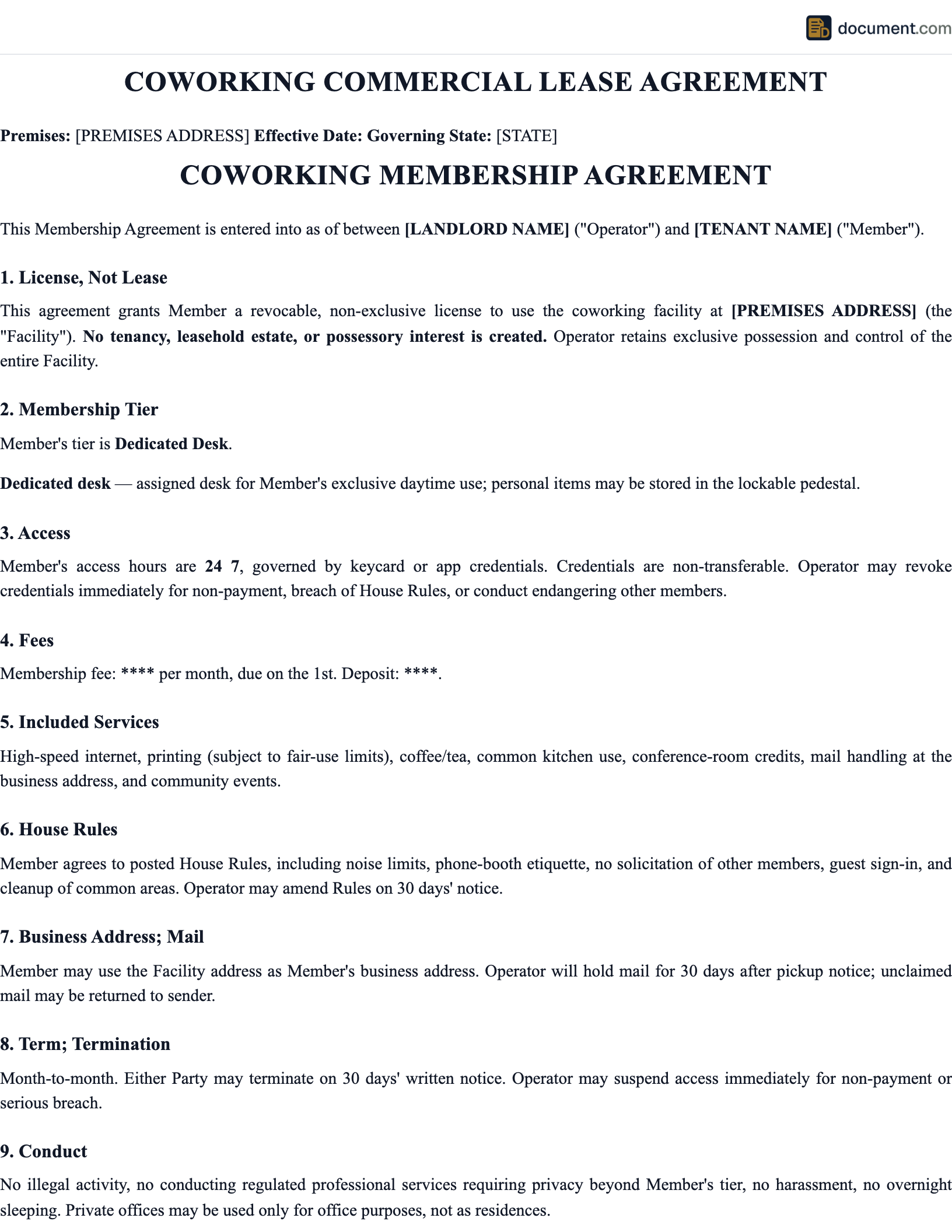
Below is a preview of our Virginia-specific coworking space lease agreement. Your customized document will include all fields and provisions required under VA law.
COWORKING SPACE LEASE AGREEMENT
STATE OF VIRGINIA
VA-Compliant Template
PARTY A:
Name: [Full Legal Name]
Address: [Virginia Address]
PARTY B:
Name: [Full Legal Name]
Address: [Virginia Address]
PROPERTY / PREMISES:
Address: [Property Address]
County: [Virginia County]
VIRGINIA COMPLIANCE
This document complies with Virginia (VA) state law requirements and includes all provisions mandated for this type of document in Virginia.