
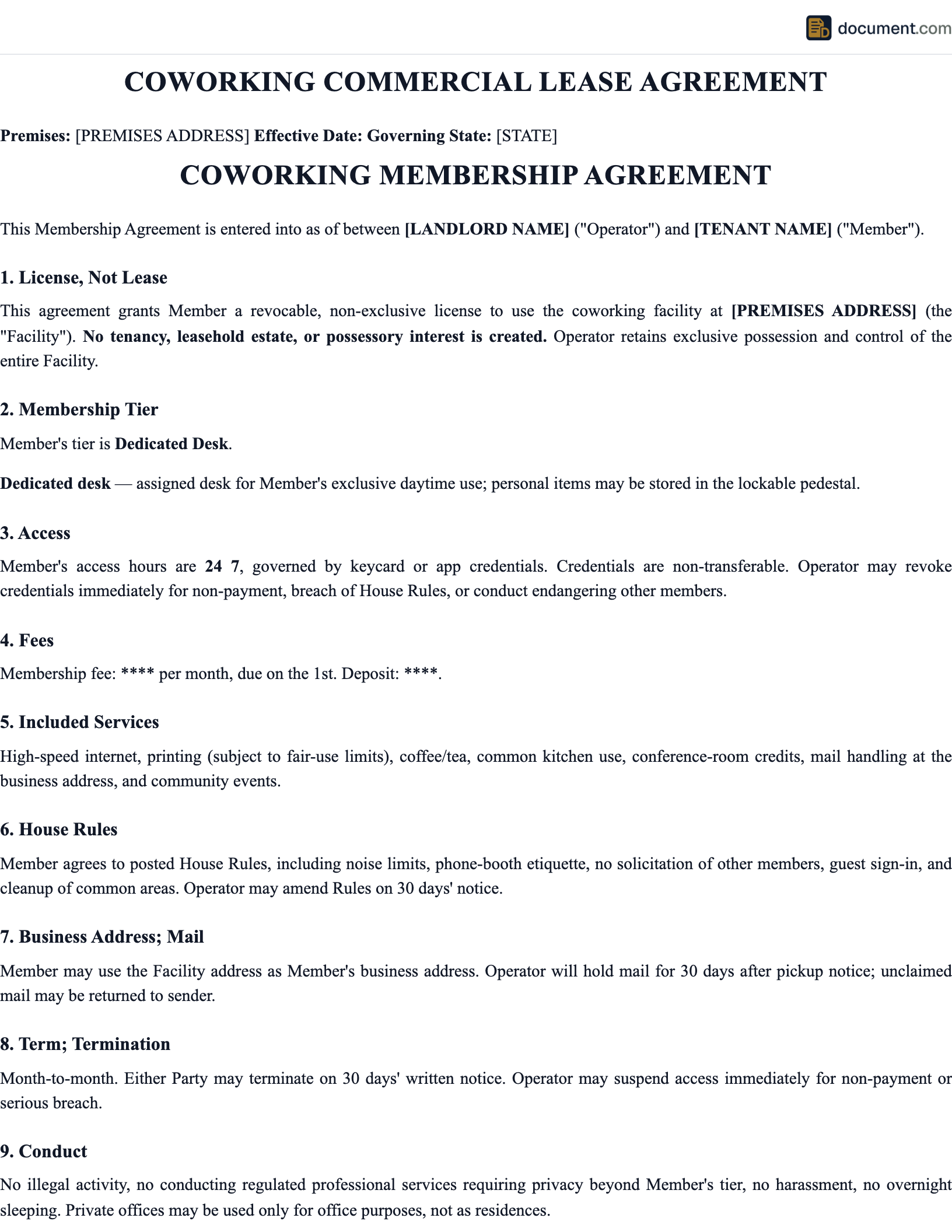



Vermont Coworking Space Lease Agreement Overview
Vermont's coworking market is anchored in Burlington, where remote workers, independent consultants, and small businesses seek professional workspace without committing to traditional multi-year office leases. The state's quality of life has attracted a wave of remote workers from larger metros, and coworking operators in Burlington serve this population alongside local entrepreneurs and small nonprofits. Vermont's creative economy, farm-to-table food industry, outdoor recreation businesses, and craft manufacturing companies all produce professionals who benefit from flexible workspace arrangements.
Vermont coworking agreements are governed by contract law, since the state has no commercial landlord-tenant statute providing default member protections. Most operators structure agreements as licenses rather than leases, which limits member rights if the operator closes or is evicted from its own master lease. Key issues for Vermont coworking members include winter building access and heating, parking in Burlington's limited downtown environment, internet reliability for remote workers, and whether amenities promised verbally are actually included in the written agreement.
VT
State-specific
Varies
Filing fees
Written
Required format
Contract
Law governs
Vermont Legal Requirements
Vermont has specific requirements for commercial lease documents that must be followed to ensure enforceability. Understanding VT's legal framework helps protect both landlord and tenant interests.
Vermont Coworking Agreement Note
Vermont coworking operators typically structure agreements as licenses, not leases, and Vermont law supports this distinction when properly documented. Vermont provides no statutory protections for coworking members, so every right you need, including guaranteed access hours, refund of prepaid fees, parking access, and advance notice of termination, must be stated in the written agreement. Read the full document before signing, and confirm winter access and heating provisions specifically.
Agreement Requirements
- Agreement Type: Confirm whether the document is a license agreement or a sublease, since the distinction affects your rights under Vermont law if the operator faces eviction or financial difficulty
- Membership Tier and Included Amenities: Dedicated desk versus hot desk status, conference room hours, kitchen and lounge access, and printing allowances should all be documented in the written agreement rather than assumed from marketing materials
- Internet Specifications: Minimum download and upload speeds and whether the connection is shared or offers any dedicated bandwidth guarantee; Vermont's remote worker population places high demands on coworking internet
- Parking Terms: Whether parking is included and at what cost; Burlington's downtown parking is limited and operators may charge $50 to $100 per month separately; confirm before signing
- Winter Access and Heating: Confirm 24-hour building access availability, snow removal procedures for parking and building entrances, and that HVAC maintains a workable temperature through Vermont's extended winter season
- Term and Termination: Month-to-month versus fixed term, required notice period, method of delivery, and whether deposits or prepaid fees are refundable upon early termination
How to Execute a Vermont Coworking Agreement
Joining a coworking space in Vermont is simpler than a traditional office lease but still requires care, particularly around winter access, parking, and what the agreement actually guarantees you.
Visit During Peak Hours and Test the Space
Visit any Burlington or Vermont coworking space during the hours you plan to use it, not just during a scheduled sales tour. Vermont coworking spaces tend to be smaller than urban counterparts, and noise levels, available seating, and conference room access during peak hours can differ significantly from what you see during an off-peak tour. Run an independent internet speed test on the guest network. If you plan winter use, check how the space handles heating and whether the parking situation is manageable during snowstorms.
Confirm Parking Before Everything Else
Burlington's downtown coworking spaces often do not include parking. City garages and lots near Church Street typically run $50 to $100 per month for monthly permits, and street parking is metered. Confirm parking terms before committing to any Burlington coworking space, and add the monthly parking cost to your true membership cost calculation. South Burlington operators generally offer surface parking included, but confirm this in writing since Vermont winters mean parking lot maintenance and snow removal are real operational considerations.
Read the Full Agreement
Vermont coworking operators draft agreements to protect the operator. Read the termination provisions (how much notice the operator can give you to vacate), the exact definition of what your membership tier includes, the deposit refund policy, and any arbitration clause that limits your rights. Confirm whether the agreement is a license or a sublease, since that distinction determines your rights under Vermont law if the operator loses its own lease or closes.
Choose Term Length Deliberately
Vermont's small coworking market means that month-to-month memberships may not guarantee your desk or office space from month to month. Fixed-term agreements (typically 6 or 12 months) offer lower rates and space security but include early termination fees. Vermont's statute of frauds (12 V.S.A. Section 181) requires agreements exceeding one year to be in writing. Understand the consequences of breaking a fixed term early before committing, and factor Vermont's seasonal economy into your planning if your business has revenue fluctuations tied to ski season or summer tourism.
Sign and Retain a Complete Copy
Execute the agreement in writing. Request a complete executed copy including all exhibits, fee schedules, and rules documents incorporated by reference. Vermont law does not require notarization for a coworking license to be enforceable between the parties, but written documentation protects both parties in any dispute about what the membership includes. Keep your copy in an accessible location.
Tax Implications for Vermont Coworking Members
Vermont's income tax is among the higher rates in New England, but there is no sales tax on commercial real property rental, and coworking fees are generally deductible as business expenses.
| Tax / Cost Category | Vermont Treatment |
|---|---|
| State Income Tax | Vermont imposes a progressive income tax on individuals (3.35% to 8.75% depending on income) and an 8.5% corporate income tax on Vermont-source business income. Vermont's income tax rates are among the higher rates in New England, which affects the net after-tax cost of business operations in the state. |
| Sales Tax on Services | Vermont does not impose sales tax on commercial real property rental. Vermont's sales tax rate is 6% on goods and taxable services. If your coworking agreement bundles taxable services (IT support, staffing, equipment rental) with space access, those service components may be subject to Vermont sales tax. Pure membership fees for space access are generally exempt from sales tax. |
| Property Tax (Operator Absorbed) | Vermont's property tax system is unusually complex because commercial properties are subject to both a municipal property tax and a statewide education tax under Acts 60 and 68. Coworking operators typically absorb these costs within membership fees rather than passing them through separately. Vermont's combined property tax burden on commercial property can be higher than the local mill rate alone suggests due to the education tax component. |
| Federal Business Expense Deduction | Coworking membership fees paid for business use are generally deductible as ordinary business expenses under IRC Section 162. Vermont largely conforms to federal income tax treatment of business expenses, so Vermont-deductible treatment follows federal rules. Retain monthly invoices and your written membership agreement to document business use. |
Sample Vermont Coworking Space Lease Agreement
Below is a preview of our Vermont-specific coworking space lease agreement. Your customized document will include all fields and provisions required under VT law.
COWORKING SPACE LEASE AGREEMENT
STATE OF VERMONT
VT-Compliant Template
PARTY A:
Name: [Full Legal Name]
Address: [Vermont Address]
PARTY B:
Name: [Full Legal Name]
Address: [Vermont Address]
PROPERTY / PREMISES:
Address: [Property Address]
County: [Vermont County]
VERMONT COMPLIANCE
This document complies with Vermont (VT) state law requirements and includes all provisions mandated for this type of document in Vermont.
Vermont Resources
Important Considerations for Vermont Coworking Members
Vermont's coworking market is small, seasonal, and subject to winter conditions that don't apply in most other states. These points should inform your evaluation and agreement review.
License Structure Limits Your Rights
Vermont coworking operators structure agreements as licenses, not leases, and Vermont courts honor this distinction when properly drafted. A license can be revoked more easily than a lease, operators can require you to vacate with short notice, and you have fewer options if the operator closes or defaults on its own lease. For remote workers and short-term users, this flexibility may be acceptable. For businesses that depend on a specific Burlington location, the license structure is a real risk that deserves evaluation before committing to a long-term membership.
Vermont Winters Are Severe and Sustained
Burlington averages over 80 inches of annual snowfall and temperatures below 0°F during peak winter. For coworking members, this creates real questions about building access during snowstorms, parking lot conditions, and whether HVAC maintains adequate temperatures on very cold days and weekends. Vermont's winter lasts from November through early April, representing nearly half the calendar year. Before committing to any Vermont coworking space, ask specifically how the building handles access and heating during severe winter weather events, and get answers in writing rather than as verbal assurances.
Seasonal Economy Affects Membership Decisions
Vermont's economy has pronounced seasonal characteristics. Ski season (December through March), foliage season (September and October), and summer recreation (June through August) create distinct demand patterns that affect local businesses, service providers, and the professionals who support them. If your business has seasonal revenue variability tied to Vermont's patterns, consider whether a month-to-month membership provides the flexibility you need, or whether a fixed-term agreement is appropriate given your cash flow expectations throughout the year.