



Utah Coworking Space Lease Agreement Overview
Salt Lake City's coworking market has grown steadily alongside the Silicon Slopes tech ecosystem, which stretches from downtown Salt Lake through the suburban corridors in Lehi and Provo. Remote workers, independent consultants, early-stage startups, and established tech companies seeking overflow space have driven demand for flexible workspace across the Wasatch Front. Operators including Kiln, Industrious, WeWork, and several local independents serve different segments of this market, from hot desks for freelancers to private suites for growing teams.
Utah coworking agreements are governed entirely by contract law, since the state has no commercial landlord-tenant statute providing default protections. Most operators structure their agreements as licenses rather than leases, which limits member rights in the event of operator closure or early termination. Key issues for Utah coworking members include parking costs in downtown Salt Lake, internet quality for tech workers with high bandwidth needs, winter building access and heating, and whether amenities promised in marketing materials are actually included in the written agreement.
UT
State-specific
Varies
Filing fees
Written
Required format
Contract
Law governs
Utah Legal Requirements
Utah has specific requirements for commercial lease documents that must be followed to ensure enforceability. Understanding UT's legal framework helps protect both landlord and tenant interests.
Utah Coworking Agreement Note
Utah coworking agreements are typically structured as licenses rather than leases, and operators draft them to maximize their own flexibility. Utah law provides no statutory protections for coworking members, so every right you want, including advance termination notice, refund of prepaid fees, and guaranteed amenity access, must be stated in the written agreement. Read the full document before signing, not just the rate sheet.
Agreement Requirements
- Agreement Type: Confirm whether the document is a license agreement or a sublease, since the distinction affects your rights under Utah law if the operator is evicted or goes out of business
- Membership Tier and Amenities: Dedicate desk versus hot desk status, conference room inclusion and monthly hours, and kitchen and lounge access should all be listed in the agreement, not just in marketing materials
- Internet Specifications: Minimum download and upload speeds, dedicated versus shared bandwidth, and backup connectivity for tech workers who cannot afford downtime in the Silicon Slopes ecosystem
- Parking Terms: Whether parking is included or priced separately, the monthly cost per stall, and the parking location relative to the space; downtown Salt Lake City parking costs $60 to $130 per month and should be budgeted before signing
- Term and Termination: Month-to-month versus fixed term, required notice period (typically 30 days), and whether deposits or prepaid fees are refundable upon early termination
- Security Deposit: Amount, conditions for deduction, and timeline for return after membership ends; Utah law imposes no default rules for commercial deposit returns, so the agreement governs entirely
How to Execute a Utah Coworking Agreement
Joining a coworking space in Utah involves more than signing the first agreement you receive. Following a deliberate process protects you from hidden costs and unfavorable terms.
Tour the Space During Actual Working Hours
Visit any Utah coworking space you are considering during the hours you plan to use it, not just during a scheduled tour. Check internet speed independently using a speed test on the operator's guest network. Assess noise levels, seating availability for your tier, and whether conference rooms are actually bookable or perpetually occupied. In Salt Lake City's busier locations, overcrowding is a real issue during peak hours.
Confirm Parking Before Anything Else
For downtown Salt Lake City locations, confirm whether parking is included and at what cost before moving further in the process. Operators frequently advertise all-in monthly rates that do not include parking, and adding $60 to $130 per month for a parking stall changes the true cost of membership significantly. In Silicon Slopes suburbs like Lehi, surface parking is generally included, but confirm this in writing.
Read the Full Agreement, Not Just the Rate Card
Coworking operators in Utah draft their agreements to protect the operator. Review the termination provisions (how much notice the operator can give you to vacate), the definition of what amenities are actually included in your tier, the prepaid fee refund policy, and any arbitration clause that waives your right to litigate disputes in Utah courts. If the agreement is a license rather than a lease, note that this limits your protections under Utah property law.
Choose Month-to-Month or Fixed Term Deliberately
Month-to-month memberships offer flexibility but often cost more per month and may not lock in your desk or office space. Fixed-term agreements (typically 6 or 12 months) offer lower rates and guaranteed space but carry early termination fees. Utah law will enforce whatever the agreement says, so understand the fee structure for breaking a fixed term early before you commit.
Sign and Retain a Complete Copy
Execute the agreement in writing. Utah's statute of frauds requires agreements exceeding one year to be written, but even short-term memberships should be documented. Request a fully executed copy of the agreement, including all exhibits, fee schedules, and rules documents that are incorporated by reference. Keep this in a place you can access if a dispute arises about what your membership includes.
Tax Implications for Utah Coworking Members
Utah's tax environment is generally favorable for coworking members, with no sales tax on real property rental and a flat income tax rate. Key cost variables are parking and potential sales tax on bundled services.
| Tax / Cost Category | Utah Treatment |
|---|---|
| State Income Tax | Utah imposes a flat 4.85% income tax on individuals and pass-through entities. C corporations pay the same rate. No special coworking or commercial lease surcharge applies at the state level. |
| Sales Tax on Services | Utah does not impose sales tax on commercial real property rental. However, if your coworking agreement bundles taxable services (IT support, staffing, printing services) with space access, portions of the payment may be subject to Utah's combined sales tax rate of approximately 7.19% in Salt Lake County. Review your agreement to understand what is being sold as a service versus a real property license. |
| Property Tax (Operator Absorbed) | Coworking operators in Utah typically absorb building property taxes within the membership fee rather than passing them through as a separate line item. Salt Lake County property tax rates average 1.0% to 1.4% of assessed value. Unlike traditional office leases, members generally do not receive CAM reconciliation statements or pay annual property tax adjustments. |
| Federal Business Expense Deduction | Coworking membership fees paid for business purposes are generally deductible as ordinary business expenses under IRC Section 162. Retain monthly invoices and your written membership agreement to document business use. If you work from a coworking space instead of a home office, the coworking deduction may be more straightforward than a home office deduction. |
Sample Utah Coworking Space Lease Agreement
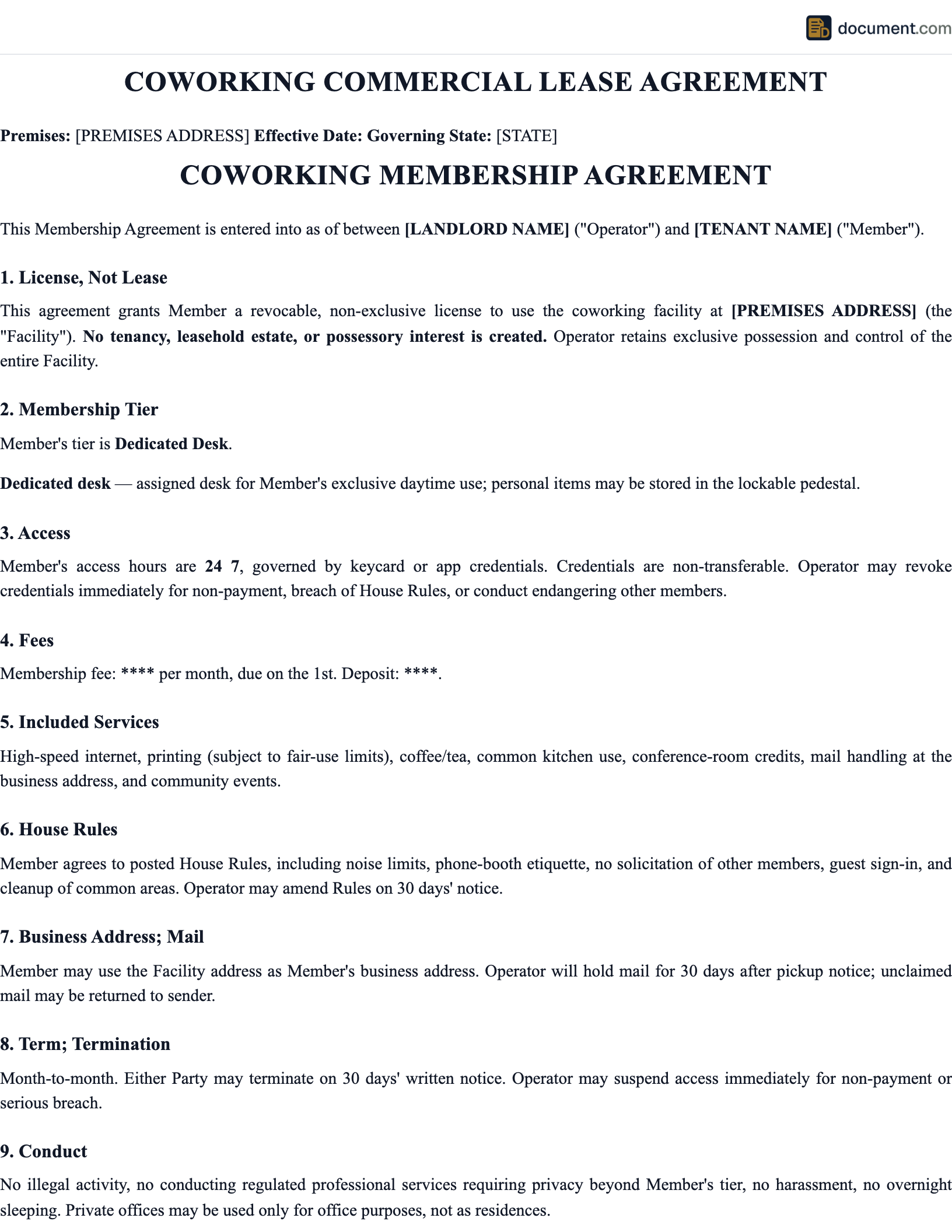
Below is a preview of our Utah-specific coworking space lease agreement. Your customized document will include all fields and provisions required under UT law.
COWORKING SPACE LEASE AGREEMENT
STATE OF UTAH
UT-Compliant Template
PARTY A:
Name: [Full Legal Name]
Address: [Utah Address]
PARTY B:
Name: [Full Legal Name]
Address: [Utah Address]
PROPERTY / PREMISES:
Address: [Property Address]
County: [Utah County]
UTAH COMPLIANCE
This document complies with Utah (UT) state law requirements and includes all provisions mandated for this type of document in Utah.
Utah Resources
Important Considerations for Utah Coworking Members
Utah's coworking market is growing, but members should enter agreements with clear expectations about what they are and are not getting under Utah law.
License Versus Lease Protections
Most Utah coworking operators structure their agreements as licenses, not leases, and Utah courts honor this distinction when the document is drafted properly. A license can be revoked more easily than a lease, operators can require members to vacate with shorter notice, and members have fewer options if an operator closes or defaults on the building's master lease. This is not necessarily a problem for flexible, short-term users, but businesses that depend on a specific location should understand this risk before committing.
Silicon Slopes Internet Demands
Utah's Silicon Slopes tech community has some of the highest bandwidth demands of any coworking market in the country. Video calls, cloud-native workflows, and SaaS development teams routinely saturate shared internet connections. Before committing to a coworking space in Lehi, Provo, or Salt Lake City for tech work, run an independent speed test during peak hours, confirm whether the operator offers dedicated or guaranteed bandwidth tiers, and check whether there is redundant connectivity in case the primary ISP goes down.
Winter Access and Heating
Salt Lake City averages more than 50 inches of snow annually, and coworking buildings must maintain adequate heating and access through January and February cold snaps. Confirm that 24-hour building access is available if you have early or late work schedules, that the building's parking areas are plowed, and that HVAC maintains a workable temperature outside standard business hours. Some smaller coworking operators in the Wasatch Front reduce hours or heating during weekends and holidays.