



Texas Coworking Space Lease Agreement Overview
Texas has four major coworking markets, each with distinct characteristics. Austin leads in flexible workspace demand driven by tech sector density, startup culture, and a large remote worker population. Dallas-Fort Worth has significant coworking activity in financial services, corporate satellite offices, and the growing Frisco and Uptown submarkets. Houston serves the energy industry's mobile workforce, consultants, and a growing tech community. San Antonio has a steadily growing coworking market anchored by healthcare, military contractors, and regional businesses. Together, Texas's four metros make it one of the highest-volume states for coworking lease activity in the country.
Unlike residential leases, commercial leases in Texas are primarily governed by the terms negotiated between the parties. TX provides fewer statutory protections for commercial tenants compared to residential tenants, making it essential that the document thoroughly addresses all material terms and contingencies. Texas-specific considerations may include state tax implications, local permit requirements, and TX insurance regulations. Texas coworking agreements are typically structured as licenses rather than leases, giving operators significant flexibility and limiting members' statutory protections. Key issues in Texas agreements include internet quality (critical in tech-heavy Austin), parking (essential in all four car-dependent Texas cities), and the process for terminating or upgrading membership.
TX
State-specific
Varies
Filing fees
Written
Required format
Contract
Law governs
Texas Legal Requirements
Texas coworking agreements must be complete and precise. Whether structured as a lease or a license, the agreement is the member's only source of protection under Texas law.
Texas Coworking Agreement Note
Texas law does not specifically regulate coworking or shared workspace agreements. Members who rely on verbal promises or implied service obligations will find very limited recourse in Texas courts. The state's commercial legal framework is among the most operator-favorable in the country. In Austin's active coworking market, major national operators use standardized agreements that heavily favor the operator. Members making commitments longer than month-to-month should read every provision carefully.
Document Requirements
- Agreement Type: Specify whether the agreement is a lease or a license; Texas courts treat these differently and the distinction affects member rights on termination
- Membership Tier and Services: Define exactly what is included (internet, conference rooms, printing, parking) and what costs extra; Texas operators are not required to disclose additional charges unless the agreement requires it
- Internet Specifications: Minimum bandwidth, network architecture, VPN policy, and operator obligations during outages; particularly important in Austin where tech-sector members have high connectivity demands
- Parking Terms: Whether parking is included, cost if separate, location, and any restrictions; essential in all four Texas markets where members drive to the space
- Term and Termination: Month-to-month vs. fixed term; notice period required to terminate; early termination fee structure
- Security Deposit: Amount, conditions for return, and timeline; Texas law provides no commercial deposit protections beyond the written agreement
How to Execute a Coworking Agreement in Texas
Joining a coworking space in Texas moves quickly, particularly in Austin where popular spaces can have waitlists. These steps help members approach the process with clarity.
Visit and Test the Space During Working Hours
Visit Austin, Dallas, Houston, or San Antonio coworking spaces during typical working hours to assess internet speed, conference room availability, noise levels, parking, and overall community fit. In Austin, spaces catering to tech workers are often crowded mid-week and the experience on a Tuesday afternoon is different from a Friday morning.
Confirm Parking Before Anything Else
All four major Texas cities are highly car-dependent. Confirm the parking arrangement in detail: included vs. paid, location, monthly cost, and availability before peak hours. In downtown Austin and downtown Dallas, parking can significantly increase total workspace cost and is frequently not included in base coworking fees.
Read the Full Agreement Before Signing
Texas coworking operators use agreements that are generally standardized in the operator's favor. Review every section, with particular attention to the early termination fee, what constitutes a breach, how the operator can change house rules or pricing, and what happens to advance-paid fees if the operator closes. Texas courts enforce these provisions as written.
Choose Month-to-Month vs. Term Deliberately
Texas coworking operators typically offer a discount for committing to a 6 or 12-month term. Evaluate the financial exposure of the early termination penalty against the monthly savings to determine whether the commitment makes sense for your business timeline. Month-to-month memberships at a slight premium offer more flexibility with less financial risk.
Execute and Retain a Complete Copy
Sign the agreement and retain a complete executed copy including all referenced exhibits and house rules. Texas law requires no notarization for a coworking agreement to be enforceable between parties.
Tax Implications for Texas Coworking Memberships
Texas offers a straightforward tax environment for coworking members, though there are important nuances to understand.
| Tax / Cost Item | Texas Treatment |
|---|---|
| State Income Tax on Membership | None. Texas has no state income tax. Coworking membership fees have no TX income tax dimension for either the member or the operator |
| Sales Tax on Services | Texas imposes a 6.25% state sales tax with local add-ons bringing the combined rate to 8.25% in Austin, Dallas, Houston, and San Antonio. Whether coworking memberships are subject to TX sales tax depends on service structure; operators should verify their obligations with a Texas tax advisor |
| Parking Costs | In downtown Austin and Dallas, parking can add $100 to $250 per month to total workspace cost if not included in the membership. Budget parking separately when comparing coworking options across Texas cities |
| Federal Business Deduction | Coworking membership fees paid for business use are deductible as ordinary business expenses for federal tax purposes. Members using coworking space as their primary workspace should retain documentation of membership costs and business purpose |
| Texas Franchise Tax | Businesses operating in Texas pay the margin tax on revenues. Coworking membership fees are a deductible operating expense for franchise tax calculation purposes; consult a Texas tax advisor for the applicable calculation method for your business type |
Sample Texas Coworking Space Lease Agreement
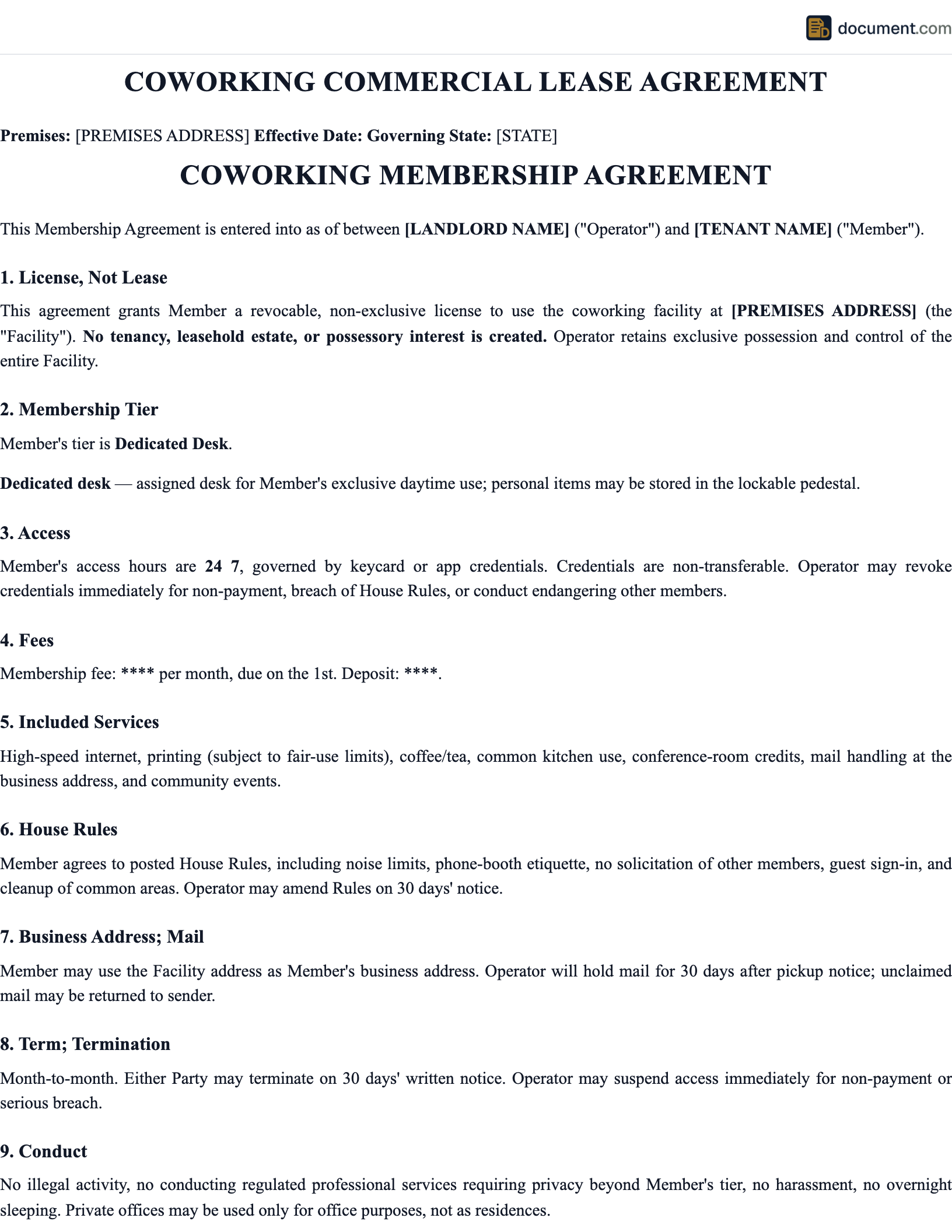
Below is a preview of our Texas-specific coworking space lease agreement. Your customized document will include all fields and provisions required under TX law.
COWORKING SPACE LEASE AGREEMENT
STATE OF TEXAS
TX-Compliant Template
PARTY A:
Name: [Full Legal Name]
Address: [Texas Address]
PARTY B:
Name: [Full Legal Name]
Address: [Texas Address]
PROPERTY / PREMISES:
Address: [Property Address]
County: [Texas County]
TEXAS COMPLIANCE
This document complies with Texas (TX) state law requirements and includes all provisions mandated for this type of document in Texas.
Texas Resources
Important Considerations for Texas Coworking Agreements
Parking Is a Non-Negotiable Budget Item in Texas
Texas is a car-dependent state. Unlike New York or San Francisco where many coworking members arrive by transit, the overwhelming majority of Texas coworking members drive. Operators who do not include parking in base membership pricing are effectively requiring members to find and pay for parking independently. Factor parking into the true monthly cost before signing any Texas coworking agreement.
Texas Operators Have Broad Contractual Flexibility
Texas's commercial-friendly legal environment means coworking operators can include broad unilateral modification rights, aggressive termination provisions, and sweeping limitation of liability clauses. These provisions are generally enforceable under Texas law. Members should read every clause, not just the summary or pricing page, before signing.
Austin Internet Demands Are Among the Highest in the Country
Austin's tech-heavy coworking member base places exceptional demands on internet infrastructure. Shared bandwidth in a busy Austin coworking space can degrade significantly during peak hours. Members who require dedicated bandwidth, low latency for video production or gaming, or isolated network segments for data security should verify the space's technical specifications before committing.