



Tennessee Coworking Space Lease Agreement Overview
Tennessee's coworking market is dominated by Nashville, which has become one of the most significant flexible workspace markets in the South. The city's extraordinary population growth, large influx of remote workers from coastal cities, vibrant startup ecosystem, and strong creative economy have all driven robust demand for flexible workspace alternatives to traditional multi-year office leases. Nashville coworking operators range from large national chains with significant footprints to locally operated boutique spaces in neighborhoods like the Gulch, East Nashville, and 12 South that cater to specific creative and professional communities.
Tennessee coworking agreements are typically structured as licenses rather than leases, which means the operator retains significant flexibility and the member has fewer statutory protections than a traditional commercial tenant. The written agreement is the member's primary source of protection in any dispute. Key negotiating points include internet connectivity quality (critical in Nashville's tech-heavy member base), conference room access policies, parking arrangements (particularly important and often expensive in Nashville), hours of access, and the process for terminating or upgrading membership. Tennessee has no state income tax, making the all-in cost of workspace in Nashville more competitive than it might appear compared to tax-burdened markets.
TN
State-specific
Varies
Filing fees
Written
Required format
Contract
Law governs
Tennessee Legal Requirements
Tennessee coworking agreements follow general contract law principles. Whether structured as a lease or license, the agreement must clearly define all material terms because Tennessee law provides minimal baseline protections for commercial occupants.
Tennessee Coworking Agreement Note
Tennessee does not have specific statutes governing coworking or shared workspace arrangements. Members relying on implied protections or oral promises from operators will find very limited legal recourse in TN courts. Nashville coworking agreements from larger operators may be heavily standardized in the operator's favor. Members making significant financial commitments (advance payments, long terms) should read the full agreement carefully and understand the total cost of early exit before signing.
Document Requirements
- Written Agreement: Tennessee's statute of frauds (TCA 29-2-101) requires leases over one year to be in writing; even shorter-term agreements should always be documented in writing
- Party Identification: Full legal names and entity types of all parties, with proper identification of authorized signatories
- Property Description: Complete description of the premises including address, suite, and square footage
- Material Terms: All material terms including rent, term, permitted use, and maintenance obligations must be clearly stated
- Proper Execution: Signatures of authorized representatives with proper acknowledgment if recording is required in TN
- Zoning Compliance: Verify the intended use complies with Tennessee local zoning and land use regulations
How to Execute a Coworking Agreement in Tennessee
Joining a coworking space in Tennessee, particularly in Nashville, typically moves quickly. These steps help members approach the process with clarity.
Visit During Peak Hours and Test the Essentials
Visit Nashville coworking spaces during typical working hours to assess internet performance, noise levels, conference room availability, and community fit. In Nashville's active market, popular spaces can have waitlists for certain membership tiers, so start the evaluation process early.
Understand the Agreement Type and Term
Determine whether you are signing a lease or a license, and whether the arrangement is month-to-month or a fixed term. In Tennessee, fixed-term coworking agreements may carry early termination penalties equivalent to several months of fees. Understand the total financial exposure before committing.
Get All Amenity and Service Terms in Writing
Nashville coworking operators are generally professional, but verbal promises about conference room availability, internet upgrades, or parking add-ons are not enforceable under Tennessee law. Get every included service, overage policy, and add-on cost in the written agreement before signing.
Confirm Parking Separately
Nashville parking is expensive and often not included in coworking base memberships. Confirm the parking arrangement, cost, and location in writing before signing. Monthly parking in downtown Nashville can run $150 to $300 per month and should be factored into the total workspace cost comparison.
Sign and Retain a Complete Copy
Sign the agreement and retain a fully executed copy with all exhibits, schedules, and house rules incorporated. Tennessee coworking operators sometimes reference separate house rule documents that can change unilaterally; confirm the process for rule changes and whether the member has any veto rights.
Tax Implications for Tennessee Coworking Memberships
Tennessee's favorable tax environment simplifies the cost picture for coworking members, though there are a few nuances to understand.
| Tax / Cost Item | Tennessee Treatment |
|---|---|
| State Income Tax on Membership Fees | None. Tennessee eliminated its Hall Income Tax and has no income tax on wages or business income. Coworking membership fees have no TN income tax dimension |
| Sales Tax on Services | Tennessee's state sales tax rate is 7%, with local rates bringing the combined Nashville rate to 9.75%. Whether coworking memberships trigger TN sales tax depends on service structure; operators should confirm with a TN tax advisor |
| Parking Costs | Parking in downtown Nashville typically runs $150 to $300 per month if not included in the membership. Parking is frequently excluded from base coworking fees and should be budgeted separately |
| Federal Business Expense Deduction | Coworking membership fees paid for business workspace are deductible as ordinary business expenses for federal tax purposes. Home office and coworking deductions are generally mutually exclusive for the same workspace |
Sample Tennessee Coworking Space Lease Agreement
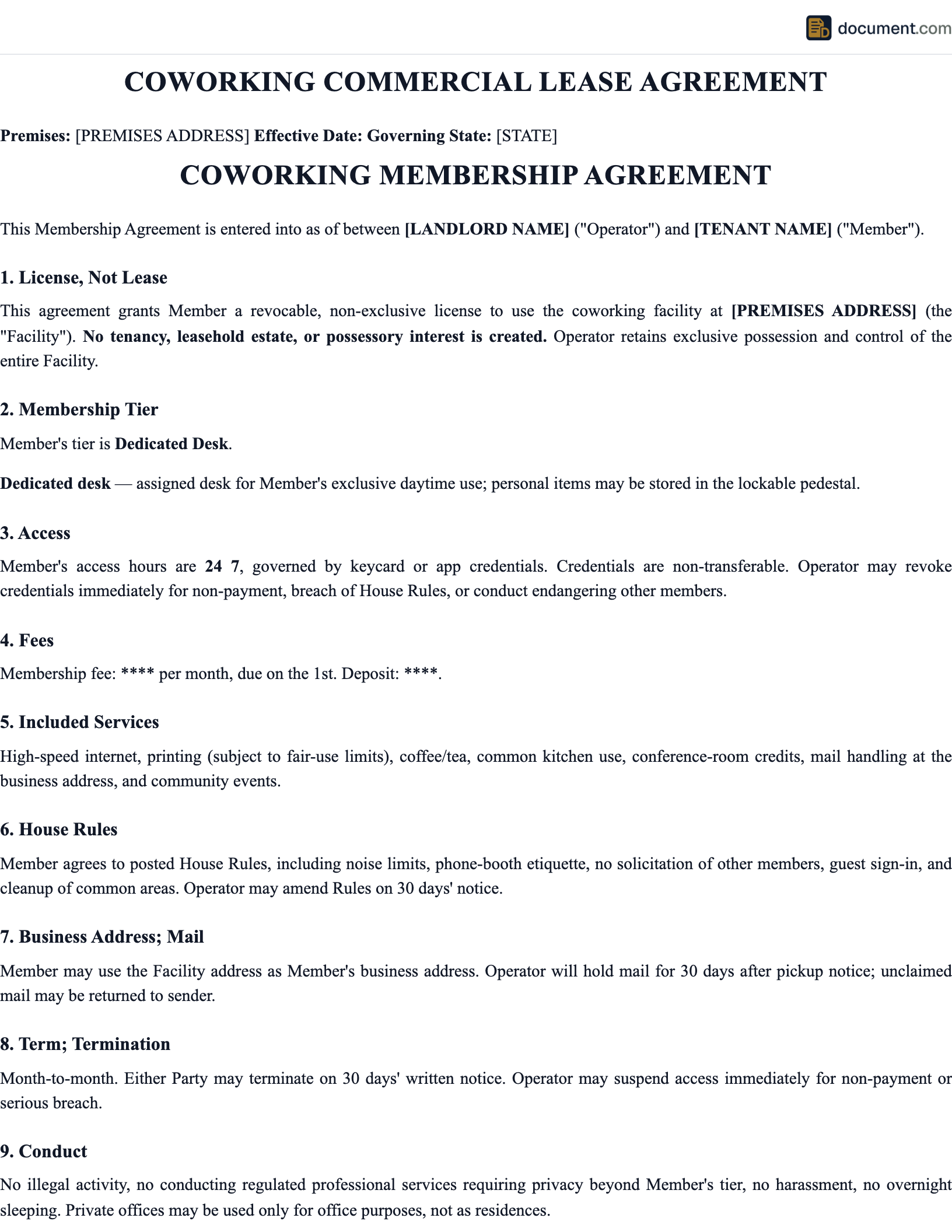
Below is a preview of our Tennessee-specific coworking space lease agreement. Your customized document will include all fields and provisions required under TN law.
COWORKING SPACE LEASE AGREEMENT
STATE OF TENNESSEE
TN-Compliant Template
PARTY A:
Name: [Full Legal Name]
Address: [Tennessee Address]
PARTY B:
Name: [Full Legal Name]
Address: [Tennessee Address]
PROPERTY / PREMISES:
Address: [Property Address]
County: [Tennessee County]
TENNESSEE COMPLIANCE
This document complies with Tennessee (TN) state law requirements and includes all provisions mandated for this type of document in Tennessee.
Tennessee Resources
Important Considerations for Tennessee Coworking Agreements
Nashville Parking Is a Real Budget Item
Nashville has significant parking challenges in its urban core. Members who drive should confirm parking availability and monthly cost before signing any coworking agreement. Monthly parking near popular Nashville coworking locations can add $150 to $300 per month to the total workspace cost, and should be treated as a line item in any workspace budget comparison.
License vs. Lease Protections
Most Nashville coworking operators use license agreements that can be terminated on shorter notice and with fewer tenant protections than a commercial lease. Members making financial commitments exceeding 6 months should understand the difference and evaluate whether the operator's financial stability and track record support the commitment.
Internet Quality Matters for Nashville's Tech Workers
Nashville attracts a significant number of remote tech, media, and financial services workers who require reliable high-speed internet. Coworking agreements should specify minimum bandwidth, redundancy (dual ISP or cellular backup), and the operator's obligations in the event of an outage that affects the member's ability to work.