



South Dakota Coworking Space Lease Agreement Overview
Coworking space has grown steadily in South Dakota, particularly in Sioux Falls where small businesses, remote workers in the financial sector, and entrepreneurs have created demand for flexible workspace alternatives to traditional office leases. The state's business-friendly environment, no income tax, and low cost of living relative to coastal markets make it an attractive destination for remote professionals who want a physical workspace without committing to a long-term office lease. Sioux Falls has several coworking operators concentrated near downtown and along the I-229 corridor.
Most South Dakota coworking agreements are structured as licenses rather than commercial leases, giving operators flexibility and reducing the tenant protections that SD law would otherwise provide. This structure makes the written agreement the sole governing document for the relationship. The agreement needs to address internet infrastructure (critical for financial and tech workers), shared amenity access rules, parking (a key amenity in SD given the car-dependent culture of Sioux Falls), building access hours during harsh winter months, and the process for ending the membership with appropriate notice.
SD
State-specific
Varies
Filing fees
Written
Required format
Contract
Law governs
South Dakota Legal Requirements
Whether structured as a lease or a license, a South Dakota coworking agreement must be clear, complete, and signed by authorized representatives of both the operator and the member. The state's minimal regulatory framework means the document itself provides all the protection available.
South Dakota Coworking Agreement Note
South Dakota does not have specific statutes regulating coworking or shared workspace agreements. These arrangements are governed entirely by contract law. If the agreement is structured as a license rather than a lease, the member has fewer rights on termination and fewer remedies if the operator fails to deliver promised amenities. Members considering month-to-month versus term commitments should fully understand the financial consequences of each option before signing.
Document Requirements
- Agreement Type: Specify whether the agreement is a lease or a license; the distinction affects the member's rights on termination and the operator's obligations under SD law
- Membership Tier and Amenities: Define the exact level of access included: hot desk, dedicated desk, private office; conference room hours; parking allocation
- Internet and Tech Infrastructure: Bandwidth guarantees, network segmentation, VPN policy, and the operator's obligations in the event of extended outage
- Term and Termination: Whether the membership is month-to-month or a fixed term; notice required to terminate; any early termination fee
- Security Deposit: Amount (if any), conditions for return, and timeframe for return after membership ends; South Dakota law sets no deposit cap or return deadline for commercial arrangements
- Building Access Hours: Winter hours and any restrictions on access during SD holiday closures or extreme weather events
How to Execute a Coworking Space Agreement in South Dakota
Joining a coworking space in South Dakota is typically faster than entering a traditional office lease, but the agreement still deserves careful review before signing. Follow these steps.
Choose a Membership Tier and Tour the Space
Visit the coworking location during typical working hours. Test the internet speed, check the conference room availability process, confirm parking, and assess noise levels and building security. South Dakota coworking operators vary widely in quality and focus area.
Review the Agreement Type and Term
Determine whether the agreement is a lease or a license, and whether you are committing to a fixed term or month-to-month. In South Dakota, fixed-term agreements may carry an early termination penalty; understand the total financial exposure before signing.
Confirm Included Services and Pricing
Get a complete list of what is included in your monthly fee and what costs extra. Conference room overages, printing, additional parking, and after-hours access fees should all be disclosed up front. South Dakota has no statute requiring operators to itemize these charges, so the written agreement is the only guarantee.
Execute the Agreement in Writing
Sign and receive a fully executed copy of the agreement. Even for month-to-month memberships, get the agreement in writing with both signatures. South Dakota's statute of frauds applies to leases over one year, but having written terms protects both parties regardless of the duration.
Pay Deposit and First Month
Most South Dakota coworking operators require the first month's fee and a security deposit at signing. The deposit return process should be clearly described in the agreement since SD commercial law sets no standard timeline or conditions for deposit returns.
Tax Implications for South Dakota Coworking Leases
South Dakota's tax climate is unusually simple for commercial tenants. No state income tax, no commercial rent tax, and a straightforward sales tax regime make coworking membership costs relatively predictable from a tax perspective.
| Tax / Cost Item | South Dakota Treatment |
|---|---|
| State Income Tax on Membership Fees | None. South Dakota has no state income tax. Coworking membership fees paid by a business are a federal business expense deduction only |
| Sales Tax on Coworking Services | South Dakota imposes a sales tax on certain services. Coworking operators should confirm whether their bundled offerings (printing, tech access, meeting rooms) trigger SD sales tax obligations at the current state rate of 4.5% |
| Property Tax Passthrough | Coworking operators typically absorb property tax as part of overhead included in membership pricing. Unlike traditional commercial leases, members generally do not receive a separate property tax line item |
| Federal Business Expense Deduction | Coworking membership fees paid for a business workspace are deductible as ordinary business expenses for federal tax purposes. Home office deductions and coworking deductions are generally mutually exclusive for the same workspace |
Important Considerations for South Dakota Coworking Agreements
Lease vs. License Distinction
Most South Dakota coworking operators use license agreements rather than leases. A license gives the operator more flexibility to terminate or change terms with shorter notice. Before signing, understand which type of agreement you have and what remedies you retain if the operator fails to perform.
Financial Services Data Requirements
A significant portion of Sioux Falls's professional community works in finance, banking, and credit processing. These workers often have regulatory obligations around data security that a generic coworking internet connection may not satisfy. Verify whether the space provides dedicated bandwidth, VLAN options, or compliance documentation before signing a financial services-related membership.
Winter Access and Business Continuity
South Dakota winters are severe enough to close roads and buildings. Check whether the coworking operator has a defined policy for extreme weather closures and whether the membership fee is reduced or credited during extended closures. Also confirm what backup access options exist if the main building is inaccessible.
Sample South Dakota Coworking Space Lease Agreement
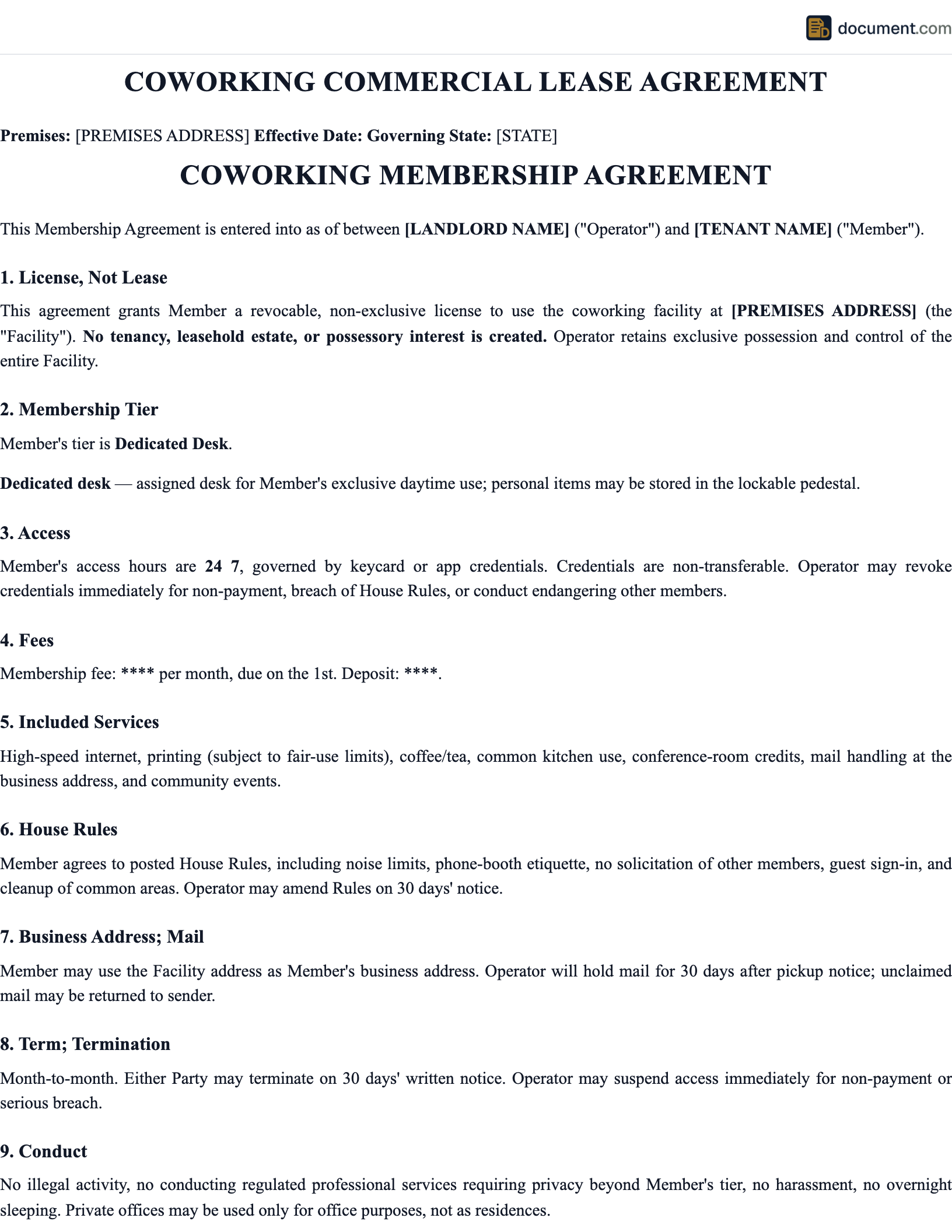
Below is a preview of our South Dakota-specific coworking space lease agreement. Your customized document will include all fields and provisions required under SD law.
COWORKING SPACE LEASE AGREEMENT
STATE OF SOUTH DAKOTA
SD-Compliant Template
PARTY A:
Name: [Full Legal Name]
Address: [South Dakota Address]
PARTY B:
Name: [Full Legal Name]
Address: [South Dakota Address]
PROPERTY / PREMISES:
Address: [Property Address]
County: [South Dakota County]
SOUTH DAKOTA COMPLIANCE
This document complies with South Dakota (SD) state law requirements and includes all provisions mandated for this type of document in South Dakota.