



South Carolina Coworking Space Lease Agreement Overview
South Carolina's coworking market reflects the state's three-city economic structure. Charleston leads in terms of operator count and member volume, with demand fueled by a wave of remote workers relocating from the Northeast and mid-Atlantic who value Charleston's coastal lifestyle at a fraction of New York or Washington costs. The Charleston market has attracted both national coworking chains and local boutique operators, giving members more options than most similarly-sized Southern cities. Columbia's market is smaller and more stable, anchored by the University of South Carolina, state government contractors, and law and professional services firms. Greenville is the fastest-growing market, where BMW, Michelin, and other European manufacturers with Upstate facilities generate demand for flexible professional space from management consultants, engineers, and supply chain specialists.
South Carolina has no coworking-specific statute or commercial tenant protection framework that applies to these arrangements. Most coworking agreements are structured as license agreements rather than leases, governed entirely by general contract law under the South Carolina Code of Laws. The residential Landlord and Tenant Act (S.C. Code Section 27-40-100 et seq.) does not apply. This means every material protection a member wants, including deposit caps, service level commitments, fee increase notice periods, and termination rights, must be negotiated and documented in the membership agreement itself.
3 Markets
Charleston, Columbia, Greenville
No Tax
SC coworking fees
License
Not a lease
Contract
Law governs
South Carolina Legal Requirements
South Carolina coworking agreements are contracts, not regulated leases. The membership agreement is your only protection, and South Carolina courts will enforce it as written, since the state's commercial real estate law presumes sophisticated parties negotiate at arm's length. Read every provision before signing, and push for clear language on fee increases, deposit returns, service commitments, and what happens if the operator fails.
License vs. Tenancy in South Carolina
South Carolina courts will analyze whether a coworking arrangement is a license or a tenancy based on whether the member has exclusive possession of a specific space and the right to exclude others. Hot-desk and shared-desk arrangements are almost certainly licenses. A private, keyed office with dedicated space assigned solely to one member may be treated as a periodic tenancy, which carries different termination notice requirements and legal remedies. If you are entering a dedicated private office arrangement, confirm how the operator characterizes the arrangement and whether that characterization reflects the actual exclusive possession you will have.
Key Agreement Provisions
- License vs. lease characterization: Confirm whether the agreement is structured as a license or a lease and whether the practical arrangement (exclusive vs. shared possession) matches that characterization
- Services enumeration: List all included services (WiFi speeds, meeting room hours per month, mail handling, printing, reception) to avoid disputes about what the monthly fee covers
- Fee increase notice: Negotiate minimum 30-day written notice for any rate changes and an exit right without penalty if rates increase beyond an agreed threshold
- Master lease disclosure: Ask whether the operator holds a direct lease or a sublease; request master lease term remaining and confirmation of any non-disturbance agreement with the building landlord
- Security deposit terms: Confirm the amount, conditions for withholding, and return timeline (negotiate 30 days since no SC statute mandates a deadline for commercial deposits)
- Termination rights: Define early termination penalty explicitly rather than leaving it to SC breach-of-contract remedies; negotiate a defined fee (1 to 2 months) rather than potential full remaining term exposure
How to Evaluate and Execute a South Carolina Coworking Agreement
South Carolina coworking agreements are typically presented as take-it-or-leave-it documents, but key terms are often negotiable, particularly for members committing to longer terms or larger private offices. Follow these steps.
Research the Operator's Stability and Master Lease
Ask how long the operator has been in the building, whether they own or sublease the space, and when the master lease expires. Charleston's market has attracted boutique operators whose financial stability may be untested. A non-disturbance agreement with the building landlord protects your occupancy if the operator defaults; ask whether one exists and request a copy if so.
Negotiate Fee Stability and Termination Terms
South Carolina has no statute requiring advance notice of fee increases for coworking arrangements. Push for a minimum 30-day written notice requirement for any fee changes and a termination right if rates rise beyond an agreed percentage. For fixed-term commitments, confirm whether the agreed rate is locked or subject to periodic escalation, and negotiate any escalation cap explicitly.
Confirm Technology and Service Commitments
Get internet speed, uptime, and VLAN availability commitments in writing for professional services and tech members. Greenville coworking spaces serving manufacturing management professionals should confirm that video conferencing and secure file transfer capacity is adequate. Charleston members should confirm whether the building's internet infrastructure is adequate for their needs given that some downtown historic buildings have infrastructure constraints.
Address South Carolina Tax Nexus
Using a Charleston, Columbia, or Greenville coworking address as your registered business address and conducting regular business activity from that location may create South Carolina corporate income tax nexus. If you are based outside South Carolina and using coworking membership primarily as a mailing address or occasional workspace, consult a South Carolina tax professional about nexus implications before establishing the membership as your primary business address.
Execute and Retain Complete Documentation
Sign and retain a complete copy of the final membership agreement. Document the condition of any assigned space at move-in. Keep records of all payments made. If your arrangement extends beyond one year, confirm the agreement is in writing to satisfy South Carolina's statute of frauds (S.C. Code Section 32-3-10).
South Carolina Coworking: Cost and Tax Considerations
South Carolina imposes no commercial rent tax or sales tax on coworking membership fees. The SC sales tax (6 percent state rate, plus local additions in some jurisdictions) applies to tangible personal property and certain services, but standard coworking membership fees for use of space are not subject to SC sales tax. This keeps the all-in cost comparison between coworking and traditional leasing straightforward in South Carolina.
Charleston coworking rates run higher than Columbia and Greenville, driven by demand from relocated remote workers and the constrained downtown inventory. Hot-desk memberships in Charleston typically run $250 to $450 per month, with dedicated desks at $450 to $700 and private offices from $700 to $1,400 depending on size and location. Columbia and Greenville rates are meaningfully lower. None of these amounts include parking, which in downtown Charleston adds $150 to $250 monthly per vehicle and should be factored into total occupancy cost comparisons with suburban alternatives.
Members who establish their primary business presence through a South Carolina coworking address and conduct meaningful business activity in the state may trigger South Carolina corporate income tax filing obligations. South Carolina taxes C-corporations at a flat 5 percent rate (one of the lower rates in the Southeast) and S-corporations and LLCs through pass-through treatment. The nexus analysis is activity-based, not just address-based, but using a coworking address as the registered agent address for a business entity combined with regular in-person client activity typically constitutes doing business in South Carolina for tax purposes.
Typical South Carolina Coworking Costs
| Fee / Cost | Typical Amount |
|---|---|
| Hot desk / shared desk (Charleston) | $250 - $450/month |
| Dedicated desk (Charleston) | $450 - $700/month |
| Private office (Charleston) | $700 - $1,400/month |
| Hot/dedicated desk (Columbia or Greenville) | $150 - $450/month |
| SC sales/rent tax on membership fees | None |
| Downtown Charleston parking (monthly) | $150 - $250 per vehicle |
| Security deposit | 1 - 2 months (no SC statutory cap) |
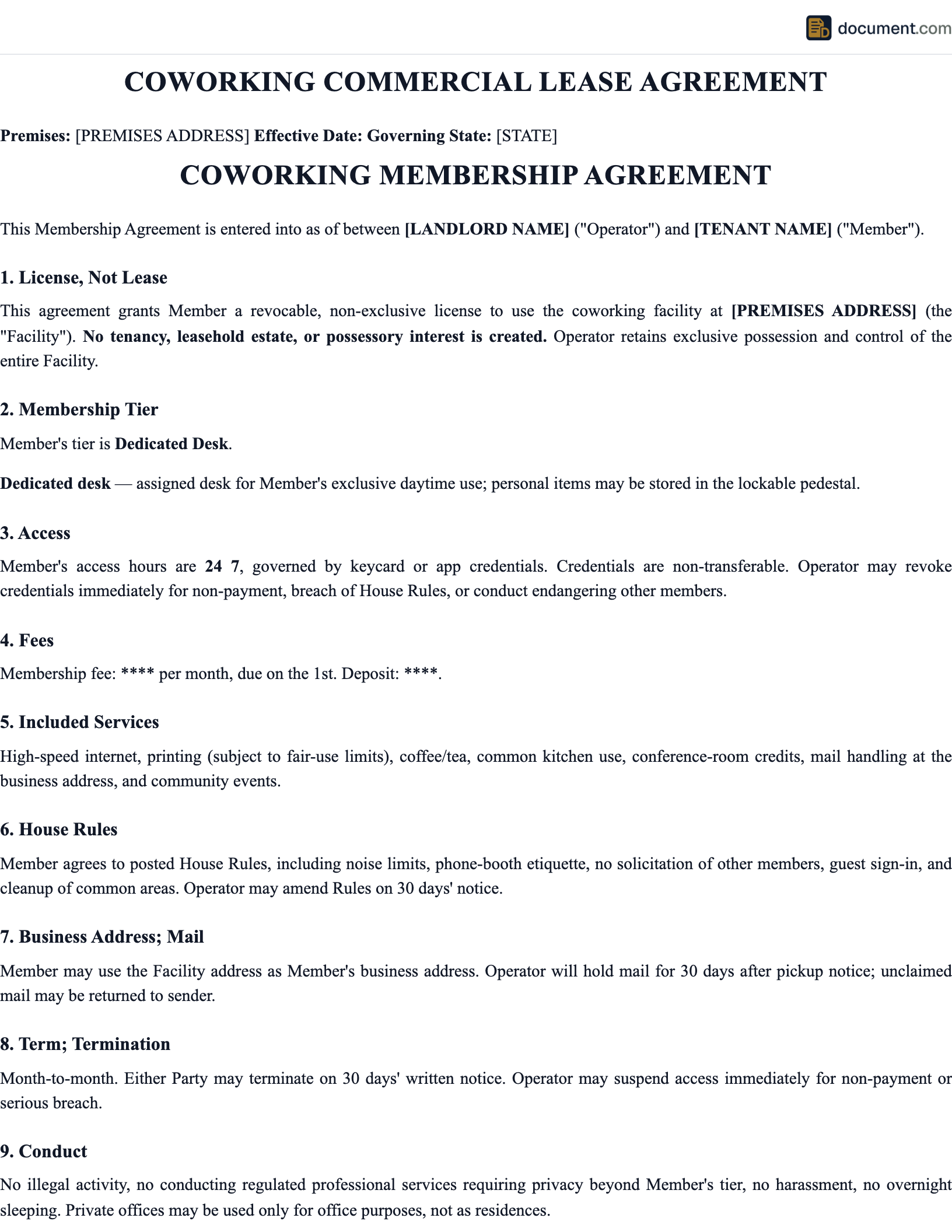
Sample South Carolina Coworking Space Lease Agreement
Below is a preview of our South Carolina-specific coworking space lease agreement. Your customized document will include all fields and provisions required under SC law.
COWORKING SPACE LEASE AGREEMENT
STATE OF SOUTH CAROLINA
SC-Compliant Template
PARTY A:
Name: [Full Legal Name]
Address: [South Carolina Address]
PARTY B:
Name: [Full Legal Name]
Address: [South Carolina Address]
PROPERTY / PREMISES:
Address: [Property Address]
County: [South Carolina County]
SOUTH CAROLINA COMPLIANCE
This document complies with South Carolina (SC) state law requirements and includes all provisions mandated for this type of document in South Carolina.