



Rhode Island Coworking Space Lease Agreement Overview
Rhode Island's coworking market is centered almost entirely in Providence, with a handful of operators occupying downtown buildings and the Jewelry District. The market is materially smaller than Boston's but costs substantially less, making Providence a rational base for remote workers, freelancers, and early-stage companies that need a professional address and shared amenities without committing to a traditional lease. RISD and Brown University generate a creative and knowledge-economy workforce that drives demand for flexible workspace, and the I-195 Redevelopment District has begun attracting life sciences and biotech startups that may outgrow coworking quickly but use it as an interim solution while seeking purpose-built lab space.
Rhode Island has no coworking-specific statute or commercial tenant protection framework that applies to these arrangements. Most coworking agreements are structured as license agreements rather than leases, governed entirely by general contract law under the Rhode Island General Laws. The residential Landlord and Tenant Act (RIGL Chapter 34-18) does not apply, meaning security deposit caps, mandatory return timelines, and habitability standards are not statutory protections a member can rely on. Everything must be negotiated and documented in the membership agreement itself.
Providence
Primary market
No Tax
RI coworking fees
License
Not a lease
Contract
Law governs
Rhode Island Legal Requirements
Because Rhode Island coworking agreements are contracts rather than regulated leases, the membership agreement is the member's only line of protection. Read it carefully before signing, and push for clear language on the points most likely to create disputes: fee increases, deposit return, service levels, and what happens if the operator fails.
License vs. Tenancy in Rhode Island
Rhode Island courts may characterize a coworking arrangement as a tenancy rather than a license if the member has exclusive possession of a defined space and the right to exclude others. This matters because a tenancy creates different legal rights and obligations, including potential notice requirements for termination. Flexible desk or hot-desk arrangements are almost certainly licenses; dedicated private offices may be analyzed differently. If your arrangement involves a private, locked office assigned solely to you, consider whether the agreement's characterization as a license accurately reflects the legal reality.
Key Agreement Provisions
- License vs. lease characterization: Confirm how the agreement characterizes your right to occupy and whether that characterization accurately reflects your level of exclusive possession
- Services enumeration: List all included services (WiFi, printing, meeting room hours, mail handling, reception) to avoid disputes about what the monthly fee covers
- Fee increase notice: Negotiate minimum 30-day written notice for fee increases and a right to terminate without penalty if rates rise beyond an agreed threshold
- Master lease disclosure: Ask whether the operator holds a direct lease or a sublease; request disclosure of master lease termination date and any non-disturbance agreement with the building landlord
- Deposit terms: Confirm the deposit amount, conditions for withholding, and return timeline (negotiate 30 days since no RI statute mandates a deadline for commercial deposits)
- Network and technology SLA: Specify minimum internet speeds, VLAN availability, and the operator's obligation to restore service within defined timeframes
How to Evaluate and Execute a Rhode Island Coworking Agreement
Rhode Island coworking agreements move faster than traditional commercial leases, but that speed should not short-circuit basic diligence. Follow these steps to protect your interests as a member.
Research the Operator's Financial Standing and Master Lease
Ask the Providence coworking operator how long they have been in the building, whether they own or sublease the space, and when the master lease expires. A boutique operator whose master lease expires in 18 months presents real displacement risk. Request confirmation of a non-disturbance agreement with the building landlord if one exists, which would protect your occupancy even if the operator defaults.
Negotiate Fee Stability and Termination Rights
Rhode Island has no statute requiring advance notice of fee increases for commercial or license arrangements. Negotiate a minimum 30-day written notice requirement for any fee changes and an exit right if rates increase by more than an agreed percentage. For fixed-term arrangements, define the early termination penalty explicitly rather than leaving it to a breach-of-contract calculation under RI common law.
Confirm Technology and Amenity Commitments
Get the operator's internet speed and uptime commitments in writing, including what remedies exist if service falls below committed levels. Professional services and tech members in Providence should confirm VLAN availability, whether the building infrastructure supports fiber, and meeting room booking procedures and limits. Do not rely on verbal assurances.
Address Rhode Island Tax Nexus Before Signing
Using a Providence coworking address as your registered business address may create Rhode Island corporate or business tax nexus. If you are based outside Rhode Island and using a coworking membership primarily as a mailing address or occasional workspace, consult a Rhode Island tax professional about whether your activity level triggers RI tax filing obligations before establishing the membership.
Execute and Retain Documentation
Sign the final membership agreement and retain a complete copy for your records. Document the condition of any assigned desk or office space at move-in and photograph any pre-existing damage. Keep records of all fee payments. If your arrangement extends beyond one year, confirm that the agreement is in writing to satisfy Rhode Island's statute of frauds (RIGL Section 9-1-4) and ensure enforceability.
Rhode Island Coworking: Cost and Tax Considerations
Rhode Island imposes no sales tax on coworking membership fees or commercial rent, which means the monthly rate you see from a Providence operator is the actual pre-tax cost. There are no city-level business taxes comparable to Philadelphia's BIRT or Portland's Business License Tax. This makes the all-in cost comparison between coworking and traditional leasing straightforward in Rhode Island: the main variables are the base membership fee, any add-on charges for private offices or additional meeting room time, and incidental expenses like parking.
Providence coworking typically runs $200 to $350 per month for a shared desk and $450 to $900 per month for a dedicated desk or private office, depending on the building, amenities, and term length. These rates are substantially lower than Boston-area equivalents, which is the core value proposition for companies willing to base teams in Providence. Operators rarely include parking in the base membership fee, and downtown Providence parking adds $100 to $200 monthly per vehicle, which should be factored into total cost comparisons with suburban alternatives.
Members who operate businesses from a Providence coworking address and have substantial Rhode Island activity may have Rhode Island corporate income tax obligations. Rhode Island taxes C-corporations at a flat 7 percent rate on apportioned income. S-corporations and LLCs with Rhode Island activity file through the pass-through entity structure. Using a coworking address as the sole connection to Rhode Island typically constitutes doing business in the state for tax purposes if accompanied by meaningful business activity. Consult a Rhode Island CPA before using a coworking membership to establish a state presence.
Typical Rhode Island Coworking Costs
| Fee / Cost | Typical Amount |
|---|---|
| Shared desk (hot desk) | $200 - $350/month |
| Dedicated desk | $350 - $550/month |
| Private office | $600 - $1,100/month |
| RI commercial rent/sales tax on fees | None |
| Security deposit | 1 - 2 months (no RI cap) |
| Downtown Providence parking (monthly) | $100 - $200 per vehicle |
Sample Rhode Island Coworking Space Lease Agreement
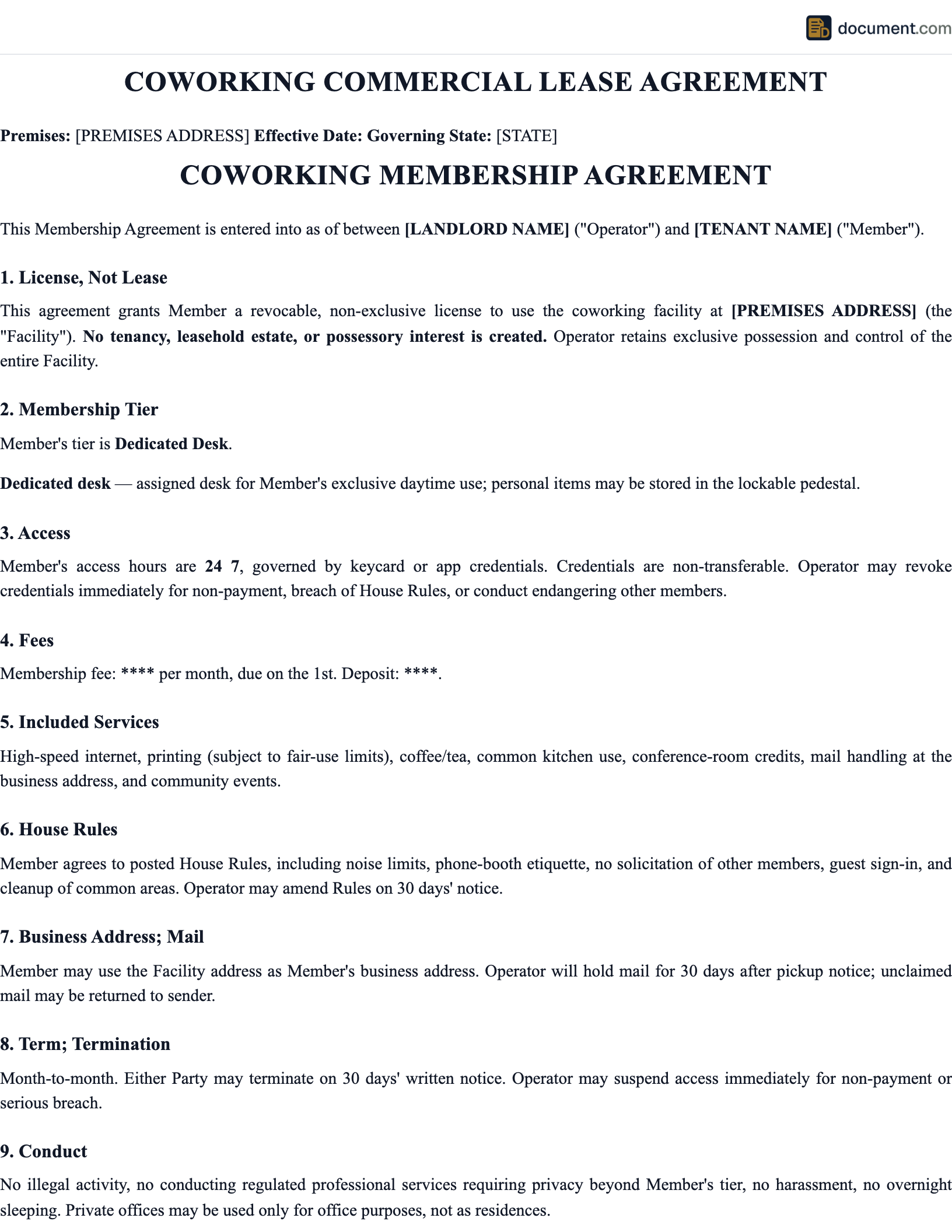
Below is a preview of our Rhode Island-specific coworking space lease agreement. Your customized document will include all fields and provisions required under RI law.
COWORKING SPACE LEASE AGREEMENT
STATE OF RHODE ISLAND
RI-Compliant Template
PARTY A:
Name: [Full Legal Name]
Address: [Rhode Island Address]
PARTY B:
Name: [Full Legal Name]
Address: [Rhode Island Address]
PROPERTY / PREMISES:
Address: [Property Address]
County: [Rhode Island County]
RHODE ISLAND COMPLIANCE
This document complies with Rhode Island (RI) state law requirements and includes all provisions mandated for this type of document in Rhode Island.