
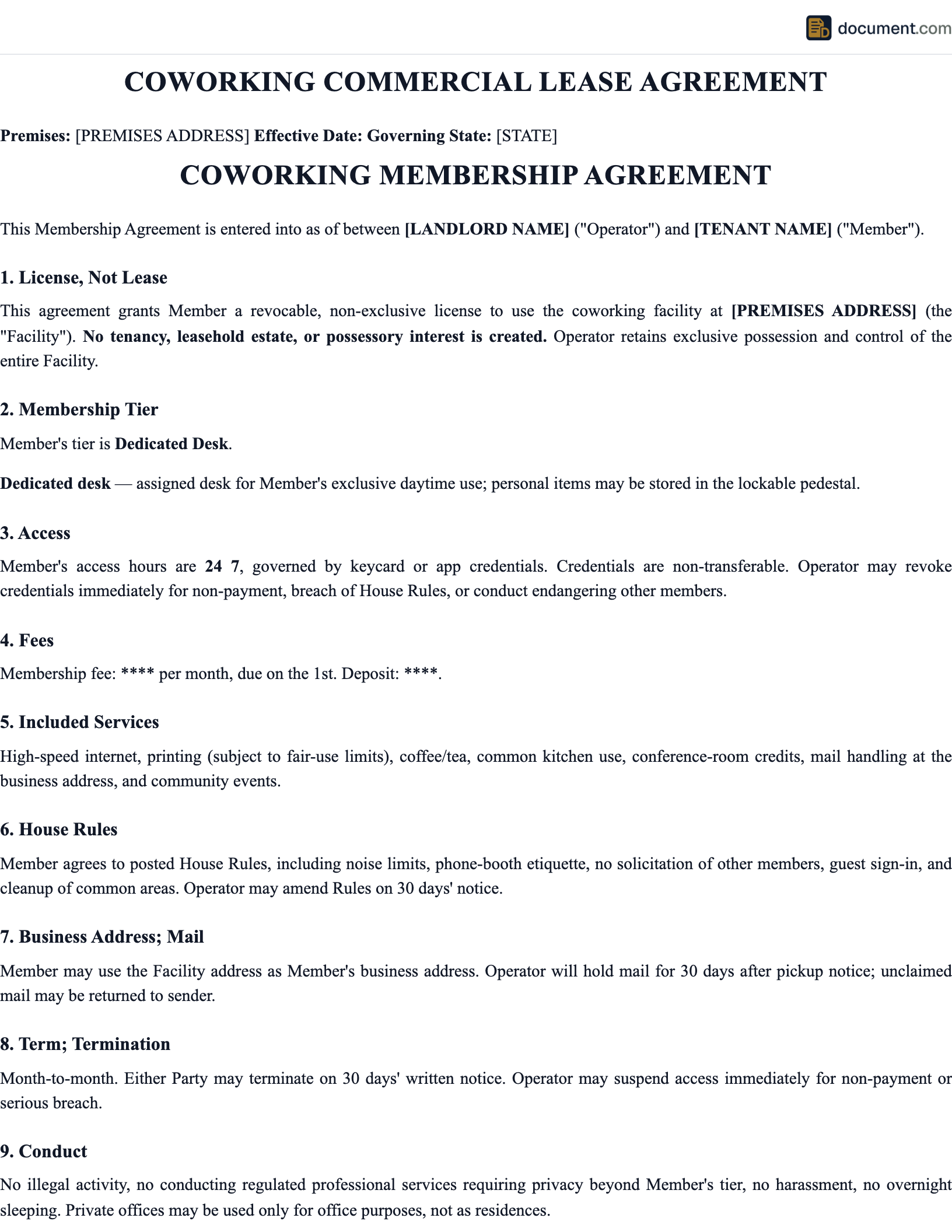



Oregon Coworking Space Lease Agreement Overview
Portland leads Oregon's coworking market by a wide margin, with a mature ecosystem of coworking spaces catering to the city's creative economy, technology sector, and growing population of remote workers from major employers who have relocated to the Pacific Northwest. The Central Eastside has seen the most growth in creative and tech-oriented coworking, while the Pearl District hosts more corporate-leaning flexible workspace operators. Oregon's lack of a state sales tax means coworking membership fees are not subject to sales tax, which is a small advantage compared to many other states.
Oregon has no coworking-specific statute. Coworking arrangements are governed by general Oregon contract law when structured as license agreements, or by commercial landlord-tenant principles when they effectively grant exclusive possession of a defined space. Oregon's residential rent stabilization law does not apply to commercial or coworking agreements, so membership fee increases are unlimited absent a contractual provision. Oregon's Consumer Privacy Act (effective 2024 for qualifying controllers) adds a data privacy layer that both operators and members in Portland's tech community should understand. The agreement should address network security and data handling obligations.
OR
State-specific
Varies
Filing fees
Written
Required format
Contract
Law governs
Oregon Legal Requirements
Oregon has specific requirements for commercial lease documents that must be followed to ensure enforceability. Understanding OR's legal framework helps protect both landlord and tenant interests.
Oregon Coworking Agreement Note
Oregon has no statute specifically governing coworking membership agreements. Oregon's statute of frauds (ORS 41.580) requires leases over one year to be in writing; month-to-month license agreements do not require a writing but having one is strongly advisable. Oregon's Consumer Privacy Act (OCPA) applies to qualifying businesses collecting personal data; coworking operators should review their data collection practices for OCPA compliance.
Key Provisions for Oregon Coworking Agreements
- License vs. Tenancy Structure: Clarify whether the agreement creates a license for shared access or a tenancy in a defined space; this determines what legal remedies apply if either party defaults
- Fee Increase Notice: Oregon has no statutory notice requirement for commercial fee increases; negotiate a minimum 30-day advance written notice provision
- Network and Technology SLA: Portland's tech community requires fiber-grade speeds and uptime guarantees; specify minimum speeds, uptime SLA, and credit provisions for outages
- Data Privacy Representations: Address OCPA compliance, network security practices, and operator liability for data breaches on shared infrastructure
- Master Lease Disclosure: Ask whether the operator holds a direct lease or sublicenses from a primary tenant; a subtenant operator default can affect member access
- Security Deposit Terms: No Oregon statute governs commercial deposit returns; negotiate return deadline, itemized accounting requirement, and deposit segregation from operating funds
How to Set Up a Coworking Agreement in Oregon
Whether you are a Portland coworking operator or a business selecting flexible workspace in Oregon, these steps help ensure the agreement is enforceable and protects your interests under Oregon law.
Research the Operator's Standing
Confirm the coworking operator's relationship to the building: are they the primary tenant or a subtenant? Does their master lease permit sublicensing to members? Portland's elevated office vacancy has created financial pressure on some operators, making this due diligence more important than in prior years.
Review and Negotiate the Membership Agreement
Pay attention to fee increase provisions, termination rights, what services are included versus extra charge, and how damage or loss is handled. Oregon courts enforce commercial contracts as written, so vague or one-sided provisions are worth pushing back on before signing.
Negotiate Technology and Security Terms
Portland's tech and creative sectors have high network security expectations. Negotiate internet speed minimums, uptime SLAs, the operator's OCPA-compliant data practices, and whether you can connect proprietary networking equipment for secure client work.
Confirm Portland Business License Obligations
If you will be conducting business from a Portland coworking address and generating over $50,000 in Portland gross receipts, you may need a Portland Business License. Discuss this with the Oregon Revenue Division or a Portland tax attorney before treating the coworking address as your principal place of business.
Execute and Retain the Agreement
Both parties sign the membership agreement. Retain a fully executed copy. For any arrangement lasting over six months, consider having an Oregon attorney review the agreement before signing to ensure termination and deposit provisions adequately protect you.
Oregon Coworking: Tax and Cost Considerations
Oregon's absence of a state sales tax is a genuine advantage for coworking operators and members. Membership fees are not subject to Oregon sales tax, unlike in states such as Texas or California where commercial services can trigger sales tax obligations.
Portland-based coworking operators are subject to the Portland Business License Tax on gross receipts. Members who use a Portland coworking address as their principal business location and exceed the gross receipts threshold are separately responsible for their own Portland business license. The Metro Supportive Housing Services Tax and Multnomah County Preschool for All employer taxes also apply to businesses with employees working in the Portland metro.
All-inclusive coworking membership fees typically bundle utilities, internet, and amenity access without separate property tax or CAM passthrough to members. This predictability is a cost advantage over traditional commercial leases. If you move from coworking to a traditional Oregon office lease, budget for property tax passthrough, operating expense reconciliation, and insurance costs that are separate from base rent in most Oregon net leases.
Oregon Fees & Costs
Below is a breakdown of typical costs associated with commercial lease transactions in Oregon. Actual fees may vary by county and specific circumstances.
| Fee / Cost | Typical Amount |
|---|---|
| Document Preparation | $200 - $1,000 |
| Legal Review | $500 - $2,500 |
| Recording Fees (if applicable) | $25 - $150 |
| Notarization | $5 - $25 per signature |
| Title Search (if needed) | $200 - $500 |
Sample Oregon Coworking Space Lease Agreement
Below is a preview of our Oregon-specific coworking space lease agreement. Your customized document will include all fields and provisions required under OR law.
COWORKING SPACE LEASE AGREEMENT
STATE OF OREGON
OR-Compliant Template
PARTY A:
Name: [Full Legal Name]
Address: [Oregon Address]
PARTY B:
Name: [Full Legal Name]
Address: [Oregon Address]
PROPERTY / PREMISES:
Address: [Property Address]
County: [Oregon County]
OREGON COMPLIANCE
This document complies with Oregon (OR) state law requirements and includes all provisions mandated for this type of document in Oregon.