



Ohio Coworking Space Lease Agreement Overview
Ohio's coworking market has matured significantly since 2020, driven by growth in remote work, a thriving startup ecosystem in Columbus, and the healthcare and technology communities in Cleveland and Cincinnati. Columbus leads the state, with operators ranging from national chains to local independents concentrated in the Short North, Franklinton, and the Innovation District near Ohio State University. The Columbus market is competitive enough that operators have invested in genuine amenity differentiation, including conference facilities, podcast studios, and event spaces that go well beyond desk and internet access. Cleveland's coworking scene has found its footing in University Circle and Ohio City, serving biomedical researchers, healthcare consultants, and tech workers. Cincinnati's OTR neighborhood has become a creative and startup hub where several coworking spaces have built genuine community around design, marketing, and consumer brand companies.
Ohio has no coworking-specific statute. All member rights come from the written membership agreement, governed by Ohio contract law. Courts enforce these agreements as written. In practice, Ohio's competitive coworking market in Columbus gives members reasonable leverage to negotiate better terms than the standard operator boilerplate, particularly on rate lock provisions, deposit return timelines, and cancellation notice periods. In Cleveland and Cincinnati, the market is tighter and operators have less pressure to customize terms, but reasonable requests are usually accommodated by operators who want to maintain occupancy.
OH
State-specific
Varies
Filing fees
Written
Required format
Contract
Law governs
Ohio Legal Requirements
Ohio has no coworking-specific statute, so the membership agreement is the primary source of member rights. The requirements below reflect what members should confirm before signing any Ohio coworking agreement.
Auto-Renewal and Rate Change Provisions Deserve Close Attention
Ohio coworking agreements frequently include auto-renewal clauses that restart the membership term unless cancelled within a specific window, often 30 days before renewal. Missing the window can lock you into another full membership period. Similarly, most agreements allow the operator to change rates with advance notice, and that notice period can be as short as 30 days. Read these provisions before signing, not after you receive a rate increase notice.
What to Confirm Before Signing
- Membership tier and specific inclusions: Confirm what is included at your tier: hot desk versus dedicated desk, monthly meeting room hour allocation, printing, mail and business address service, kitchen access, and event invitations. Ohio operators vary significantly in what each tier includes.
- Internet infrastructure: Ask about upload and download speeds, whether the network is shared with all members or segmented, and whether a dedicated or private VLAN is available. Columbus operators serving the tech and startup community often have enterprise-grade infrastructure; others do not. Run a speed test during your tour.
- Cancellation notice and process: Confirm the written notice period required for cancellation and to what address or email the notice must be sent. Ohio courts enforce the written agreement, and verbal cancellations from staff do not substitute for proper written notice under the contract.
- Deposit amount and return conditions: Document the deposit amount, conditions for deductions, and the return timeline after cancellation. The return period in Ohio coworking agreements varies from 14 to 60 days depending on the operator.
- Rate change notice period: Confirm how much advance notice the operator must provide before changing membership rates. A 30-day minimum is standard, but some agreements allow shorter windows. Negotiate a longer notice period if budget predictability is important to your business.
- Permitted use and client access: Confirm whether clients may visit you at the space, whether there are restrictions on who may accompany you, and whether guest day passes are available for client meetings.
How to Execute an Ohio Coworking Agreement
Joining a coworking space in Ohio is generally quick, but a few specific steps will protect your interests and help you get the most from your membership.
Tour Multiple Operators and Compare
In Columbus especially, multiple operators compete actively for members, and the differences in amenities, community culture, and pricing are meaningful. Tour at least two or three options before committing. Visit during peak hours to assess actual noise levels, desk availability, and meeting room competition. In Cleveland and Cincinnati, options are fewer but quality varies significantly.
Read the Full Agreement Before Signing
Do not rely on the verbal summary from the sales staff. Read the actual membership agreement, including auto-renewal provisions, rate change notice periods, cancellation requirements, deposit return conditions, and any restrictions on permitted use. Ohio courts enforce the written contract, not what the staff said during your tour.
Assess Tech Infrastructure for Your Industry
If you work in tech, healthcare, or legal services, confirm whether the operator's network meets your security requirements. Ohio's Columbus tech community has attracted operators with enterprise-grade infrastructure, but not all spaces have invested equally. Ask about VLANs, network segmentation, and whether the operator can support video conferencing at scale without bandwidth degradation.
Confirm Deposit Terms and Set Calendar Reminders
Document the deposit amount and return conditions in writing. Set a calendar reminder for the cancellation window if you are evaluating a term membership rather than month-to-month. Auto-renewal is a common source of disputes in Ohio coworking agreements when members miss the cancellation window.
Document Your Dedicated Space on Move-In
If you have a dedicated desk or private office, photograph its condition on day one and email the photos to the operator. Note any existing damage or equipment deficiencies. This simple step protects your deposit and creates a clear record of space condition at the start of your membership.
Tax Implications of an Ohio Coworking Membership
Ohio is favorable from a coworking tax perspective. There is no commercial rent tax, and the state's overall business tax structure has been simplified in recent years.
| Tax / Cost Item | Notes |
|---|---|
| No commercial rent tax | Ohio does not impose a statewide tax on commercial rent or coworking membership fees. Members pay only the membership amount and any overage fees without an additional rent tax layer at the state level. |
| Membership fee deductibility | Coworking membership fees paid for business purposes are generally deductible as ordinary and necessary business expenses for federal and Ohio income tax purposes. Ohio does not impose a traditional income tax in the same way as most states — instead, it uses the Commercial Activity Tax (CAT) on gross receipts, but membership fees paid by a business are still deductible operating expenses for federal purposes. |
| Meeting room and overage fees | Meeting room fees, printing charges, guest passes, and other overage items are generally deductible as business expenses when paid for business purposes. Keep records distinguishing business versus personal use of any charged amenities. |
| Ohio municipal income taxes | Ohio workers pay municipal income taxes based on where they work. Using a Columbus coworking space means income earned there is subject to Columbus's 2.5% municipal income tax. If you are a remote worker splitting time between a coworking space and home, there are apportionment rules governing which municipality's tax applies to each day's income. Confirm your allocation with a tax professional. |
| Ohio nexus for out-of-state businesses | Using an Ohio coworking address as your registered business address or maintaining a regular business presence in Ohio through a coworking space may create Ohio nexus for state CAT and municipal income tax purposes. If you are an out-of-state business with Ohio coworking members, consult a CPA about Ohio filing obligations. |
Important Considerations for Ohio Coworking Members
Ohio's three major coworking markets each have dynamics that affect which operator and membership type makes the most sense for your business.
- Columbus's competitive market gives members real negotiating leverage: With multiple national and local operators in Columbus's Short North, Franklinton, and downtown areas, members can negotiate rate locks, longer notice periods for rate changes, and better deposit return terms. If an operator will not accommodate a reasonable request, there is usually a comparable alternative nearby. Use Columbus's market competition to your advantage.
- Cleveland's University Circle and Ohio City spaces serve specialized communities: Cleveland coworking spaces near University Circle have developed around the healthcare and biomedical research sector. If your work is healthcare-adjacent, these spaces offer networking value that goes beyond physical amenities. Ohio City and the Gordon Square area serve a more creative and entrepreneurial community with a different culture. Match the space community to your work, not just the price point.
- Cincinnati's OTR neighborhood has genuine startup community density: Over-the-Rhine has become Cincinnati's creative and startup hub, and several coworking spaces there are embedded in that community with events, mentorship programming, and investor connections that are not available from a standard desk rental. If you are building a consumer brand, design firm, or early-stage company in Cincinnati, the community access from an OTR coworking space may be as valuable as the physical space.
- Ohio operator stability has generally improved since 2020: Ohio's coworking operators weathered the pandemic shakeout better than those in some coastal markets, partly because rent costs are lower and operators had less financial leverage. That said, national brand operators have continued to close underperforming locations. Research the specific operator's tenure and backing before committing to a longer-term membership plan or making any meaningful prepayment.
- Timing your graduation to a traditional lease is worth planning: Ohio office rents are among the most affordable in the country for a major state, and the transition from coworking to a dedicated office is economically accessible at relatively early stages of business growth. Use your coworking period to establish Ohio credit history and business references that will support a traditional lease application in Columbus, Cleveland, or Cincinnati when the time is right.
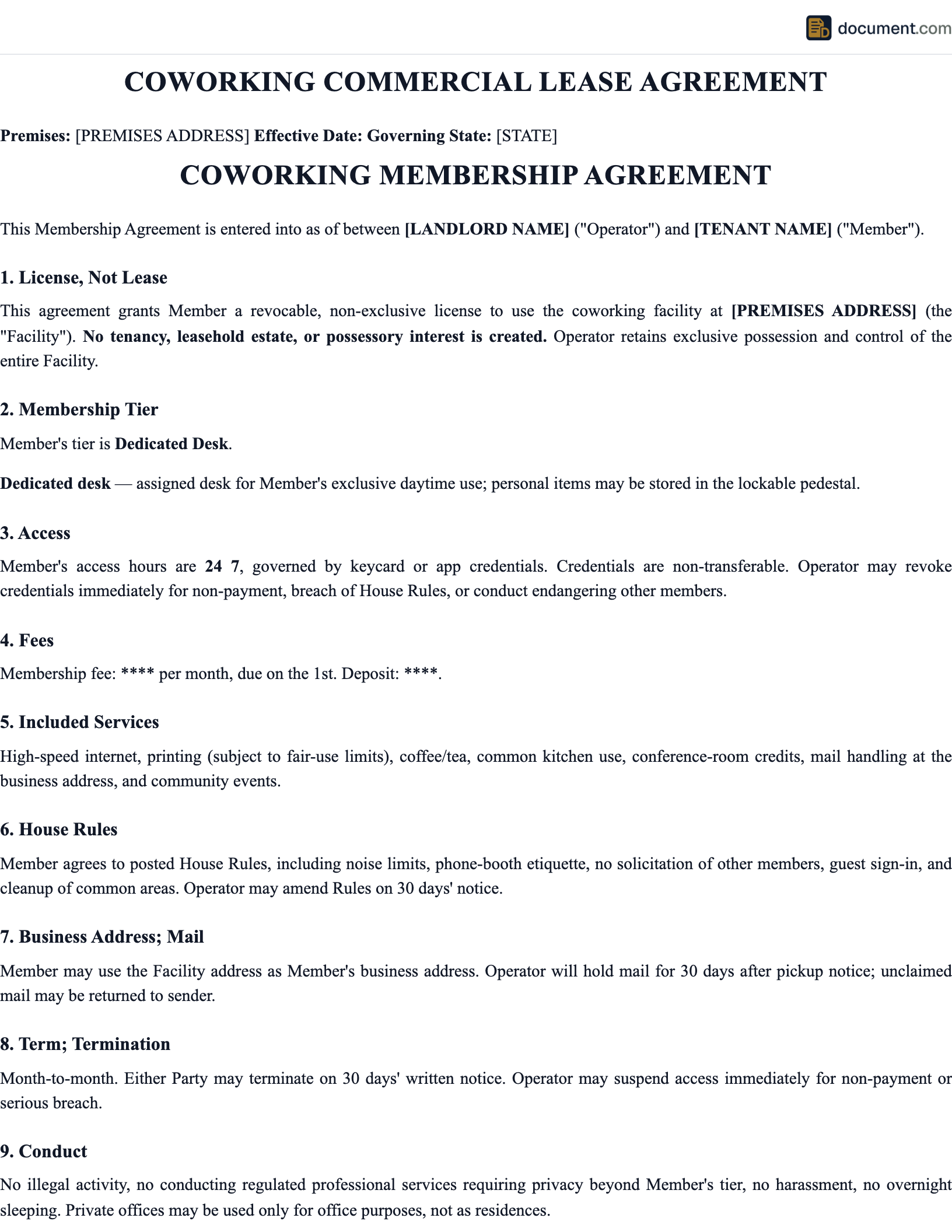
Sample Ohio Coworking Space Lease Agreement
Below is a preview of our Ohio-specific coworking space lease agreement. Your customized document will include all fields and provisions required under OH law.
COWORKING SPACE LEASE AGREEMENT
STATE OF OHIO
OH-Compliant Template
PARTY A:
Name: [Full Legal Name]
Address: [Ohio Address]
PARTY B:
Name: [Full Legal Name]
Address: [Ohio Address]
PROPERTY / PREMISES:
Address: [Property Address]
County: [Ohio County]
OHIO COMPLIANCE
This document complies with Ohio (OH) state law requirements and includes all provisions mandated for this type of document in Ohio.