



North Carolina Coworking Space Lease Agreement Overview
North Carolina's coworking market has grown substantially alongside the state's broader commercial real estate expansion, driven by rapid in-migration, corporate relocations to Charlotte and the Research Triangle, and a startup and freelance professional community that values flexibility over long-term lease commitments. Charlotte's coworking scene has concentrated in the South End, Uptown, and NoDa neighborhoods, catering to fintech companies, financial services consultants, and creative professionals. Raleigh and Durham's market is shaped by the Research Triangle's academic and startup ecosystem, with several spaces specifically serving biotech entrepreneurs, software developers, and university spinout companies.
North Carolina has no coworking-specific statute. Membership agreements are governed by contract law, and the state's commercial landlord-tenant framework provides minimal mandatory protections for members. This means the membership agreement itself determines everything from cancellation rights to deposit return conditions. North Carolina's business-friendly legal environment lets operators structure favorable agreements, which is why reading the full terms before signing is particularly important for NC members who cannot rely on statutory protections to fill gaps in the contract.
NC
State-specific
Varies
Filing fees
Written
Required format
Contract
Law governs
North Carolina Legal Requirements
Coworking membership agreements in North Carolina are governed by contract law. Month-to-month memberships do not trigger the state's statute of frauds writing requirement, but written agreements are essential for any arrangement to protect both parties from disputes about cancellation terms, deposit return conditions, and what amenities were promised.
Auto-Renewal and Cancellation Notice in NC Coworking Agreements
North Carolina coworking agreements commonly include auto-renewal clauses that roll memberships into new terms unless written notice is given within a specific window before the renewal date. Missing this window by even a few days can commit you to another full term. Set a calendar reminder well in advance of your renewal date, and confirm in writing with the operator if you intend to cancel rather than relying on a verbal conversation.
Core Agreement Requirements
- Membership Tier Definition: Specify exactly which amenities are included at each tier: hot desk, dedicated desk, or private office, along with meeting room credits and after-hours access rights
- Internet and Tech Infrastructure: Document the guaranteed bandwidth, network type, and what happens during extended outages; critical for Research Triangle tech members with heavy connectivity requirements
- Cancellation Notice Period: Confirm the written notice requirement; Charlotte and Raleigh operators typically require 30 days for month-to-month and 60 to 90 days for committed terms
- Deposit Return Terms: NC has no statutory deposit return deadline for commercial arrangements; the agreement controls entirely; push for a 30-day itemized return obligation
- Rate Change Notice: Confirm how much notice the operator must give before increasing membership rates for month-to-month agreements; 30 days written notice is a reasonable minimum
- ADA Compliance: Confirm the space and common areas meet ADA Title III requirements; NC coworking spaces as places of public accommodation must provide reasonable accommodations to members with disabilities
How to Execute a North Carolina Coworking Agreement
North Carolina coworking agreements are typically signed online through the operator's membership platform. The simplicity of the signing process does not reduce the binding legal effect of what you agree to.
Tour During Peak Hours and Test the Connection
Visit the space on a weekday during normal business hours to assess actual noise levels, internet performance, meeting room availability, and HVAC comfort. Charlotte's summer heat and Raleigh-Durham's humidity make building cooling an important practical consideration for daily comfort.
Read the Full Agreement Including Linked Documents
Print or save the full agreement and any linked house rules, acceptable use policies, or privacy notices at the time of signing. NC operators can update linked documents, and having a contemporaneous copy protects you if terms change after you sign.
Assess Tech Requirements for Your Industry
Research Triangle members in life sciences, defense contracting, or financial services often have data security and confidentiality requirements that shared coworking environments may not fully support. Assess network segmentation options, visitor access restrictions, and any compliance requirements before committing.
Confirm Deposit Return Terms Before Signing
North Carolina has no statutory deadline for returning commercial deposits. If the agreement is silent on return timing, push for an amendment or addendum specifying a 30-day return period with itemized deductions. This is especially important for private office memberships where the deposit may be two or more months of fees.
Set Calendar Reminders for Cancellation Deadlines
Immediately after signing, set calendar reminders at least two months before any auto-renewal date. NC coworking agreements are binding contracts, and missing the cancellation window means committing to another full term regardless of whether the space continues to meet your needs.
North Carolina Tax Implications for Coworking Members
North Carolina's tax treatment of coworking membership fees is relatively straightforward compared to states with commercial rent taxes or gross receipts taxes on lease payments.
| Tax or Cost Item | Details |
|---|---|
| No Commercial Rent Tax | NC does not impose a commercial rent tax or gross receipts tax on coworking membership fees; straightforward treatment compared to states like New Mexico or New York |
| Membership Fee Deductibility | Coworking fees are generally deductible as ordinary business expenses for federal and NC state income tax; NC's declining corporate income tax rate improves after-tax economics for business tenants |
| Meeting Room and Service Fees | Overage charges for meeting rooms and additional services are also deductible business expenses; track separately from base membership fees for tax documentation |
| NC Business Address Nexus | Using a North Carolina coworking address as your business's registered address may create NC tax nexus; consult a CPA if your business operates primarily outside NC but uses an NC coworking address |
Important Considerations for North Carolina Coworking Members
Charlotte and Raleigh-Durham's fast growth means that the coworking market is still maturing. Some operators have expanded aggressively and may face financial pressures if occupancy softens. Before committing to a longer-term membership, assess the operator's financial stability by asking how long they have been in operation at the specific location, what their current occupancy level is, and whether they own or sublease the building. Operators who sublease from a building owner are exposed to the risk of the master lease terminating, which would affect member access.
The Research Triangle coworking market has developed some specialized niche operators that cater specifically to life sciences, defense, and university spinout companies. These specialized spaces often have amenities like secure meeting rooms, network segregation, and event programming that generic coworking spaces do not offer. If your work involves sensitive research, government contracts, or IP-sensitive development, a specialized operator may be worth a premium over a generic coworking chain.
Charlotte's South End neighborhood has become one of the most active coworking corridors in the Southeast, with multiple operators competing for members in a concentrated area. That competition gives Charlotte South End members meaningful leverage to negotiate pricing and terms. Compare at least two or three operators in your target neighborhood before committing, and use competing offers as a negotiating tool if you prefer one space but another is offering better terms.
Sample North Carolina Coworking Space Lease Agreement
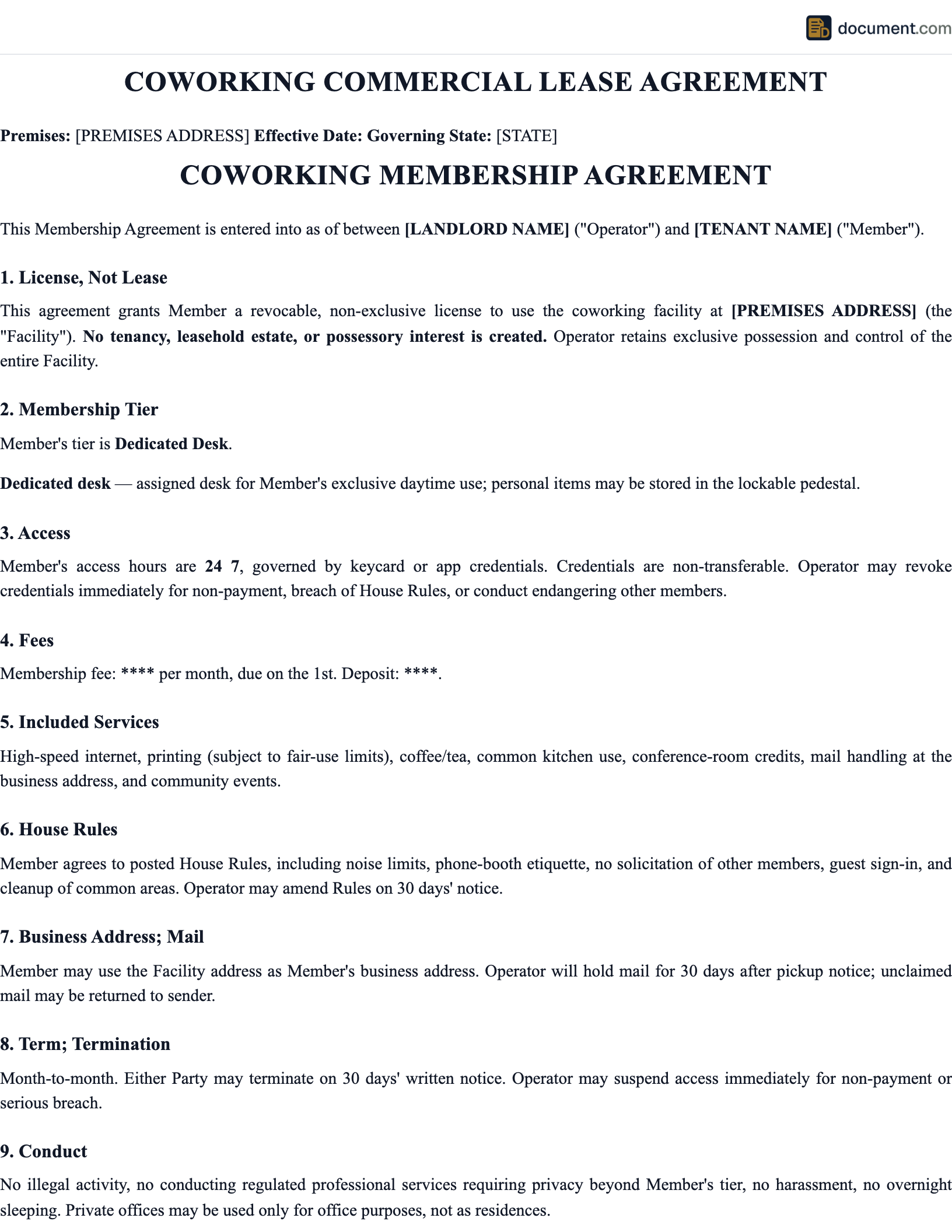
Below is a preview of our North Carolina-specific coworking space lease agreement. Your customized document will include all fields and provisions required under NC law.
COWORKING SPACE LEASE AGREEMENT
STATE OF NORTH CAROLINA
NC-Compliant Template
PARTY A:
Name: [Full Legal Name]
Address: [North Carolina Address]
PARTY B:
Name: [Full Legal Name]
Address: [North Carolina Address]
PROPERTY / PREMISES:
Address: [Property Address]
County: [North Carolina County]
NORTH CAROLINA COMPLIANCE
This document complies with North Carolina (NC) state law requirements and includes all provisions mandated for this type of document in North Carolina.