



New York Coworking Space Lease Agreement Overview
New York City has one of the world's largest concentrations of coworking spaces, and the market operates at a complexity level that reflects the broader NYC commercial real estate environment. The major national operators have substantial Manhattan footprints, but the city also has a deep ecosystem of boutique and neighborhood-specific coworking spaces in Brooklyn, Queens, and the Bronx that cater to creative industries, tech startups, and local small businesses. Upstate New York cities like Buffalo, Albany, and Syracuse have smaller but active coworking markets that operate at a fraction of the cost and with far simpler agreement terms.
New York has no coworking-specific statute. NYC coworking agreements are governed by contract law and, depending on how the arrangement is structured, may implicate the commercial landlord-tenant provisions of the Real Property Law. The NYC Commercial Rent Tax affects the underlying building lease rather than individual member agreements, but operators price their memberships to account for their CRT exposure. NYC's Human Rights Law applies to coworking spaces as places of public accommodation, providing broader disability accommodation and anti-discrimination protections than federal ADA alone.
NY
State-specific
Varies
Filing fees
Written
Required format
Contract
Law governs
New York Legal Requirements
New York's statute of frauds requires commercial leases exceeding one year to be in writing. Most NYC coworking agreements for committed terms of one year or more satisfy this automatically, since operators use written membership agreements. Month-to-month arrangements also benefit from written terms even though not strictly required, given NYC's complex dispute resolution environment.
Auto-Renewal and Deposit Return in NYC
NYC coworking agreements commonly include auto-renewal provisions that roll month-to-month or annual memberships into new terms unless the member gives advance written notice. Some operators set the cancellation window at 30 to 60 days before renewal, and members who miss the window are locked into another term. Read the agreement's renewal and cancellation provisions carefully. Also confirm the deposit return timeline: NYC law does not specify a return deadline for commercial security deposits, so the agreement controls entirely.
Core Agreement Requirements
- Membership Tier and Space Rights: Specify precisely whether the membership is hot desk, dedicated desk, or private office, and define any territorial limitations on where the member can work within the space
- Data Security and Network Terms: NYC members in regulated industries need clarity on network segmentation, shared infrastructure policies, and the operator's liability in a breach scenario
- Meeting Room Credits and Booking Rules: Document included meeting room hours, overage pricing, advance booking windows, and cancellation policies for unused reservations
- Cancellation Notice Period: NYC agreements typically require 30 days written notice for month-to-month and 60 to 90 days for committed terms; confirm what happens if notice arrives one day late
- NYCHRL Accommodation Rights: NYC's Human Rights Law requires operators to engage in an interactive process for disability accommodation requests; confirm how the operator handles such requests
- Sublicensing Restrictions: Many NYC coworking agreements prohibit members from sublicensing their access to third parties; confirm the guest policy and any team member add-on pricing structure
How to Execute a New York Coworking Agreement
NYC coworking agreements are signed online in most cases, which makes it easy to click through without reading carefully. That ease of execution does not reduce the binding legal effect of what you agree to.
Compare Multiple NYC Operators Before Committing
NYC has enough coworking operators that competitive comparison is worthwhile. Evaluate not just monthly price but meeting room allotment, network reliability, the specific neighborhood and transit access, community fit, and whether the operator has a track record of building stability. Several large NYC coworking operators have had significant financial difficulties, so operator financial stability matters alongside amenity quality.
Read the Full Agreement and All Linked Documents
NYC coworking membership agreements often incorporate by reference house rules, acceptable use policies, and privacy notices that live on the operator's website and can change. Print or save these documents at the time of signing so you have a contemporaneous record of what terms you agreed to. Pay special attention to the renewal provision, price change notice period, deposit return timeline, and early termination fees.
Assess Data Security for Your Specific Industry
NYC's high concentration of financial services, legal, healthcare, and government contract work means many coworking members have specific data handling obligations under FINRA, HIPAA, or federal contractor rules. Assess whether the space's shared network architecture and visitor access policies are compatible with your confidentiality obligations before signing, not after.
Negotiate Deposit Terms and Return Conditions
NYC has no statutory deposit return deadline for commercial coworking arrangements. The agreement's terms control completely. Push for a defined return period of 30 days after move-out, and specify that deductions must be itemized in writing. For larger private office deposits, ask whether the deposit can be held in a segregated account rather than the operator's general operating account.
Document Your Space at Move-In and Set Calendar Reminders for Renewal Dates
Photograph the condition of your dedicated desk or private office at move-in. Set calendar reminders well in advance of your membership renewal or cancellation deadline. Missing a NYC coworking cancellation window by even a few days can lock you into another full term with no statutory right to exit early.
New York Tax Implications for Coworking Members
New York City's tax environment adds some complexity that coworking members should understand, particularly around how the CRT affects operator pricing and how membership fees are treated as business expenses.
| Tax or Cost Item | Details |
|---|---|
| NYC Commercial Rent Tax (Indirect) | CRT applies to the operator's underlying building lease in Manhattan south of 96th Street; operators price memberships to cover this cost; members pay it indirectly through elevated rates |
| Membership Fee Deductibility | Coworking membership fees are generally deductible as ordinary and necessary business expenses for federal and NY state income tax; retain monthly invoices as documentation |
| NYC Business Tax | Businesses operating in NYC may be subject to NYC business income taxes in addition to NY state taxes; confirm whether using a NYC coworking address creates any nexus for NYC tax purposes |
| Meeting Room and Overage Charges | Additional charges for meeting rooms and services beyond base membership are deductible business expenses; track them separately for tax documentation purposes |
Important Considerations for New York Coworking Members
The NYC coworking market went through a significant correction after several large national operators encountered financial difficulties. The lesson for members is that operator stability matters as much as amenities and price. A financially stressed operator may cut services, change terms unilaterally, or close locations with minimal notice. Ask about the operator's lease structure for the underlying space, how long they have been operating the specific location, and whether they have contingency plans for location closure before committing to a longer-term membership.
For professionals in regulated industries, NYC's dense professional community creates specific coworking considerations. Attorneys working in coworking spaces must protect client confidentiality in shared environments. Financial professionals must comply with data security requirements. Healthcare professionals must ensure HIPAA compliance in shared spaces. The agreement should be evaluated not just for its commercial terms but for whether the physical and network environment is consistent with your professional obligations.
NYC coworking members who eventually graduate to a traditional office lease will find the transition significant. Traditional NYC office leases require multi-year commitments, detailed TI negotiations, personal guarantees, and a negotiation process that can take months. Start exploring traditional lease options six to twelve months before you actually need to be out of coworking, not six weeks before. Many NYC tenant brokers offer free consultations that can help you understand the timeline and what to expect from a traditional lease negotiation.
Sample New York Coworking Space Lease Agreement
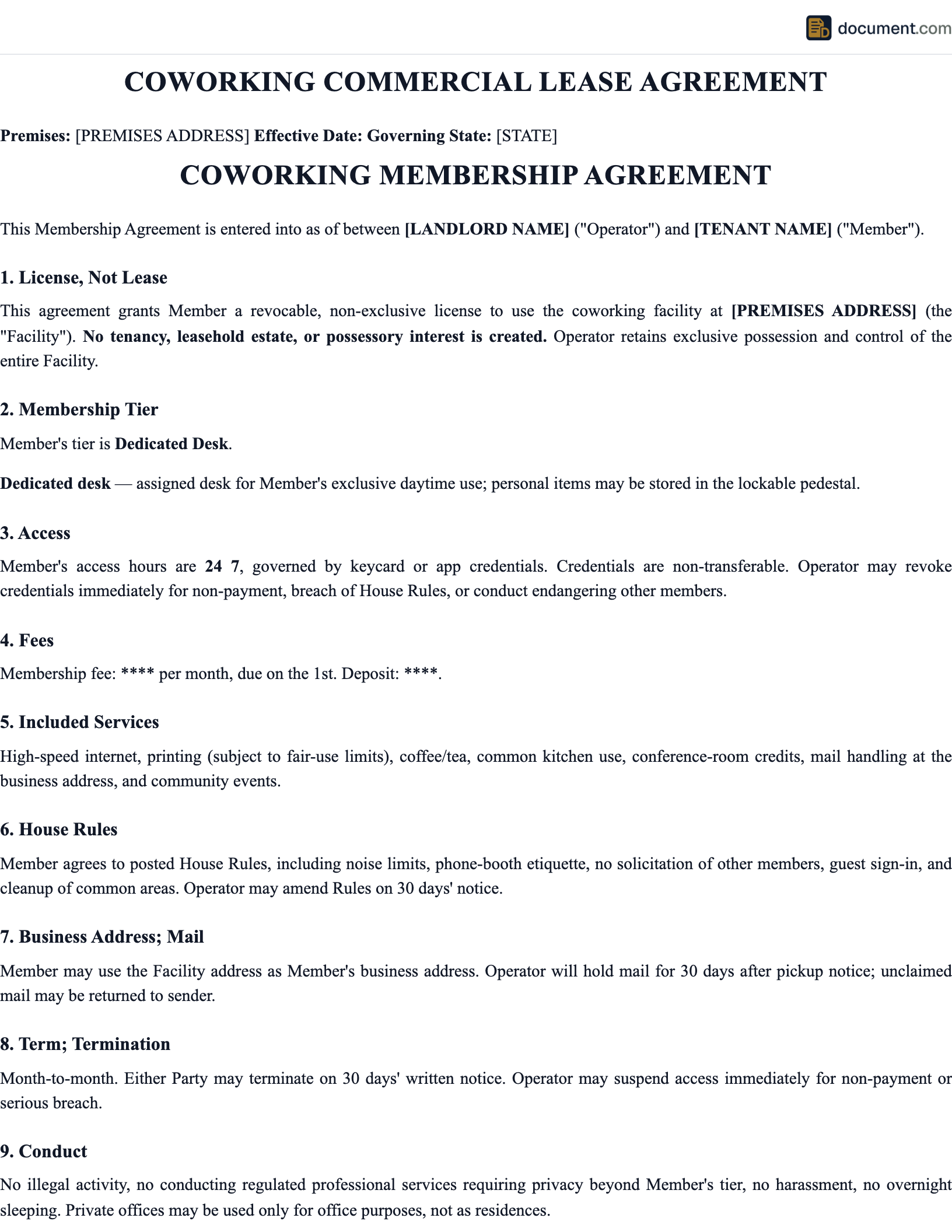
Below is a preview of our New York-specific coworking space lease agreement. Your customized document will include all fields and provisions required under NY law.
COWORKING SPACE LEASE AGREEMENT
STATE OF NEW YORK
NY-Compliant Template
PARTY A:
Name: [Full Legal Name]
Address: [New York Address]
PARTY B:
Name: [Full Legal Name]
Address: [New York Address]
PROPERTY / PREMISES:
Address: [Property Address]
County: [New York County]
NEW YORK COMPLIANCE
This document complies with New York (NY) state law requirements and includes all provisions mandated for this type of document in New York.