
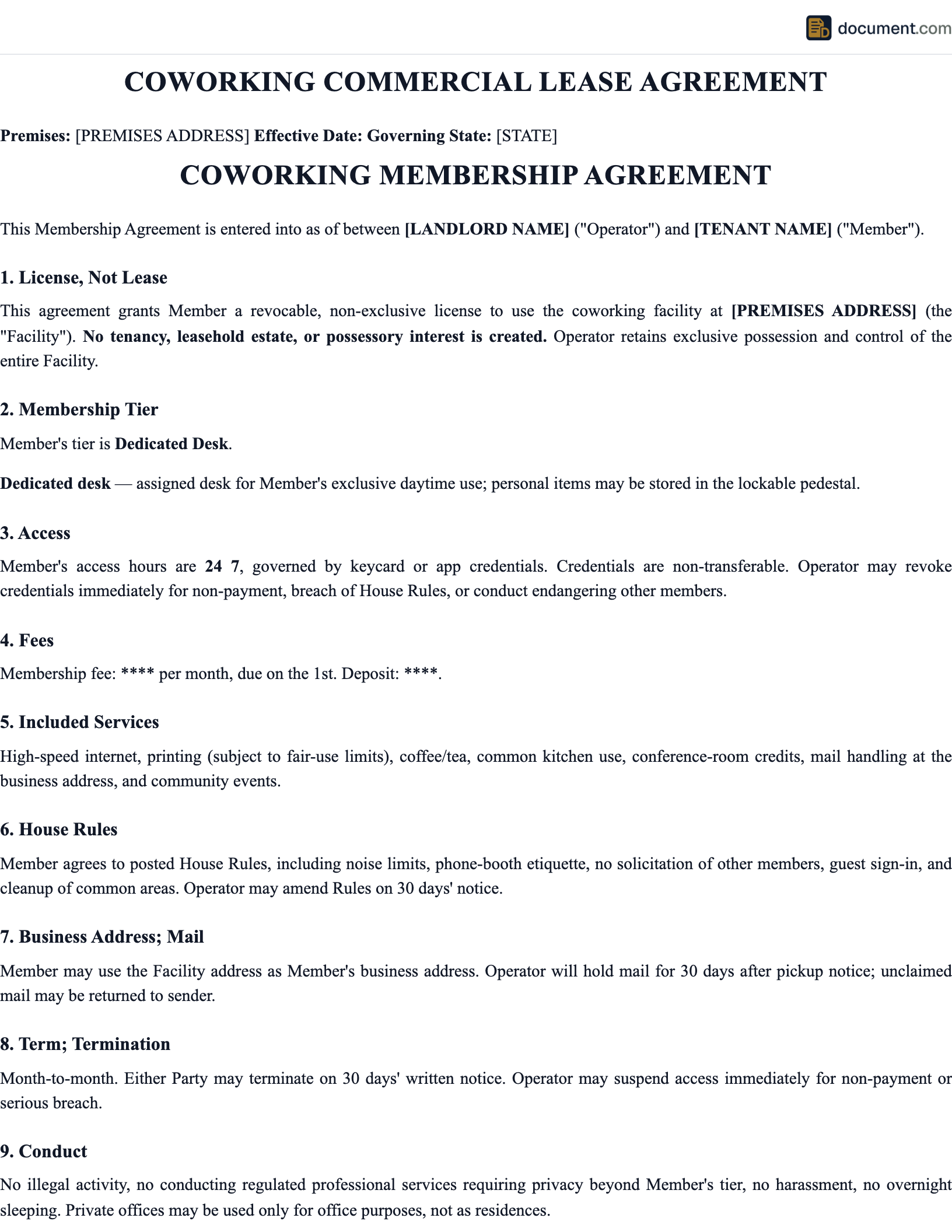



New Jersey Coworking Space Lease Agreement Overview
New Jersey has developed into one of the most active coworking markets outside of New York City, driven by the state's dense population, strong NJ Transit and PATH rail network, and the growing number of professionals working remotely from the New York metro area. The Hudson waterfront corridor (Jersey City, Hoboken) functions as a high-density coworking market with pricing that approaches Manhattan rates. Suburban markets throughout Morris County, Middlesex County, Mercer County (Princeton), and the Southern NJ Philadelphia corridor offer coworking at prices well below the NYC metro premium while still serving well-educated professional workforces.
Coworking agreements in New Jersey are governed by general contract law and are typically structured as licenses rather than traditional leases. The distinction matters because a license conveys permission to use shared space without exclusive possession, giving operators more operational flexibility and giving members fewer statutory protections than a residential tenancy would provide. New Jersey's security deposit statute does not apply to commercial coworking arrangements, so deposit amounts, return timelines, and withholding conditions are entirely negotiated. Members should read the full membership agreement carefully, particularly the termination and fee provisions, before committing.
License
Typical structure
No cap
Deposit limit
NJ Transit
Key location driver
No
Sales tax on fees
New Jersey Legal Requirements for Coworking
New Jersey imposes no statutory framework specific to coworking membership agreements. The agreement document controls all material terms, which is why reading and negotiating the membership contract carefully matters significantly in New Jersey's high-cost markets.
New Jersey Coworking Note
New Jersey's residential security deposit statute (N.J.S.A. 46:8-19) does not apply to commercial coworking memberships. No NJ statute caps deposits, governs return timelines, or mandates disclosure formats for commercial coworking arrangements. Sales tax does not apply to NJ coworking fees. Transit access and parking provisions are especially important in Northern NJ markets.
Key Terms to Address in a New Jersey Coworking Agreement
- Membership tier definition: Clearly define whether the membership is hot desk (any available seat), dedicated desk (same seat reserved), or private office (exclusive enclosed space), and what this means for access rights and eviction risk
- Transit and parking provisions: Specify whether on-site parking is included, available for a separate fee, or not available; confirm visitor parking access for clients; Northern NJ operators near PATH or NJ Transit stations should address commuter parking specifically
- Deposit terms: No NJ statute governs coworking deposits; the agreement must specify deposit amount, return timeline (typically 30 days after membership end), and permissible withholding conditions
- Internet and tech infrastructure: Specify minimum bandwidth, provider identity, uptime commitment, and remedies if connectivity fails for extended periods; fiber access is standard in Jersey City and Hoboken facilities
- Termination notice: Define notice requirements and penalties; month-to-month memberships typically require 30 days notice, while committed-term private offices often carry termination penalties equal to remaining months
- Business address authorization: Confirm whether the operator permits use of the coworking address for NJ Division of Revenue business registration and client correspondence
How to Find and Join a New Jersey Coworking Space
Selecting and signing a New Jersey coworking membership involves key steps that reflect the state's unique transit-oriented market dynamics.
Choose the Right NJ Submarket
Identify the submarket based on commuting patterns: Jersey City and Hoboken for NYC-adjacent workers who want PATH or NJ Transit access; Morristown and Parsippany for Morris County commuters; Princeton for Mercer County and pharma corridor workers; Cherry Hill and Marlton for South Jersey Philadelphia-area professionals. Pricing, amenities, and community vary substantially across these markets.
Assess Transit Access and Parking
Visit the location during your actual commute time to test the walk or drive from your transit station. Confirm whether parking is included, available for a fee, or scarce. In Jersey City and Hoboken, parking is often a separate and significant cost; in suburban NJ locations, it is typically included. Ask about visitor parking for clients specifically if you plan to host meetings regularly.
Review the Full Membership Agreement
Read the complete agreement before signing. Focus on deposit terms (amount, return timeline, withholding conditions), early termination penalties, guest and conference room policies, internet SLA, fee escalation provisions, and whether the address can be used for NJ Division of Revenue business registration. Ask for the member handbook if it is incorporated by reference into the agreement.
Test the Infrastructure
Run speed tests at the facility during peak hours. Confirm the provider and connection type (fiber vs cable). Ask about backup connectivity if the primary connection fails. In Northern NJ facilities where members are conducting financial, legal, or tech work, gigabit fiber is increasingly standard; do not accept shared cable with no guaranteed minimum bandwidth for mission-critical work.
Sign and Register
Sign the membership agreement, pay the deposit and first month's fee, and obtain your access credentials. If using the address for NJ business registration, update the entity address with the New Jersey Division of Revenue and Enterprise Services. Keep a copy of the signed membership agreement and any addenda for your records.
Tax Implications for New Jersey Coworking Members
New Jersey's tax environment for coworking members is more complex than many states because of the state's high income tax rates and significant operating costs. Understanding what is and is not taxed affects how members budget coworking costs.
New Jersey does not impose sales tax on coworking membership fees. The NJ sales tax (6.625 percent) applies to many tangible goods and certain services, but commercial space use including coworking memberships is not subject to state sales tax. This is meaningfully different from New York City, which imposes a commercial rent tax on occupied space in certain boroughs. NJ coworking members pay only the stated membership fee without an added tax layer on the transaction itself.
For business entities, coworking membership fees are deductible as ordinary and necessary business expenses against New Jersey Corporation Business Tax (9 percent for corporations) and federal income tax. Individual members operating as sole proprietors or single-member LLCs can deduct coworking fees on their Schedule C against New Jersey gross income tax, which has rates ranging from 1.4 to 10.75 percent depending on income level. The deductibility effectively reduces the after-tax cost of coworking by 30 to 40 percent for most NJ business operators, depending on their combined state and federal marginal rates.
Typical New Jersey Coworking Membership Costs
New Jersey coworking pricing spans a wide range depending on proximity to New York City. Hudson waterfront markets price near Manhattan levels; suburban NJ markets price substantially lower. No sales tax applies to membership fees.
| Membership Type | Jersey City / Hoboken | Suburban NJ |
|---|---|---|
| Hot Desk | $250 - $450/month | $150 - $300/month |
| Dedicated Desk | $450 - $750/month | $300 - $500/month |
| Private Office (1-4 persons) | $1,200 - $2,500+/month | $500 - $1,500/month |
| Day Pass | $40 - $75/day | $25 - $50/day |
| Security Deposit | 0 - 2 months; no statutory cap under NJ law | |
| Sales Tax on Fees | None (NJ does not impose sales tax on commercial space use) | |
Sample New Jersey Coworking Space Lease Agreement
Below is a preview of our New Jersey-specific coworking space lease agreement. Your customized document will include all fields and provisions required under NJ law.
COWORKING SPACE LEASE AGREEMENT
STATE OF NEW JERSEY
NJ-Compliant Template
PARTY A:
Name: [Full Legal Name]
Address: [New Jersey Address]
PARTY B:
Name: [Full Legal Name]
Address: [New Jersey Address]
PROPERTY / PREMISES:
Address: [Property Address]
County: [New Jersey County]
NEW JERSEY COMPLIANCE
This document complies with New Jersey (NJ) state law requirements and includes all provisions mandated for this type of document in New Jersey.