



New Hampshire Coworking Space Lease Agreement Overview
New Hampshire has emerged as one of the more interesting coworking markets in New England, driven by a combination of remote work migration from Massachusetts and the state's structural tax advantages. Portsmouth's Market Street and downtown core have seen coworking operators open to serve an influx of knowledge workers who relocated from the Boston area but still need professional workspace. Manchester, the largest city, has broader office inventory and a growing startup ecosystem anchored by Alpha Loft and similar organizations, which have seeded demand for flexible professional space.
Coworking agreements in New Hampshire are governed by general contract law. Most are structured as licenses rather than leases, which means members do not receive the same possession rights as traditional tenants. This structure works in both parties favor for flexibility, but it also means the agreement document carries nearly all the weight: there are no statutory protections on deposit amounts, no mandatory notice periods for membership termination, and no required amenity standards. Understanding what is and is not negotiable is essential before signing.
None
Income tax
None
Sales tax on fees
License
Typical structure
No cap
Deposit limit
New Hampshire Legal Requirements
New Hampshire imposes no statutory framework specific to coworking or commercial flexible space agreements. The parties are free to negotiate all terms, which means the agreement document needs to address everything that matters: deposit handling, amenity availability, guest policies, internet uptime commitments, and access hours.
New Hampshire Coworking Note
New Hampshire has no income tax on wages and no sales tax, so coworking fees are not subject to state sales tax. There is no statutory cap on security deposits for commercial arrangements. Most coworking agreements are structured as licenses, not leases, giving members limited eviction protections but also more flexibility to exit with shorter notice periods.
Key Terms to Address in the Agreement
- Membership tier and access rights: Define whether the membership is hot desk (any available seat), dedicated desk (same seat every day), or private office (exclusive enclosed space), and what hours access is permitted
- Internet and tech infrastructure: Specify minimum bandwidth, provider, uptime commitment, and what happens if connectivity fails for extended periods; fiber access is a meaningful differentiator in NH markets
- Conference room inclusion: Clarify whether meeting rooms are included in the base fee or billed separately per hour, and how far in advance bookings must be made
- Deposit and return terms: No NH statute governs commercial deposits; the agreement must specify the deposit amount, return timeline, and permissible withholding conditions
- Early termination rights: Define notice requirements (typically 30 days for month-to-month, longer for committed terms) and any termination penalties; NH law does not limit commercial termination fees
- Business address use: Confirm whether the operator permits use of the coworking address for NH Secretary of State registration and client correspondence
How to Find and Sign a Coworking Agreement in New Hampshire
Selecting and signing a New Hampshire coworking agreement involves a few distinct steps that differ from traditional office leasing, particularly given the state's tax positioning.
Identify the Right Location and Tier
Decide whether Portsmouth (Seacoast access, boutique operators), Manchester (larger facilities, stronger startup community), or a southern NH location (Nashua, Salem) best serves your team's commuting patterns and the income tax planning goals of your employees. Match the membership tier (hot desk, dedicated desk, private office) to how the space will actually be used day to day.
Assess the Tech Infrastructure
Ask the operator for the ISP name, connection type (fiber vs cable), and total bandwidth in the facility. Visit during peak hours to test the actual speeds. Confirm whether conference rooms have separate AV connections or rely on the shared network. For members planning to conduct video calls with large files, fiber with at least 200 Mbps symmetrical is the practical minimum.
Review the Membership Agreement
Read the full agreement before signing. Confirm deposit terms, notice periods for cancellation, guest policy, conference room allocation and overage pricing, and whether the address can be used for business registration with the NH Secretary of State. Ask for the member handbook if amenity policies are incorporated by reference rather than stated in the agreement itself.
Confirm the Tax Situation
If establishing NH work presence is part of your tax planning, verify with a tax advisor that your actual work pattern qualifies for NH income tax treatment versus Massachusetts. The coworking location, membership agreement, and your work calendar will all factor into any audit. A coworking membership alone does not establish NH residency for tax purposes.
Sign and Register
Sign the membership agreement, pay the deposit and first month's fee, and obtain access credentials. If using the address for business purposes, register it with the NH Secretary of State and update your registered agent information. Keep a copy of the signed agreement and any addenda; these may be requested by lenders or clients who need to verify your business address.
Tax Implications for New Hampshire Coworking Members
New Hampshire's tax profile is genuinely unusual in New England, and understanding it correctly matters for both coworking operators setting prices and members deciding how to structure their arrangements. The state levies no personal income tax on wages and no general sales tax, which means coworking membership fees are not subject to any state or local sales tax burden on the member side.
For businesses, the Business Profits Tax applies at 8.5 percent on net income for entities with more than $50,000 in gross income, and the Business Enterprise Tax applies at 0.55 percent on enterprise value for those with more than $250,000 in gross receipts. Coworking fees paid by a business entity are fully deductible as ordinary and necessary business expenses against both BPT liability and federal taxable income.
The more significant tax issue for many NH coworking members is the Massachusetts border question. Workers employed by Massachusetts companies who work from New Hampshire are subject to Massachusetts income tax only on days they actually work in Massachusetts. Genuine NH workdays at a coworking facility reduce Massachusetts tax exposure dollar-for-dollar. However, the Massachusetts Department of Revenue has aggressively audited this position, and members should document their actual NH workdays carefully. A coworking membership is supporting evidence of NH presence, but it is not conclusive on its own.
Typical New Hampshire Coworking Membership Costs
Coworking pricing in New Hampshire is generally lower than Boston or Cambridge, though Portsmouth commands a modest premium within the state due to its desirability and limited inventory. No sales tax applies to any of these fees.
| Membership Type | Typical Monthly Cost (NH) |
|---|---|
| Hot Desk (open seating) | $150 - $300/month |
| Dedicated Desk (reserved seat) | $300 - $500/month |
| Private Office (1-4 persons) | $500 - $1,400/month |
| Day Pass | $25 - $50/day |
| Security Deposit | 0 - 2 months (no statutory cap) |
| Sales Tax on Fees | None (NH has no general sales tax) |
Sample New Hampshire Coworking Space Lease Agreement
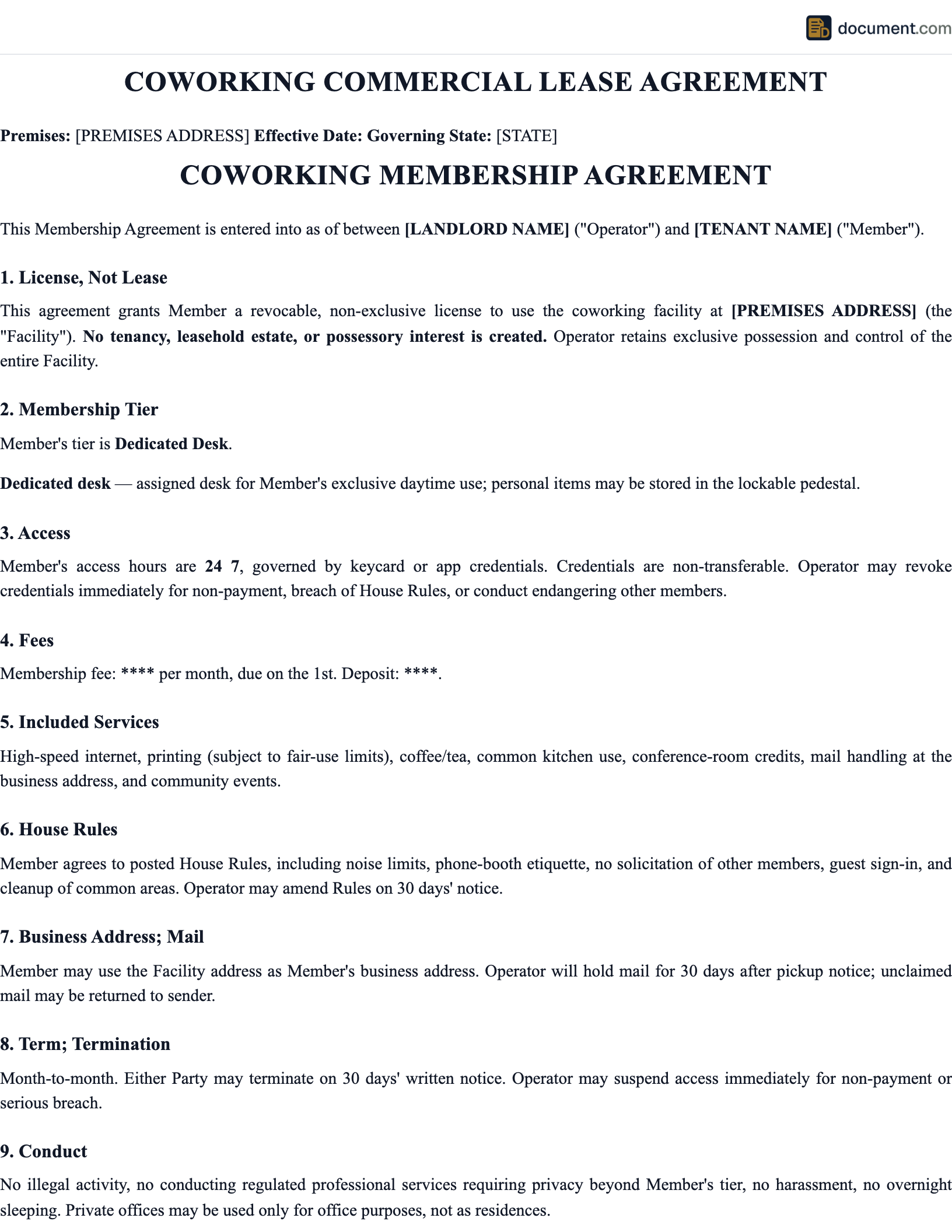
Below is a preview of our New Hampshire-specific coworking space lease agreement. Your customized document will include all fields and provisions required under NH law.
COWORKING SPACE LEASE AGREEMENT
STATE OF NEW HAMPSHIRE
NH-Compliant Template
PARTY A:
Name: [Full Legal Name]
Address: [New Hampshire Address]
PARTY B:
Name: [Full Legal Name]
Address: [New Hampshire Address]
PROPERTY / PREMISES:
Address: [Property Address]
County: [New Hampshire County]
NEW HAMPSHIRE COMPLIANCE
This document complies with New Hampshire (NH) state law requirements and includes all provisions mandated for this type of document in New Hampshire.