



Montana Coworking Space Lease Agreement Overview
Montana has become an unlikely hotspot for flexible workspace demand. The remote work transformation brought thousands of professionals to Bozeman and Missoula who wanted to maintain professional work environments without committing to traditional long-term office leases. Coworking operators have responded by opening facilities in downtown Bozeman, the University District in Missoula, and adjacent communities like Whitefish and Kalispell. The market is younger and less saturated than coastal cities, which means both members and operators are still working through what the standard agreement looks like in Montana.
From a legal standpoint, Montana treats coworking agreements as commercial contracts. There is no special regulatory category for coworking, no state licensing requirement for operators, and no statutory protections for members beyond what the contract provides. Montana's no-sales-tax environment is a genuine advantage, as monthly membership fees are not subject to any state sales tax. Internet reliability is the practical issue that differentiates good and bad coworking agreements in Montana: operators should specify bandwidth commitments and redundancy provisions, and members should understand their remedies if connectivity falls below the stated standard.
MT
State-specific
Varies
Filing fees
Written
Required format
Contract
Law governs
Montana Legal Requirements
Montana does not have a dedicated coworking statute. Agreements are enforced under general contract principles. The legal framework favors well-drafted agreements over statutory protections, which means both operators and members bear responsibility for making sure the contract says what they intend.
Montana Important Note
Montana has no sales tax on coworking memberships and no statutory security deposit cap for commercial agreements. There are also no mandatory cooling-off periods or consumer-protection rules that apply to business tenants. Members who are sole proprietors or freelancers should be aware that they are treated as commercial parties in Montana, not consumers, and have limited statutory recourse if the agreement is unfavorable.
Key Provisions for Montana Coworking Agreements
- Written Form: Required by Montana statute of frauds if the term exceeds one year; strongly recommended for all durations
- Internet and Tech Infrastructure: Specify guaranteed bandwidth, redundancy (fiber plus failover), and remedies for outages; critical for Montana remote-worker members
- Shared Amenity Access: Define which amenities are included in the base fee, which require separate booking, and what happens if an amenity is temporarily unavailable
- Termination Notice: Month-to-month memberships should state the required notice period; longer terms should address early termination fees and buyout rights
- Guest and Visitor Policies: Montana coworking operators set their own guest policies; these should be written into the agreement or incorporated by reference to house rules
- Parking: In downtown Bozeman and Missoula, parking is a real constraint; the agreement should specify whether parking is included and on what terms
How to Execute a Montana Coworking Agreement
Entering a coworking agreement in Montana is faster and simpler than a traditional office lease, but it still requires attention to the specific terms. Here is a practical sequence.
Tour the Space and Confirm Tech Infrastructure
Visit the coworking facility in person and test internet speeds, cell signal, and meeting room availability. In Montana's mid-size markets, fiber availability and redundancy vary building by building. Ask the operator to show you their internet service provider contract and any backup connectivity arrangement.
Choose Your Membership Tier and Term
Montana coworking operators typically offer hot desk, dedicated desk, and private office tiers. Month-to-month terms provide maximum flexibility and are common with the remote-worker population. Longer commitments, typically three to twelve months, usually come with a discount. Confirm what is included in each tier: meeting room credits, printing, mail services, and after-hours access matter differently depending on your use case.
Review the Membership Agreement Carefully
Read the full agreement, not just the pricing page. Montana operators may include liability waivers, guest restrictions, data privacy terms, and rules about the types of business activity permitted in the space. Some industries, including legal, financial advisory, and healthcare, may have client confidentiality requirements that affect whether a shared coworking environment is appropriate.
Confirm Zoning and Business License Compliance
If you have a Montana business license requirement tied to a physical address, confirm whether the coworking operator can serve as your registered address. Not all coworking facilities in Montana offer registered agent or mail services. Bozeman and Missoula have local business license requirements that may be tied to your location.
Sign and Pay the Deposit
Execute the agreement and pay the required deposit. Retain a fully signed copy of the agreement. If you are committing to a term longer than one month, note the cancellation and notice requirements so you can manage the relationship appropriately going forward.
Tax Implications for Montana Coworking Members
Montana's tax structure is favorable for coworking members. There is no state sales tax, so monthly membership fees are not subject to any Montana sales tax, unlike in states such as Arizona or Tennessee where commercial rental fees may be taxed. This reduces the effective cost of coworking by several percentage points compared to high-sales-tax states.
For businesses operating in Montana, coworking membership fees are generally deductible as ordinary business expenses for both Montana income tax and federal tax purposes. Montana does have a state income tax with rates up to 6.75%, so the deduction has real value. If the coworking space is a member's sole business location, there may be questions about the home office deduction under federal law, but the general rule is that coworking memberships are straightforward business expense deductions.
Remote workers who relocated to Montana and maintain coworking memberships should be aware that Montana will tax their income on a full-year basis once they establish domicile. The tax savings from no sales tax are partially offset by Montana's income tax, but the overall picture is still favorable compared to California or other high-tax origin states. A Montana CPA can help new residents understand their full tax picture.
Montana Fees & Costs
Below is a breakdown of typical costs associated with commercial lease transactions in Montana. Actual fees may vary by county and specific circumstances.
| Fee / Cost | Typical Amount |
|---|---|
| Document Preparation | $200 - $1,000 |
| Legal Review | $500 - $2,500 |
| Recording Fees (if applicable) | $25 - $150 |
| Notarization | $5 - $25 per signature |
| Title Search (if needed) | $200 - $500 |
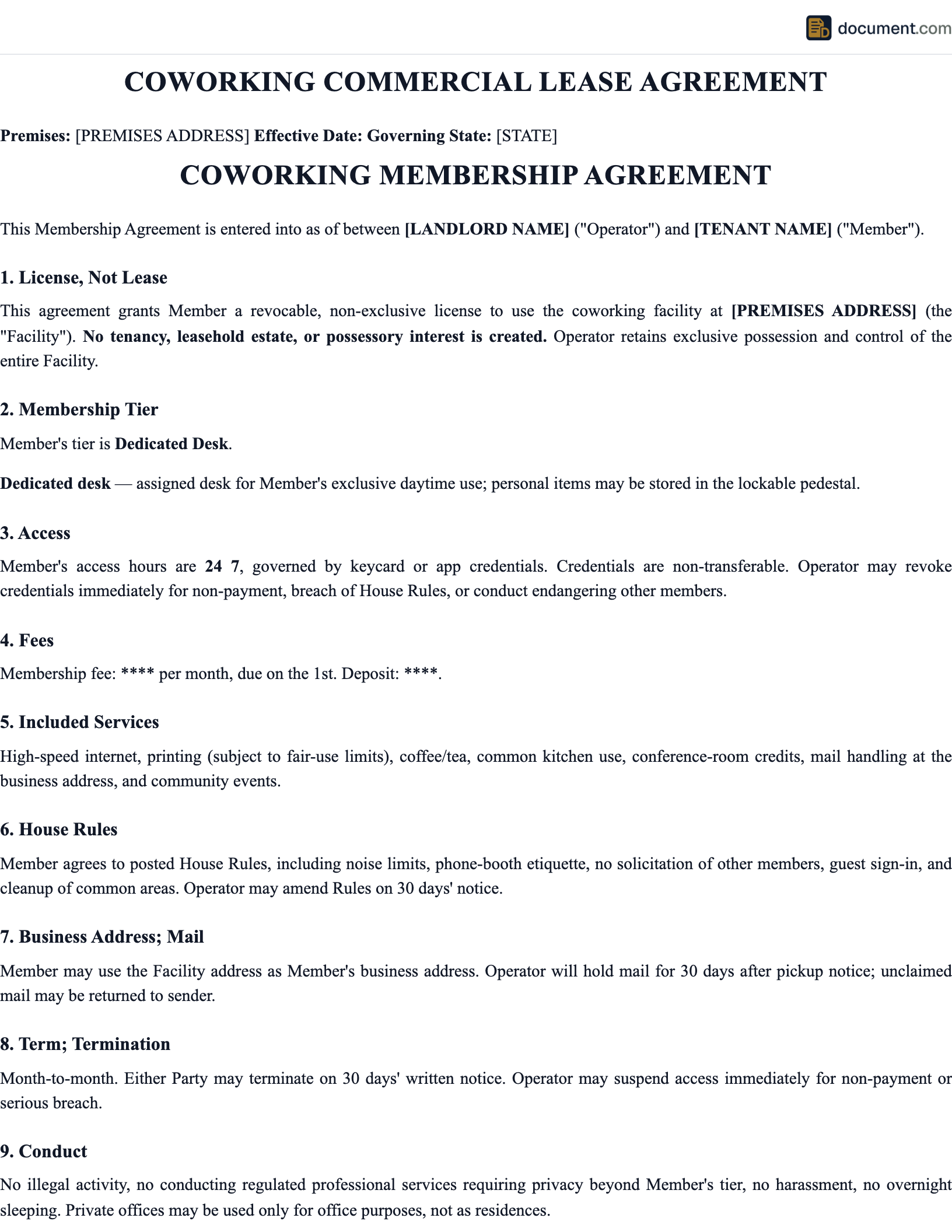
Sample Montana Coworking Space Lease Agreement
Below is a preview of our Montana-specific coworking space lease agreement. Your customized document will include all fields and provisions required under MT law.
COWORKING SPACE LEASE AGREEMENT
STATE OF MONTANA
MT-Compliant Template
PARTY A:
Name: [Full Legal Name]
Address: [Montana Address]
PARTY B:
Name: [Full Legal Name]
Address: [Montana Address]
PROPERTY / PREMISES:
Address: [Property Address]
County: [Montana County]
MONTANA COMPLIANCE
This document complies with Montana (MT) state law requirements and includes all provisions mandated for this type of document in Montana.