



Missouri Coworking Space Lease Agreement Overview
Missouri's coworking market is concentrated in Kansas City and St. Louis, with a distinct mix of national operators and well-established local independents in both cities. Kansas City's Crossroads Arts District has been a hub for creative and tech coworking, while the suburban Johnson County market serves the significant portion of the KC metro that works on the Kansas side. In St. Louis, Clayton offers the highest-quality coworking product for professional services and corporate users, while neighborhoods like Midtown Alley and Cherokee attract startups and creative businesses. Missouri coworking agreements are governed entirely by contract law — the state has no commercial tenant statute.
Missouri does not impose sales tax on commercial real property leases at the state level, which means coworking arrangements structured as real property leases benefit from lower all-in costs than in states that tax commercial rent. However, operators who bundle services with membership fees may face Missouri sales tax on the service components. Coworking agreements structured as licenses rather than leases avoid real property lease classification but give operators broader flexibility to terminate or modify the arrangement. Security deposits are unregulated for commercial arrangements — return conditions must be negotiated into the agreement explicitly.
None
State sales tax on rent
None
Deposit cap
Contract
Law governs
KC / STL
Primary markets
Missouri Legal Requirements
Missouri imposes no commercial tenant statute, so the written coworking agreement is the complete legal framework for the member. Missouri courts enforce clear contract terms as written.
License vs. Lease and Master Lease Risk
Most Missouri coworking agreements are structured as licenses, not leases, giving operators broader termination flexibility. If the operator holds the space under a master lease rather than owning the building, a master lease termination can end your access regardless of what your membership agreement says. In Kansas City and St. Louis markets, where coworking operators sometimes occupy large floor plates on short master leases, this risk is real. Ask the operator whether they own or lease the building before signing a long-term membership.
Key Provisions to Review
- License or lease characterization: Understand how the agreement is structured and what termination rights each party has under Missouri contract law
- Termination and notice: Identify the minimum notice each party must provide; negotiate the operator's termination rights to require cause or longer notice periods
- Rate lock or escalation cap: Confirm whether the rate is fixed for the term or adjustable; negotiate a cap on increases if month-to-month
- Amenity commitments in writing: List all included services and their specifications — internet speed, conference room credits, access hours — in the signed agreement
- Insurance requirements: Confirm required coverage types and limits before signing; obtain a certificate of insurance naming the operator as additional insured
- Registered agent eligibility: Confirm with the operator and the Missouri Secretary of State whether the coworking address qualifies for registered agent purposes before using it in business formation documents
How to Execute a Missouri Coworking Agreement
Missouri coworking agreements are private contracts. No government filing is required for a coworking membership to be binding.
Tour Options in Your Target Submarket
In Kansas City, compare Crossroads, Power and Light District, and suburban Johnson County options. In St. Louis, compare Clayton, Midtown Alley, and downtown options. Location affects commute patterns, parking costs, and whether your clients will find the address credible for your industry.
Read the Full Agreement and Ask About Sales Tax
Missouri does not tax commercial real property leases at the state level, but operators who bundle services may face sales tax on service components. Ask how the operator handles Missouri sales tax so you can compare all-in costs accurately across operators.
Arrange Required Insurance
Obtain a general liability certificate naming the operator as additional insured before your start date. Add personal property coverage for your equipment through a business owner's policy if you work with valuable technology.
Sign and Retain the Full Agreement
Execute the membership agreement and keep a signed copy with all attachments — fee schedule, house rules, amenity descriptions. Missouri courts enforce written terms; attachments incorporated by reference are part of the contract.
Test Access and Technology on Day One
Verify internet speeds, key card or fob access during your contracted hours, and conference room availability. Document discrepancies from what the agreement promises in writing immediately — it is easier to resolve issues before you are dependent on the space.
Missouri Coworking Cost Summary
Kansas City and St. Louis coworking rates are significantly below coastal markets, reflecting the general affordability of Missouri commercial real estate.
| Membership Type | Typical Monthly Rate |
|---|---|
| Hot desk (flexible) | $125 - $225/month |
| Dedicated desk | $250 - $400/month |
| Private office (1-2 people) | $500 - $900/month |
| Security deposit | Typically one month's fee; no statutory cap in Missouri |
| Missouri state sales tax | Not applicable to real property leases; may apply to bundled service components depending on operator structure |
Important Considerations
- Kansas City two-state complexity: If you need access to both the Missouri and Kansas sides of the KC metro, confirm the operator's access policy if they have multiple locations. Some operators have both Missouri and Kansas locations that are accessible under a single membership.
- St. Louis City earnings tax: Employees working in a coworking space within St. Louis City limits are subject to the city's 1% earnings tax on wages earned there. This does not apply to spaces in Clayton or other St. Louis County municipalities.
- Master lease risk: Ask whether the operator owns or leases the building. If leasing, a master lease termination could end your membership access regardless of what your agreement says. Operators who own their buildings provide more stability for longer-term memberships.
- Deductibility: Coworking membership fees are generally deductible as ordinary business expenses for Missouri and federal income tax purposes. Retain monthly statements and the membership agreement for documentation.
Sample Missouri Coworking Space Lease Agreement
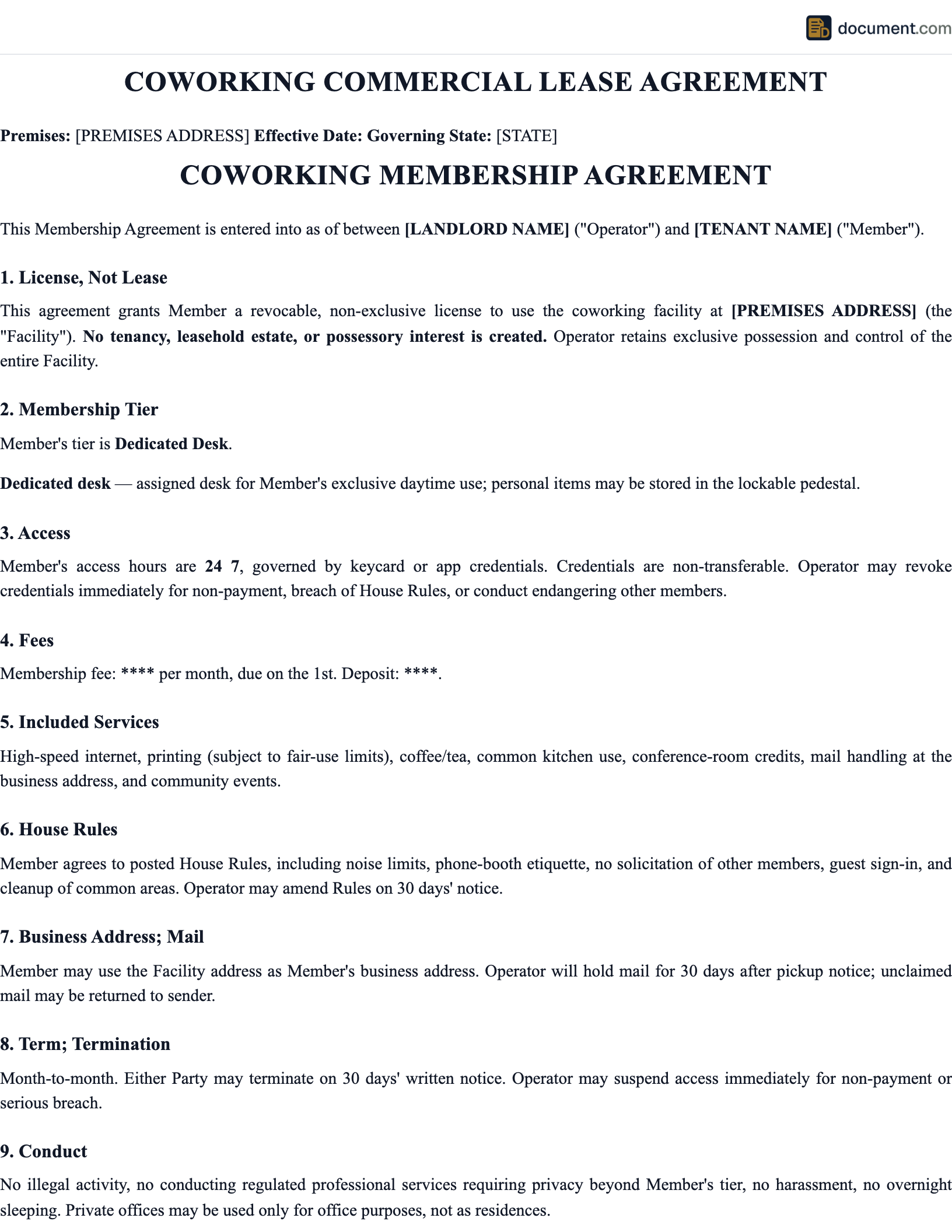
Below is a preview of our Missouri-specific coworking space lease agreement. Your customized document will include all fields and provisions required under MO law.
COWORKING SPACE LEASE AGREEMENT
STATE OF MISSOURI
MO-Compliant Template
PARTY A:
Name: [Full Legal Name]
Address: [Missouri Address]
PARTY B:
Name: [Full Legal Name]
Address: [Missouri Address]
PROPERTY / PREMISES:
Address: [Property Address]
County: [Missouri County]
MISSOURI COMPLIANCE
This document complies with Missouri (MO) state law requirements and includes all provisions mandated for this type of document in Missouri.