



Michigan Coworking Space Lease Agreement Overview
Michigan's coworking market reflects its broader economic story: concentrated activity in Detroit and Grand Rapids, with limited options outside those two metros. Detroit's coworking scene has benefited from the city's recovery, with operators establishing spaces in Corktown, Midtown, Eastern Market, and the central business district that serve a mix of startups, remote workers, and established professionals who want urban flexibility. Grand Rapids has a smaller but growing coworking sector anchored by its healthcare and manufacturing professional community.
Michigan commercial law governs coworking agreements through general contract principles. The state has no coworking-specific statute and no commercial tenant protection law that would apply to members. The written agreement is the primary legal document governing the coworking relationship, which means what you negotiate and sign determines your rights if a dispute arises over pricing, amenity access, or early termination. Michigan courts will enforce clear commercial agreements as written, so the quality of the agreement matters as much as the quality of the space.
MI
State-specific
Varies
Filing fees
Written
Required format
Contract
Law governs
Michigan Legal Requirements
Michigan coworking agreements are governed by general commercial contract principles. No Michigan statute specifically addresses coworking memberships or licenses.
Michigan Specific Note
Michigan coworking operators in Detroit's recovering downtown often occupy space as subtenants under master leases with building owners. If the operator's master lease fails, members may lose access regardless of whether their own agreement is current. Ask any Detroit or Grand Rapids coworking operator whether it has a non-disturbance agreement with the building owner before signing a fixed-term membership. Michigan courts enforce commercial agreements as written, so the written coworking agreement is your primary protection.
Key Provisions to Address
- Lease vs. license distinction: Understand whether the agreement grants exclusive possession of a defined space (lease) or access to shared space at the operator's discretion (license); your legal remedies differ significantly
- Termination and notice: Confirm the notice period required for termination by either party and any early termination fee applicable to fixed-term memberships
- Rate lock for fixed terms: Insist that fixed-term agreements specify a locked monthly rate with any escalation limited to a defined formula or percentage cap
- Amenity inclusions: Confirm what is included in the base fee versus metered separately, particularly parking, conference room hours, and after-hours access
- Insurance requirements: Most Michigan operators require commercial general liability coverage; confirm required limits and additional insured endorsement requirements before signing
- Business address and registered agent use: Confirm explicitly whether the membership includes the right to use the address for Michigan LARA business filings and mail handling
How to Execute a Michigan Coworking Agreement
Signing a Michigan coworking agreement is straightforward but benefits from careful review before you commit.
Compare Options in Your Michigan Market
Detroit and Grand Rapids each have multiple coworking operators with meaningfully different pricing, amenities, and community focuses. Tour at least two to three options before committing, particularly in Detroit where the quality and infrastructure of spaces varies considerably by neighborhood and building vintage.
Read the Full Agreement Before Signing
Focus on the termination and notice provisions, the fee schedule for add-on services, the operator's right to modify rules or pricing during the term, and what happens to your property if you default or abandon the space.
Arrange Insurance Coverage
Most Michigan coworking operators require commercial general liability coverage before you can access the space. Contact your business insurance provider before signing to confirm coverage can be arranged quickly and get the certificate of insurance naming the operator as additional insured.
Sign and Retain a Copy
Execute the agreement through an authorized representative if signing on behalf of an entity. Retain a fully executed copy. Michigan commercial agreements do not require notarization to be enforceable unless the agreement will be recorded, which is rare for coworking arrangements.
Confirm Access and Technology Setup
Before your first day, verify that your key card or access credentials work, that the internet speed and configuration meet your needs, and that any conference room bookings you need for the first week are reserved in the operator's booking system.
Important Considerations and Tax Notes for Michigan Coworking
Michigan coworking memberships carry straightforward cost and tax treatment compared to traditional office leases.
- Deductibility: Monthly coworking fees paid for business purposes are deductible as ordinary business expenses at both the federal level and under Michigan's Corporate Income Tax. Keep records of monthly payments and the business purpose for each period.
- Michigan sales tax: Michigan does not impose a general sales tax on commercial rent payments. Some add-on coworking services, particularly equipment rentals, may be subject to Michigan's 6% sales tax; confirm with the operator which line items on the invoice include tax.
- Master lease risk: In Detroit's developing commercial market, some coworking operators occupy space under master leases from building owners who themselves are recovering from the city's economic challenges. Ask the operator whether it owns the building or subleases from the owner, and whether there is a non-disturbance agreement protecting members in the event of operator default.
- Parking cost in Michigan: Unlike dense coastal markets where parking is scarce, Michigan coworking spaces in suburban areas often include parking. Detroit downtown and Midtown spaces may charge separately for parking, which can add $100 to $200 per month to the effective membership cost.
Michigan Coworking Cost Summary
Below is a breakdown of typical costs associated with Michigan coworking memberships.
| Cost Item | Michigan Range |
|---|---|
| Hot Desk Membership | $150 - $350/month in Michigan markets; Detroit downtown tends to the higher end |
| Dedicated Desk | $300 - $600/month depending on operator and location |
| Private Office (small) | $600 - $1,500/month for 1-2 person offices in Detroit and Grand Rapids |
| Security Deposit | Typically one to two months of membership fees for fixed-term agreements |
| Notarization | $5 - $25 per signature |
| Title Search (if needed) | $200 - $500 |
Sample Michigan Coworking Space Lease Agreement
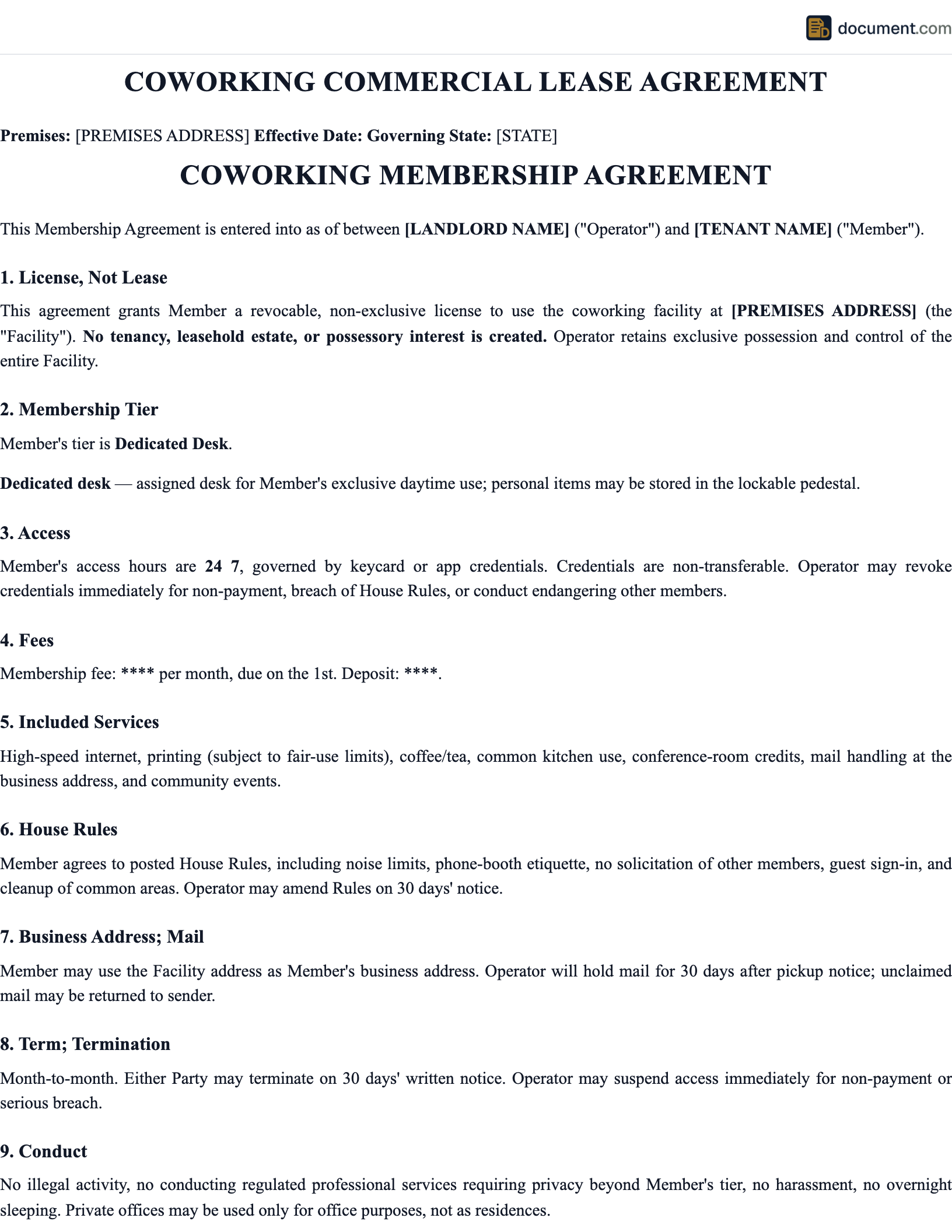
Below is a preview of our Michigan-specific coworking space lease agreement. Your customized document will include all fields and provisions required under MI law.
COWORKING SPACE LEASE AGREEMENT
STATE OF MICHIGAN
MI-Compliant Template
PARTY A:
Name: [Full Legal Name]
Address: [Michigan Address]
PARTY B:
Name: [Full Legal Name]
Address: [Michigan Address]
PROPERTY / PREMISES:
Address: [Property Address]
County: [Michigan County]
MICHIGAN COMPLIANCE
This document complies with Michigan (MI) state law requirements and includes all provisions mandated for this type of document in Michigan.