



Massachusetts Coworking Space Lease Agreement Overview
Boston and Cambridge have one of the most active coworking markets in the country, driven by a startup ecosystem that regularly produces companies that outgrow a WeWork desk before they can commit to a traditional office lease. The coworking agreements used in Massachusetts vary considerably in legal form: some are structured as commercial subleases, others as licenses, and a handful of larger operators use hybrid membership agreements that blend elements of both. Understanding which type of agreement you are signing matters because it determines your legal status and what protections you have if the operator faces financial difficulty or tries to terminate your agreement early.
Massachusetts commercial law governs these agreements primarily through contract principles. The state's statute of frauds requires written agreements for terms exceeding one year, and Chapter 93A's prohibition on unfair or deceptive trade practices applies to coworking operators just as it does to other commercial landlords. Security deposits for coworking memberships are not capped by statute, though most operators in the Greater Boston area require only one to two months given the shorter terms involved. The written agreement controls notice periods, early termination rights, amenity access, and everything else that matters to the day-to-day coworking relationship.
MA
State-specific
Varies
Filing fees
Written
Required format
Contract
Law governs
Massachusetts Legal Requirements
Massachusetts coworking agreements are governed by contract law. The key requirements flow from general commercial law principles and what the written agreement itself specifies, not from a coworking-specific statute.
Massachusetts Specific Note
Massachusetts coworking operators often structure their agreements as licenses rather than leases to preserve flexibility in removing members without going through a formal eviction process. If the agreement is a license, you do not have statutory tenant protections. Chapter 93A still applies to deceptive or unfair conduct by the operator, but your ability to remain in the space over the operator's objection is limited by the agreement's termination and notice provisions. Read these sections carefully before signing.
Key Provisions to Address
- License vs. lease distinction: Confirm whether the agreement grants exclusive possession of a defined space (lease) or a right to use shared space (license), as this determines your legal remedies in a dispute
- Notice and termination: Identify the minimum notice period for termination by either party and any early termination fees that apply to fixed-term memberships
- Amenity access rights: Define which amenities are included at what hours, what is metered separately, and whether the operator can modify amenity offerings during the term
- Technology and bandwidth: Get written commitments on internet speed and reliability if your work depends on consistent connectivity
- Insurance obligations: Most Massachusetts operators require commercial general liability coverage; confirm amounts and whether the operator needs to be named as additional insured
- Rate escalation rights: Fixed-term agreements should lock the membership rate; month-to-month agreements should specify how and when the operator can adjust pricing
How to Execute a Massachusetts Coworking Agreement
Signing a coworking agreement in Massachusetts is less formal than a traditional office lease but still deserves careful review. Here is how to approach it.
Identify Whether It Is a Lease or a License
Read the agreement's recitals and operative language. If it grants you exclusive possession of a defined suite, it is likely a lease. If it gives you access to shared space at the operator's discretion, it is probably a license. Your legal rights differ significantly between the two.
Review the Fee Schedule and Escalation Provisions
Confirm the base membership fee, what is included, what is metered separately, and whether the operator can raise rates during your term. For fixed-term agreements, insist on a rate lock for the full term.
Verify Insurance Requirements
Most Massachusetts coworking operators require you to carry commercial general liability insurance before you can access the space. Arrange coverage in advance through your existing business insurance broker or a commercial insurer familiar with coworking endorsements.
Sign and Retain a Copy
Execute the agreement through an authorized representative if signing on behalf of an entity. Retain a fully executed copy. Notarization is not required for a coworking license or lease to be enforceable, but keep a signed copy in your records regardless.
Document Any Operator Representations
If the operator made specific claims about amenity quality, internet speeds, or available conference room hours, get them in writing as an exhibit or side letter. Massachusetts's Chapter 93A applies to deceptive pre-signing representations in commercial contexts.
Tax and Cost Considerations for Massachusetts Coworking
Coworking memberships in Massachusetts carry straightforward tax and cost implications compared to traditional office leases.
| Cost Item | Massachusetts Treatment |
|---|---|
| Membership Fee Deductibility | Monthly coworking fees are generally deductible as ordinary business expenses at the federal and Massachusetts state levels |
| Massachusetts Sales Tax on Coworking | Massachusetts does not impose a general sales tax on commercial lease payments or membership fees; confirm with a tax advisor if your agreement includes significant taxable services bundled into the fee |
| Security Deposit | No statutory cap; typically one to two months of membership fees; not required to be held in a separate account under Massachusetts commercial law |
| Insurance Premiums | Commercial general liability coverage required by most operators; premium cost depends on your industry and coverage limits, typically $400 to $1,200 annually for most professional businesses |
| CAM or Property Tax Passthrough | Coworking agreements rarely include separate CAM or property tax passthroughs; these costs are absorbed into the membership fee by the operator |
Important Considerations for Massachusetts Coworking Members
The Greater Boston coworking market is mature and competitive, which gives members some real negotiating leverage on issues that newer markets do not.
- Master lease risk: Many coworking operators in Massachusetts operate as subtenants under a master lease with the building owner. If the operator defaults on its master lease, your coworking license can be terminated even if you are current on your fees. Ask the operator whether it has any non-disturbance agreement with the building owner protecting members in that scenario.
- Cambridge vs. Boston considerations: Cambridge coworking spaces, particularly near Kendall Square, serve a heavy biotech and tech membership and command the highest prices in the state. Some operators in Cambridge have specialized spaces with reinforced floors, chemical storage, or wet lab adjacency that make them appropriate for early-stage life sciences companies.
- MBTA accessibility: Many members choose coworking spaces for their transit proximity. Confirm that the T stop advertised as nearby actually has reliable service at the hours your team will be working, particularly for late-evening access.
- Confidentiality in shared spaces: Massachusetts employers with trade secret concerns should review the confidentiality provisions in the coworking agreement. Open coworking spaces are poor environments for discussions of sensitive client matters or proprietary information. Private offices or enclosed conference rooms are the appropriate venues for confidential work.
Sample Massachusetts Coworking Space Lease Agreement
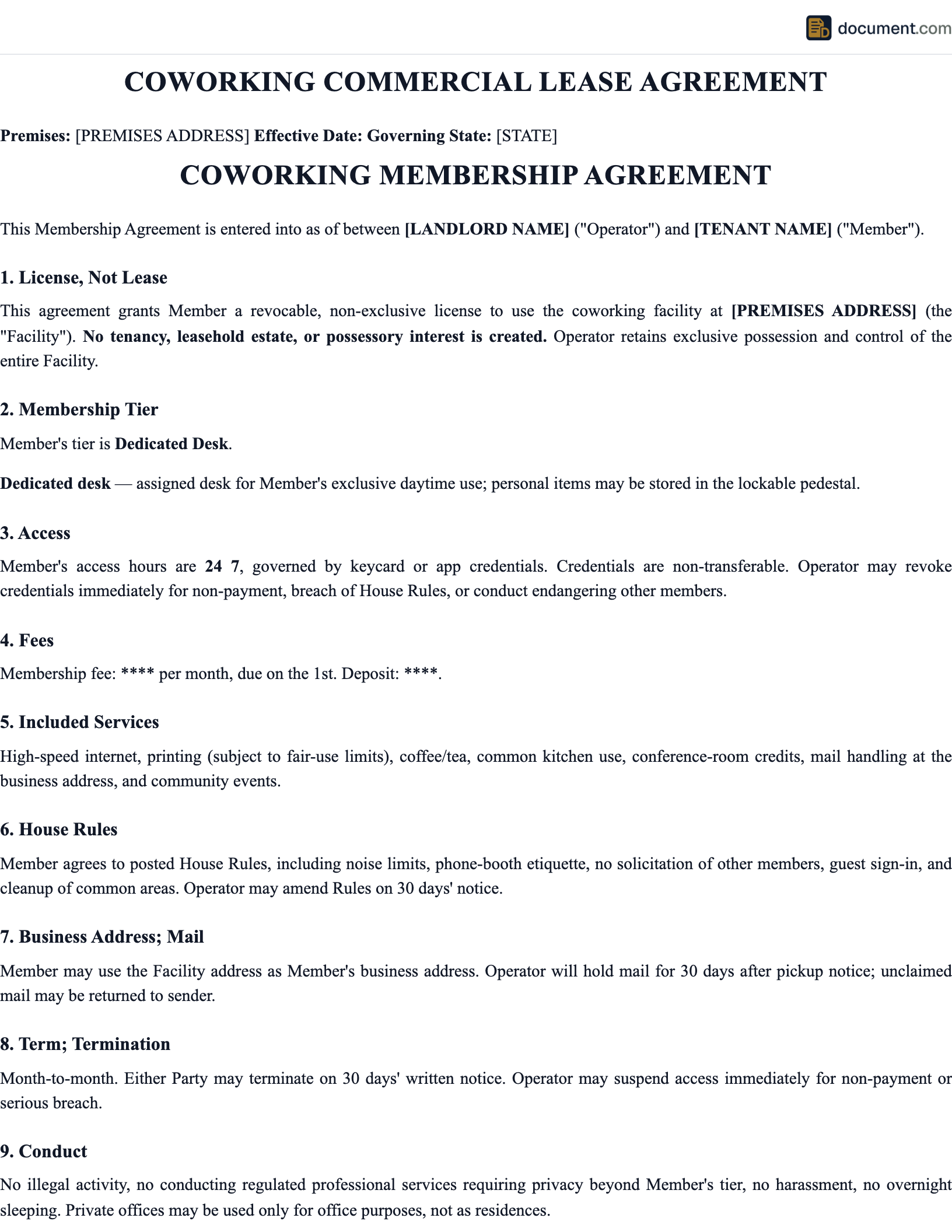
Below is a preview of our Massachusetts-specific coworking space lease agreement. Your customized document will include all fields and provisions required under MA law.
COWORKING SPACE LEASE AGREEMENT
STATE OF MASSACHUSETTS
MA-Compliant Template
PARTY A:
Name: [Full Legal Name]
Address: [Massachusetts Address]
PARTY B:
Name: [Full Legal Name]
Address: [Massachusetts Address]
PROPERTY / PREMISES:
Address: [Property Address]
County: [Massachusetts County]
MASSACHUSETTS COMPLIANCE
This document complies with Massachusetts (MA) state law requirements and includes all provisions mandated for this type of document in Massachusetts.