
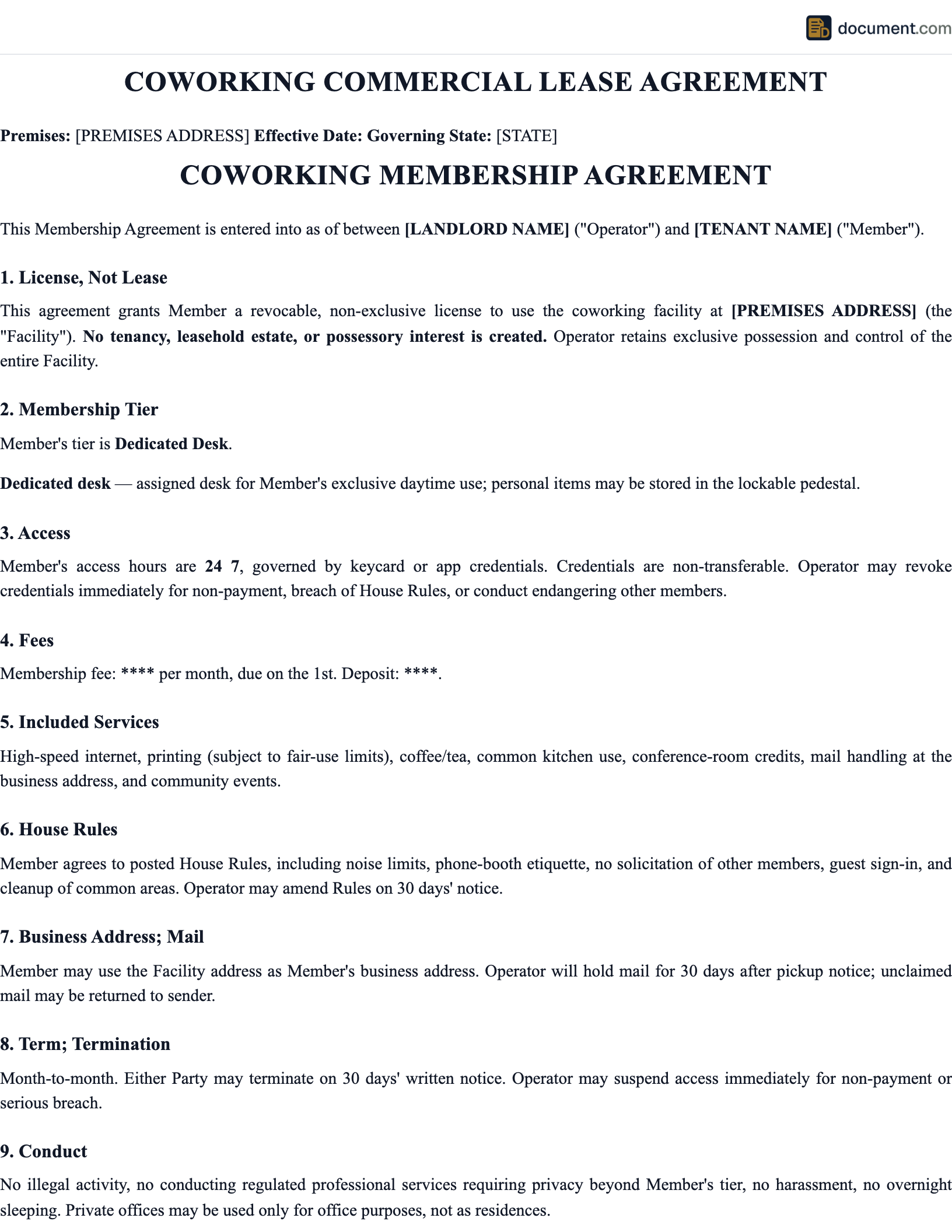



Maryland Coworking Space Lease Agreement Overview
Maryland's coworking market reflects its dual character: a Baltimore urban market and a DC suburb market that operate under very different demand drivers. Baltimore coworking concentrates in Fells Point, Federal Hill, Station North, and the downtown Charles Center area, serving creative professionals, legal and financial services consultants, and tech startups from the University of Maryland Baltimore County and Johns Hopkins innovation ecosystem. The DC suburb Maryland market, particularly Bethesda, Silver Spring, Rockville, and College Park, has a coworking demand base heavily weighted toward federal government contractors, policy professionals, healthcare consultants, and remote workers who need Metro-adjacent professional space.
The most critical structural question for any Maryland coworking arrangement is whether the document is a license or a lease. A license grants personal access rights to shared facilities without conveying any real property interest. A lease grants a possessory interest in defined space. Maryland operators almost universally structure their agreements as licenses to preserve fast termination rights and avoid commercial eviction procedures. A member who receives exclusive access to a specific private office for a defined term at defined rent may have created a lease regardless of how the document is labeled. Maryland courts look at substance over form.
Maryland provides no statutory commercial tenant protections for coworking members. The Maryland Real Property Article governs commercial landlord-tenant relationships primarily through contract principles. Whatever the signed membership agreement says is what governs. Termination notice periods, fee increase procedures, community rules enforceability, and member liability for damage are all determined by the written agreement, not by any Maryland statute that fills in gaps. Operators and members who do not address these terms clearly create disputes that Maryland courts resolve based on general contract principles of intent and reasonableness.
MD
State-specific
Varies
Filing fees
Written
Required format
Contract
Law governs
Maryland Legal Requirements
Maryland coworking membership agreements are contract-governed documents. Maryland has no statute that specifically regulates coworking memberships or sets minimum terms for commercial licenses. The following requirements apply to any Maryland coworking arrangement whether structured as a license or a short-term commercial lease.
Maryland Coworking Notice
Maryland has no statute supplying a default termination notice period for commercial coworking memberships. If the agreement does not state a notice period, termination disputes are resolved by reference to general contract law and industry custom, which may not match either party's expectation. Always confirm that the signed agreement expressly states the required notice period, typically 30 days written notice for month-to-month memberships, and that both parties have a signed copy.
Agreement Requirements
- License vs. Lease Classification: Clearly state whether the document grants a personal license to access shared facilities or a possessory lease of defined space; the classification affects termination procedures and Maryland court treatment of member disputes
- Membership Tier and Services Included: Define exactly what is included in the base membership fee, hot desk, dedicated desk, private office, conference room credits, internet, printing, parking, and what is charged separately as an add-on; DC suburb Maryland operators often charge separately for conference room time and parking
- Termination Notice Period: State the written notice period required from both operator and member; without an express notice period Maryland law does not supply a default that clearly protects either party
- Community Rules Incorporation: Community rules and conduct standards must be specifically incorporated by reference in the signed agreement; Maryland courts enforce incorporated contract terms but not unilaterally posted rules the member did not expressly acknowledge
- Fee Adjustment Provisions: Specify whether and how the operator can adjust membership fees during the term, what notice is required before an increase takes effect, and whether a member can terminate without penalty upon receiving notice of a material fee increase
- Insurance Requirements: Specify required member insurance coverage including general liability minimums and whether the operator must be named as an additional insured; Maryland healthcare professionals using the space for client contacts should confirm professional liability coverage extends to work performed from the coworking location
- Security and Access Provisions: For DC suburb Maryland spaces serving federal contractors, the agreement should address building access procedures, guest policies for client meetings, and any restrictions on the type of work that may be performed in shared spaces, particularly for contractors handling sensitive federal work
How to Draft a Coworking Space Lease Agreement in Maryland
Maryland coworking membership agreements are contract documents with no required state form. The process below covers the key drafting decisions for both operators and prospective members in the Maryland market.
Choose the Document Structure
Decide whether to structure the arrangement as a license agreement or a short-term commercial lease. Most Maryland operators prefer a license because it avoids granting a real property interest, preserves fast termination rights, and sidesteps formal eviction procedures. A license makes sense for month-to-month hot desk and dedicated desk arrangements. A private office for a fixed one-year term at fixed rent may function as a lease regardless of labeling; consult a Maryland attorney if you are unsure which structure fits the arrangement.
Define Included Services for the Maryland Market
Maryland DC suburb coworking spaces often have distinct service bundles. Bethesda and Silver Spring operators frequently include Metro-accessible building features, dedicated conference rooms for federal contractor client meetings, and enhanced network security options as selling points. Baltimore spaces may emphasize creative amenities, event programming, and community networking. List every service included in the base fee and price each add-on separately, including parking, which is a material separate expense in most Maryland urban locations.
Address Federal Contractor and Sensitive Work Provisions
If the coworking space serves the Maryland DC suburb federal contractor community, the agreement should address whether secure conference rooms are available for meetings involving controlled information, what the network security standards are for the shared infrastructure, and whether the space has any restrictions on work involving ITAR-controlled or classified subject matter. Individual federal contractors are responsible for ensuring their use of a shared workspace complies with their contract security requirements; the coworking operator should not assume those compliance obligations but should be transparent about what the space can and cannot accommodate.
Draft Termination, Fee Adjustment, and Dispute Provisions
Write out the notice period required to terminate (30 days written notice is standard for Maryland month-to-month memberships), how much advance notice the operator must give before a fee increase, and whether a material fee increase triggers a member termination right. Include a governing law clause designating Maryland law and specify the county where disputes will be litigated or arbitrated. Maryland courts enforce these provisions as written.
Execute and Retain Signed Copies
Maryland coworking memberships do not require notarization or recording. Both operator and member should sign the agreement and the community rules acknowledgment at the same time. Each party should retain a signed copy. If the member is a business entity, confirm the signatory has organizational authority to bind the company. For corporate members with government contracts, confirm that the organization's contracting officer or authorized signatory has approved the coworking membership as a business expense if required by internal approval policies.
Tax Implications for Maryland Coworking Members
Maryland coworking membership fees are deductible as ordinary business expenses under federal and Maryland income tax rules. Maryland's corporate income tax rate is 8.25 percent on Maryland taxable income. Maryland does not impose a statewide commercial rent tax on coworking membership fees. However, Maryland's 6 percent sales tax may apply to certain ancillary services depending on how the operator invoices them. Conference room hourly bookings, parking, and printing services have been subject to sales tax treatment depending on operator billing practices. Members receiving itemized invoices for ancillary coworking services should confirm Maryland sales tax treatment with their tax advisor.
Maryland businesses considering coworking locations in Baltimore City enterprise zones should investigate whether any portion of their coworking membership costs could be incorporated into an enterprise zone credit claim. The Maryland Enterprise Zone Tax Credit provides corporate income tax credits and real property tax incentives for qualifying businesses in certified zones. Coworking tenants in eligible Baltimore enterprise zone locations should discuss credit eligibility with a Maryland tax professional.
Important Considerations for Maryland Coworking Members
Transit access is a primary value driver for Maryland DC suburb coworking. Before committing to a Bethesda, Silver Spring, or Rockville coworking membership, confirm the exact walking distance to the nearest Metro station and which lines serve it. Hybrid workers who commute into DC or Virginia on some days need a space where Metro access is genuinely convenient, not just technically present. A coworking space advertising Metro access that requires a 15-minute walk or a connecting bus is not the same as a space one block from the Bethesda Red Line station.
Maryland healthcare professionals using coworking space for client contacts face licensing and HIPAA compliance considerations that do not apply to most members. A psychologist, social worker, or healthcare consultant conducting client sessions in a Maryland coworking conference room must confirm: that the conference room provides adequate acoustic privacy for confidential sessions, that client records are not stored on shared network drives or printers, and that professional liability insurance extends to services rendered from a non-primary practice location. These are not issues the coworking operator manages; the member is responsible for ensuring compliance.
Community rules enforceability matters in Maryland because coworking operators rely on them to maintain a productive shared environment. Maryland courts enforce community rules that are specifically incorporated by reference in the signed membership agreement. Rules posted on a website, bulletin board, or sent by email after signing are harder to enforce against members who did not expressly acknowledge them at signing. Operators should require a separate community rules acknowledgment signed simultaneously with the membership agreement; members should read those rules before signing because violations can be grounds for membership termination under the contract.
Maryland-Specific Key Provisions
A well-drafted Maryland coworking agreement addresses several provisions beyond basic membership terms.
Non-solicitation provisions warrant careful attention in the Maryland market. Some Maryland coworking operators include clauses that prohibit members from soliciting other members to join competing coworking facilities or from recruiting the operator's employees. Maryland courts apply a reasonableness standard to restrictive covenants in commercial agreements. A narrowly drawn non-solicitation clause directed at poaching employees or directly recruiting coworking competitors has a better chance of enforcement than a broad non-competition clause.
Property storage and liability provisions are important for DC suburb Maryland members who leave equipment and materials at the coworking space overnight. Maryland operators are not automatic bailees for member property left on-site. A member who leaves a laptop, camera, or client files at a Silver Spring coworking space in a building break-in generally has no recourse against the operator unless the agreement specifically creates a storage or bailment obligation. Members with significant property on-site should carry their own business property insurance and confirm the operator's policy does not cover member belongings.
Maryland Fees & Costs
Below is a breakdown of typical costs associated with commercial lease transactions in Maryland. Actual fees may vary by county and specific circumstances.
| Fee / Cost | Typical Amount |
|---|---|
| Document Preparation | $200 - $1,000 |
| Legal Review | $500 - $2,500 |
| Recording Fees (if applicable) | $25 - $150 |
| Notarization | $5 - $25 per signature |
| Title Search (if needed) | $200 - $500 |
Sample Maryland Coworking Space Lease Agreement
Below is a preview of our Maryland-specific coworking space lease agreement. Your customized document will include all fields and provisions required under MD law.
COWORKING SPACE LEASE AGREEMENT
STATE OF MARYLAND
MD-Compliant Template
PARTY A:
Name: [Full Legal Name]
Address: [Maryland Address]
PARTY B:
Name: [Full Legal Name]
Address: [Maryland Address]
PROPERTY / PREMISES:
Address: [Property Address]
County: [Maryland County]
MARYLAND COMPLIANCE
This document complies with Maryland (MD) state law requirements and includes all provisions mandated for this type of document in Maryland.