



Maine Coworking Space Lease Agreement Overview
Portland is Maine's coworking hub, drawing remote workers, creative professionals, tech startups, and seasonal entrepreneurs who need professional space without the overhead of a private lease. The Old Port, Bayside, and Congress Street corridors all have active coworking operators offering everything from hot desk access to dedicated offices. The rest of Maine, including Bangor, Bath, Brunswick, and Bar Harbor, has a thinner but growing coworking supply, particularly among tourism-adjacent and remote-work-driven professionals.
The most important structural distinction in Maine coworking arrangements is whether the document is a license or a lease. A license grants personal access to shared facilities but conveys no real property interest. A lease grants a possessory interest in a defined space. Maine courts recognize this distinction, and it matters for eviction procedures, subtenancy rights, and member protections. Most professional coworking operators in Maine intentionally structure their agreements as licenses to preserve quick termination rights and prevent holdover tenancy claims. If the agreement grants exclusive access to a fixed desk or private office for a set term, it may cross into lease territory regardless of how it is labeled.
Maine has no commercial tenant protection statute comparable to residential landlord-tenant law under Title 14, Chapter 709. The parties negotiate all material terms, and whatever is written controls. Maine's tourism-driven economy creates real seasonality in Portland coworking demand, and some operators offer flexible seasonal memberships to accommodate hospitality, food and beverage, and outdoor recreation professionals whose income peaks in summer. Understanding that dynamic is useful when negotiating membership tier options.
ME
State-specific
Varies
Filing fees
Written
Required format
Contract
Law governs
Maine Legal Requirements
Maine commercial coworking arrangements are governed entirely by contract law. There is no statute specifically regulating coworking memberships or commercial licenses. The agreement as signed is the binding document, and Maine courts enforce it as written. The following requirements apply whether the arrangement is structured as a license or a short-term commercial lease.
Maine Coworking Notice
Maine has no statute governing termination notice periods for commercial coworking memberships. The agreement controls entirely. If no notice period is specified, either party could claim the right to terminate with little or no warning. Always confirm the termination notice period, typically 30 days written notice, is expressly stated in the signed agreement. Month-to-month memberships without a notice provision create significant instability for both operators and members.
Agreement Requirements
- License vs. Lease Classification: The agreement should clearly state whether it is a license granting personal access rights or a lease granting a possessory interest in a defined space; the classification affects eviction procedures and holdover rights
- Membership Tier and Access Rights: Define exactly what the membership includes, hot desk access, dedicated desk, private office, conference room credits, printing, and parking, with any usage limits clearly stated
- Term and Termination Notice: State the membership term, whether month-to-month or fixed, and the notice period required from both operator and member to terminate
- Community Rules Incorporation: Community rules must be specifically incorporated by reference in the signed agreement; rules posted only on a bulletin board or website are difficult to enforce against members who did not expressly acknowledge them
- Winter Weather Access Protocol: Maine winters create real access interruptions; the agreement should state whether the operator is obligated to maintain access during storm closures, what constitutes an excused closure, and whether membership fees are suspended for extended disruptions
- Insurance Requirements: Specify whether members must carry general liability insurance with the operator as additional insured; members with professional practices should confirm their professional liability policy extends to work performed from a coworking location
- Deposit and Fee Structure: Maine imposes no statutory cap on commercial security deposits; the agreement should clearly specify what deposit is held, what it covers, and the timeline for return
How to Draft a Coworking Space Lease Agreement in Maine
Maine coworking memberships are contract-governed documents with no state-mandated form. The drafting process below covers the structural decisions that determine whether your agreement holds up and protects both sides.
Decide the Structure: License or Lease
Most Maine coworking operators draft a license agreement to avoid granting a possessory real property interest. A license gives the member access rights, not tenancy. If the member gets exclusive access to a specific private office for a fixed term, Maine courts may treat it as a lease regardless of the label. Decide which structure fits your arrangement before drafting, because the classification affects termination rights and eviction procedures.
Define Membership Tier and Included Services
List every service included in the base membership fee: hot desk access, dedicated desk, private office, conference room credits per month, printing allowance, parking, mailbox. State separately what is charged on an overage or add-on basis. Portland coworking spaces in the Old Port and Bayside neighborhoods typically bundle high-speed internet and basic printing but charge separately for conference room hours beyond the monthly allotment.
Address Termination Notice and Seasonal Flexibility
Maine law does not supply a default termination notice period for coworking licenses. Write the notice requirement explicitly, typically 30 days written notice for month-to-month arrangements. If you or your members are in tourism, hospitality, or seasonal industries, consider whether the agreement should offer a seasonal membership tier or a pause option for off-season months. Some Portland operators offer summer-only or winter-only membership tracks to match the local economy.
Include Winter Weather and Access Disruption Provisions
Maine winters are not a minor inconvenience. Portland regularly experiences significant snowfall and ice events that can close buildings, block parking, and knock out power. The agreement should define what constitutes an excused closure, whether membership fees are suspended for closures exceeding a certain number of days, who maintains sidewalk and parking lot access for member safety, and whether the operator has backup generator power for internet routers and essential systems.
Execute and Deliver Copies
Both operator and member should sign the agreement and community rules acknowledgment at the same time. Maine coworking memberships do not require notarization or recording. Each party should retain a signed copy. If the member is a business entity, confirm the signatory has authority to bind the company.
Tax Implications for Maine Coworking Members
Maine coworking membership fees are deductible as ordinary business expenses under both federal tax rules and Maine income tax. Maine does not impose a statewide commercial rent tax on membership fees. However, Maine's 5.5 percent sales tax may apply to certain ancillary services depending on how the operator invoices them. Conference room hourly bookings, parking, and printing services have been subject to sales tax treatment in Maine depending on the operator's tax position. Members who receive itemized invoices for ancillary services should confirm with their accountant whether Maine sales tax applies to those line items.
Maine businesses qualifying for the Business Equipment Tax Exemption (BETE) should determine whether equipment used at a coworking location qualifies. BETE applies to qualified business equipment placed in service in Maine and reported on business equipment tax returns. Equipment used in a coworking space is not automatically excluded, but the physical location of the equipment at a shared facility can complicate BETE classification. Discuss the BETE treatment of any significant equipment with a Maine tax advisor before filing.
Important Considerations for Maine Coworking Arrangements
Internet reliability is a genuine concern in Portland coworking spaces that serve tech startups and remote workers. Before signing, ask the operator for the committed minimum bandwidth per member, whether the network uses segmented VLANs or is a shared open network, and what service credit or accommodation applies for extended outages. Remote workers and tech professionals who depend on continuous connectivity should not assume the connection quality advertised in marketing materials matches peak-hour actual performance.
Portland's Old Port coworking spaces in historic commercial buildings occasionally face HVAC limitations. Older brick buildings on Commercial Street and Exchange Street were not built for modern open-office ventilation requirements. If the coworking space is in a historic building, ask about heating system age and summer cooling capacity before committing to a full-year membership. A poorly cooled Old Port space in July is a real productivity issue.
Members in regulated professions, including healthcare, law, and financial services, should confirm that working from a shared coworking environment complies with their professional licensing requirements, client confidentiality obligations, and insurance policy terms. Maine healthcare professionals who meet with clients at a coworking space should verify that their professional liability coverage extends to services rendered from a non-primary practice location.
Maine-Specific Key Provisions
A well-drafted Maine coworking agreement should address the following provisions beyond the basic membership terms.
Community rules should be incorporated by specific reference in the signed agreement, not merely posted on a website or bulletin board. Maine courts enforce incorporated contract terms, but unilaterally posted rules without member acknowledgment are harder to enforce. The agreement should also address whether the operator can modify community rules during the membership term, and if so, what notice is required.
For members storing physical property at the coworking space, the agreement should be clear that operator liability for member property is limited and that members are responsible for their own property insurance. Maine coworking operators are not bailees for member equipment left on-site overnight. A member who loses a laptop left at a Portland coworking space in a building break-in will generally have no recourse against the operator unless the agreement specifically creates that obligation.
Maine Fees & Costs
Below is a breakdown of typical costs associated with commercial lease transactions in Maine. Actual fees may vary by county and specific circumstances.
| Fee / Cost | Typical Amount |
|---|---|
| Document Preparation | $200 - $1,000 |
| Legal Review | $500 - $2,500 |
| Recording Fees (if applicable) | $25 - $150 |
| Notarization | $5 - $25 per signature |
| Title Search (if needed) | $200 - $500 |
Sample Maine Coworking Space Lease Agreement
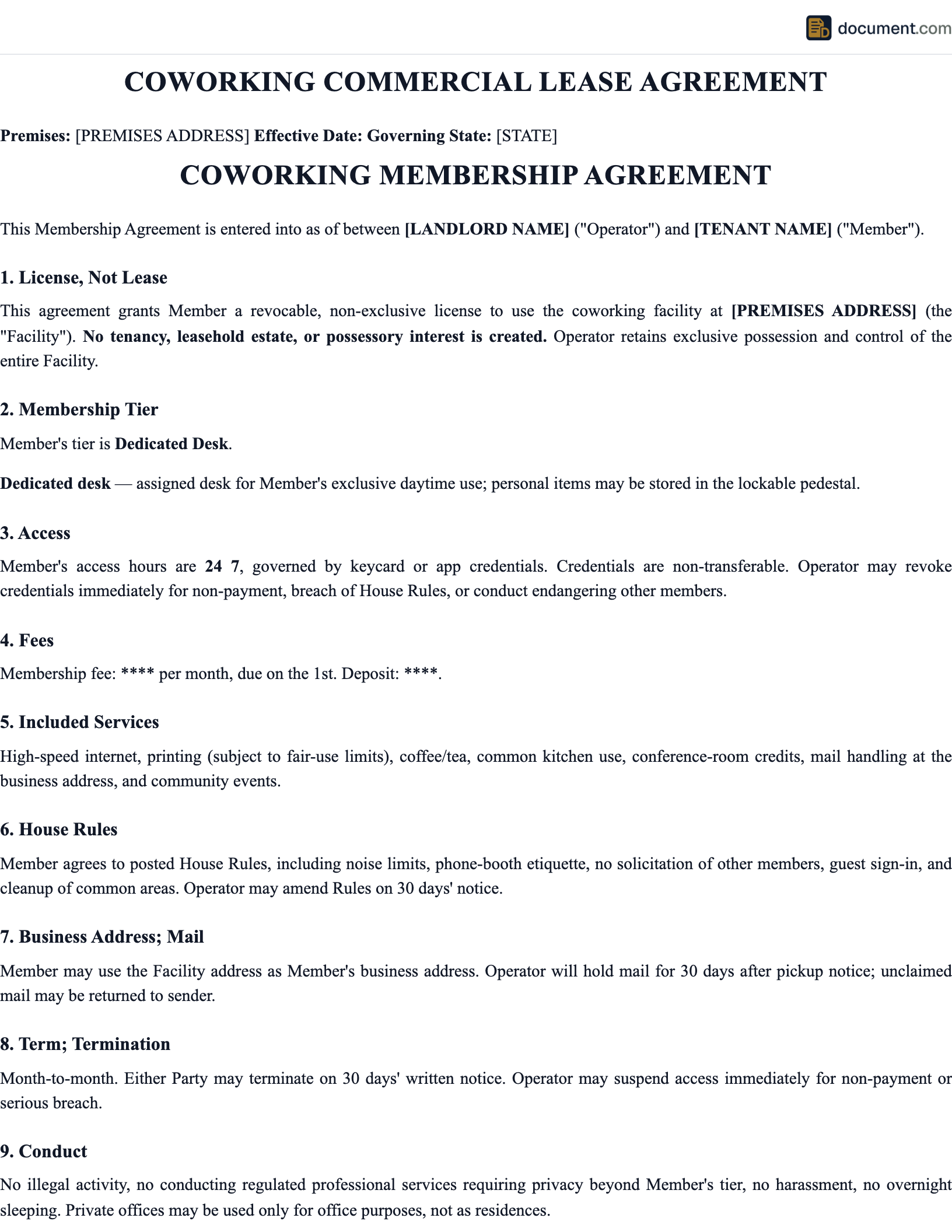
Below is a preview of our Maine-specific coworking space lease agreement. Your customized document will include all fields and provisions required under ME law.
COWORKING SPACE LEASE AGREEMENT
STATE OF MAINE
ME-Compliant Template
PARTY A:
Name: [Full Legal Name]
Address: [Maine Address]
PARTY B:
Name: [Full Legal Name]
Address: [Maine Address]
PROPERTY / PREMISES:
Address: [Property Address]
County: [Maine County]
MAINE COMPLIANCE
This document complies with Maine (ME) state law requirements and includes all provisions mandated for this type of document in Maine.