



Louisiana Coworking Space Lease Agreement Overview
Louisiana's coworking market is shaped by New Orleans' unique creative economy and Baton Rouge's more conventional professional base. New Orleans coworking attracts film industry professionals, musicians, tourism consultants, tech startups working in civic technology and disaster resilience, and an unusually high concentration of remote workers who relocated to the city for quality of life reasons. Baton Rouge coworking draws engineering, environmental consulting, and government relations professionals working with the petrochemical and state government sectors.
Louisiana coworking membership agreements are governed by Louisiana civil law, not common law. The practical implication is that the agreement is interpreted through civil code principles rather than judge-made common law rules. Most Louisiana coworking agreements are structured as licenses, not leases, which avoids the civil code's lease-specific provisions and gives operators faster removal rights for non-paying or disruptive members. However, any agreement that grants a member exclusive possession of a specific dedicated office risks being characterized as a lease under Civil Code Article 2668, which requires the lessor to deliver the thing in a condition fit for its intended use and maintain it throughout the lease term.
Hurricane and flood disruption provisions are not optional in Louisiana coworking agreements. The city of New Orleans has experienced multiple evacuation orders and extended building inaccessibility events since Katrina. A membership agreement that does not address what happens to membership fees during mandatory evacuations or building closures due to storm damage is incomplete for Louisiana and creates real liability risk for operators and uncertainty for members who have no recourse when paying for inaccessible space.
LA
State-specific
Varies
Filing fees
Written
Required format
Contract
Law governs
Louisiana Legal Requirements for Coworking Agreements
Louisiana coworking membership agreements are governed by the Louisiana Civil Code as general contracts (Article 1906 et seq.) rather than as leases under Articles 2668 through 2729, provided the agreement is drafted as a license. If a Louisiana court finds the agreement creates a lease by granting exclusive possession, the lessor's obligations under the Civil Code apply regardless of how the document is labeled.
Louisiana Civil Law and Hurricane Provisions Note
Louisiana's civil code governs this agreement. Force majeure provisions covering named storms, mandatory evacuation orders, and flood-related building closures are essential in Louisiana coworking agreements and not merely standard boilerplate. Community rules incorporated by reference must be referenced in the signed document to be enforceable under Louisiana Civil Code Article 1983. Out-of-state coworking agreement templates frequently miss Louisiana-specific civil code requirements.
Key Louisiana Coworking Agreement Requirements
- License Structure: Draft as a license, not a lease, to avoid civil code lease obligations; avoid granting exclusive possession of specific space to preserve license characterization
- Force Majeure for Storms: Explicitly address named storms, evacuation orders, and flood-related inaccessibility including fee suspension procedures and membership reactivation process
- Technology and Backup Power: Specify internet speed guarantees, generator availability for essential systems, and operator liability limits for connectivity loss during storms
- Community Rules Incorporation: Reference community rules specifically by name in the signed agreement under Louisiana Civil Code Article 1983 to make them enforceable contract terms
- Insurance Requirements: General liability minimums, additional insured status, and member obligation to carry property coverage for equipment and client materials stored at the space
- Governing Law and Venue: Specify Louisiana law and select the appropriate parish as venue; Orleans Parish for New Orleans-based spaces, East Baton Rouge Parish for Baton Rouge
How to Sign a Louisiana Coworking Agreement
Joining a coworking space in Louisiana requires signing a membership agreement that is governed by Louisiana civil law. The process does not involve any government filing. The agreement binds both parties when executed. In Louisiana, it is worth giving the agreement more than a cursory read given the civil code's different default rules.
Tour the Space and Ask About Storm Protocols
In addition to standard amenity review, ask the New Orleans or Baton Rouge operator how the space has handled past hurricane seasons, what evacuation protocols look like, and whether backup generator power is available for internet and essential equipment.
Read the Force Majeure and Termination Provisions
Louisiana agreements should include explicit storm and evacuation provisions. If the agreement you receive does not address hurricane and flood disruption, ask the operator to add language before signing.
Confirm Entity vs. Individual Membership
Sign on behalf of your business entity, not personally, to limit liability for membership fees to the entity. Louisiana recognizes this distinction under civil code contract principles.
Execute and Confirm Community Rules Are Incorporated
Ensure the signed agreement references any community rules or house rules document by name. Under Louisiana civil law, rules not referenced in the signed agreement may not be enforceable contract terms.
Retain Signed Agreement and Access Credentials
Keep a signed copy of the agreement in your business records. Receive and test access credentials before your first work day. Confirm the billing cycle start date and payment method.
Tax Implications for Louisiana Coworking Members
Louisiana coworking membership fees are deductible as ordinary business expenses under federal and Louisiana income tax rules. Louisiana does not impose a statewide commercial rent tax on membership fees. Louisiana sales tax may apply to ancillary coworking services like parking, printing, and event space hourly rentals. Businesses operating from Louisiana enterprise zone coworking locations should investigate whether they qualify for Louisiana enterprise zone tax credits, which can include employment tax credits and sales tax exemptions on qualifying purchases.
Important Considerations for Louisiana Coworking Agreements
New Orleans coworking operators in historic buildings face Historic District Landmarks Commission or Vieux Carre Commission restrictions on signage, exterior modifications, and some structural changes. Members who need building-mounted signage or exterior branding for their business should confirm with the operator what the building permits before assuming such visibility is available. During Mardi Gras, Jazz Fest, and other major New Orleans events, parking, building access, and commuting to downtown and midcity coworking locations can be severely disrupted for days at a time. Coworking members with client-facing workloads during festival periods should plan around building access logistics. Film and television production support professionals using coworking in New Orleans should confirm the operator supports secure file transfer and high-bandwidth data needs given Louisiana's active production industry.
Louisiana Fees & Costs
Below is a breakdown of typical costs associated with commercial lease transactions in Louisiana. Actual fees may vary by county and specific circumstances.
| Fee / Cost | Typical Amount |
|---|---|
| Document Preparation | $200 - $1,000 |
| Legal Review | $500 - $2,500 |
| Recording Fees (if applicable) | $25 - $150 |
| Notarization | $5 - $25 per signature |
| Title Search (if needed) | $200 - $500 |
Sample Louisiana Coworking Space Lease Agreement
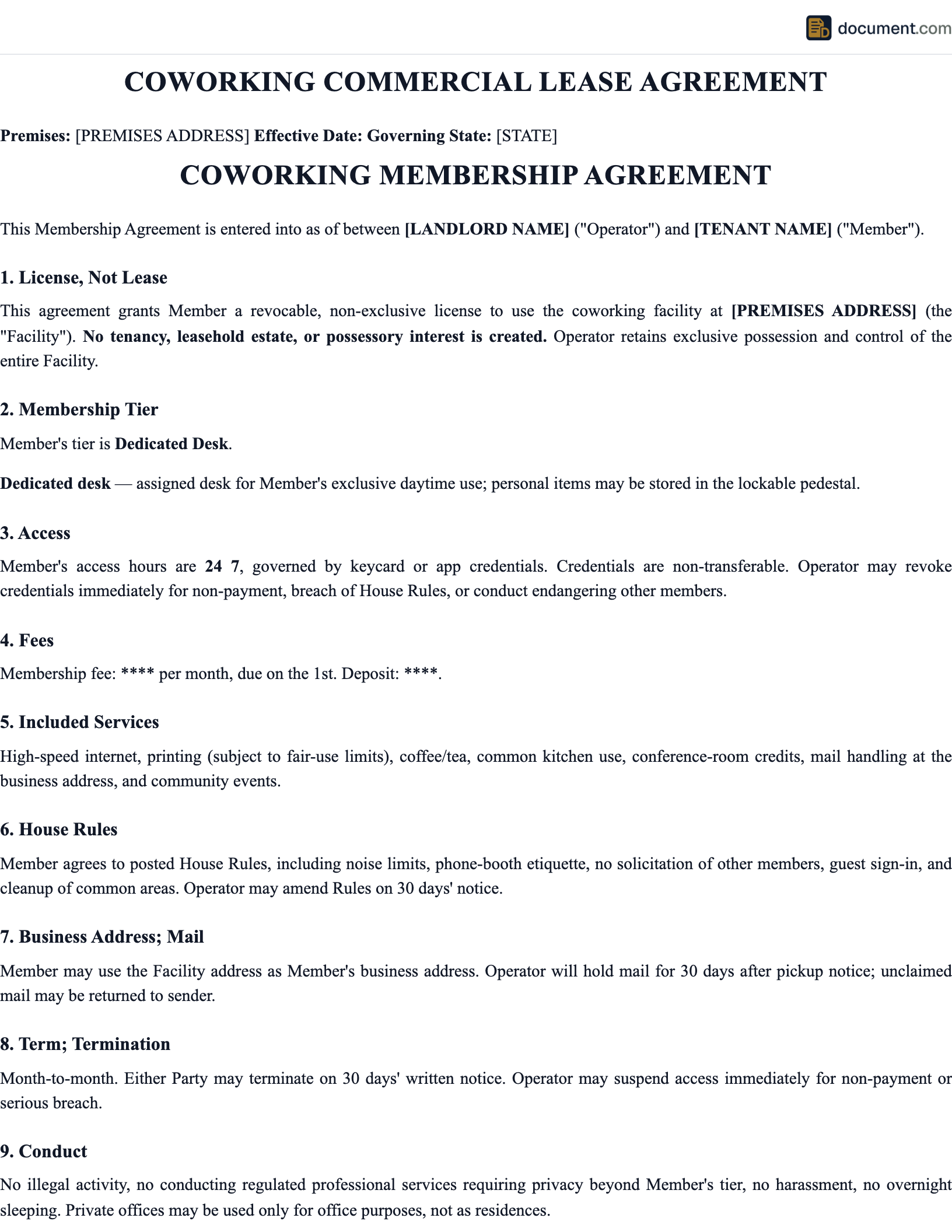
Below is a preview of our Louisiana-specific coworking space lease agreement. Your customized document will include all fields and provisions required under LA law.
COWORKING SPACE LEASE AGREEMENT
STATE OF LOUISIANA
LA-Compliant Template
PARTY A:
Name: [Full Legal Name]
Address: [Louisiana Address]
PARTY B:
Name: [Full Legal Name]
Address: [Louisiana Address]
PROPERTY / PREMISES:
Address: [Property Address]
County: [Louisiana County]
LOUISIANA COMPLIANCE
This document complies with Louisiana (LA) state law requirements and includes all provisions mandated for this type of document in Louisiana.