



Kansas Coworking Space Lease Agreement Overview
Coworking has expanded steadily across Kansas, with the strongest market concentration in the Kansas City metro area on both sides of the state line and in Wichita's growing entrepreneurial and tech scene. Kansas has no statute specifically governing coworking arrangements, so the agreement itself does every piece of legal work. Whether the deal is structured as a commercial sublease, a license agreement, or a membership contract, Kansas courts enforce the document's written terms without implying additional protections for members beyond what was agreed.
The Kansas City metro presents a cross-border consideration unique to the market: coworking members on the Kansas side operate under Kansas law, while members at locations across the state line in Missouri face different legal rules. Kansas operators in Johnson County and the Overland Park corridor have built robust coworking options that attract both tech startups and remote workers from larger regional employers. Wichita's coworking market, anchored around the Delano and Douglas Design District neighborhoods, serves a mix of aerospace-adjacent professionals, healthcare entrepreneurs, and independent creatives. In either market, the agreement does all the legal work that state law does not.
KS
State-specific
6.5%+
State sales tax
Written
Required format
Contract
Law governs
Kansas Legal Requirements
Kansas has no coworking-specific statute. Agreements are enforceable under general contract law, and Kansas courts hold both operators and members to the document's written terms. Before signing any Kansas coworking agreement, members should review the following.
Kansas Coworking Note
Kansas provides no statutory protections for coworking members beyond general contract rights. There is no deposit return timeline mandated by state law, no prohibition on mid-term fee increases if the agreement permits them, and no automatic right to renew. The Kansas City metro's cross-border geography means members should confirm which state's law governs the agreement. A Kansas-law governing clause in your agreement is essential if your location sits in Johnson County or Wyandotte County.
What Your Kansas Coworking Agreement Should Cover
- Governing Law: A Kansas-law clause is especially important for Kansas City metro agreements where Missouri-side operators may try to apply Missouri law to Kansas members
- Sales Tax Treatment: Confirm whether the 6.5% state rate plus local additions are included in quoted prices or added separately, and how the agreement documents tax obligations for multi-service memberships
- Termination and Notice: Written notice period, whether membership fees accrue through the notice period, and deposit return timeline after termination
- Amenity Entitlements: Which amenities are included, which cost extra, conference room booking limits, and what happens if a promised amenity becomes unavailable
- Fee Escalation Rights: Whether the operator can increase fees during the term and how much notice they must provide before a rate change takes effect
How to Draft a Coworking Space Lease Agreement in Kansas
Joining a coworking space in Kansas is faster than executing a traditional office lease, but a few due diligence steps protect members from pitfalls common in this lightly regulated market.
Tour Multiple Kansas City and Wichita Locations
The Kansas City metro has coworking options across Overland Park, Leawood, and downtown KCMO. Wichita has emerging options in the Delano District and near Wichita State University's Innovation Campus. Tour at least two or three spaces, test the Wi-Fi speeds at peak hours, and ask about current occupancy rates before committing.
Request the Membership Agreement in Advance
Ask for the full agreement before your move-in date. Many Kansas coworking operators use online click-through agreements that can be reviewed before signing. Pay attention to the governing law clause, sales tax treatment, fee escalation rights, and termination notice requirements.
Negotiate Non-Standard Terms
Kansas coworking operators in Wichita and smaller Johnson County markets often have flexibility on pricing and terms that national chain operators do not. Ask about free trial periods, team membership rates, or additional conference room credits if your work involves frequent meetings. Independent operators may also be willing to cap fee escalations contractually.
Confirm Kansas Secretary of State Address Use Rights
Many Kansas businesses use coworking addresses for entity registration with the Kansas Secretary of State and for professional licensing. Confirm that the operator explicitly permits address use for business registration and client communications before relying on the location for your company's official address.
Sign and Retain a Signed Copy
Execute the agreement and keep a signed copy in your files. Kansas law enforces the document as signed. Keep monthly payment receipts as documentary evidence of the ongoing relationship, which is important if any dispute arises over deposit deductions or early termination charges.
Kansas-Specific Key Provisions
Kansas coworking agreements vary between national chains and local independent operators. National chains use standardized agreements with limited room for negotiation. Independent Kansas City and Wichita operators typically have more flexibility on pricing, term length, and amenity packages. Regardless of the operator, certain provisions deserve special attention in any Kansas coworking arrangement.
The Kansas City metro's cross-border geography creates a unique legal wrinkle. If your coworking space is in Kansas but your operator is incorporated in Missouri, confirm that the agreement specifies Kansas law as the governing jurisdiction. Courts on each side of the state line apply their own state's law to contract disputes, and the outcome can differ meaningfully on issues like deposit returns and termination rights.
For Kansas businesses using coworking as part of a distributed team model with both remote and in-office employees, confirm whether the membership rate covers occasional use by team members beyond the primary member. Some Kansas City and Wichita operators offer team packages that provide better value than multiple individual memberships. If your team expects to use the space for collaborative sessions, confirm conference room access terms and whether group bookings are included or charged at premium rates.
Kansas Fees & Costs
Coworking costs in Kansas are competitive with national averages, and the Kansas City metro offers a range of options from budget-friendly hot desks to premium private offices. Sales tax adds to the effective cost depending on how the operator structures membership fees.
| Cost Item | Typical Range |
|---|---|
| Hot Desk Membership (Kansas City / Wichita) | $150 - $350/month |
| Dedicated Desk | $300 - $600/month |
| Private Office (small) | $600 - $1,200/month |
| Kansas Sales Tax (6.5% state + local) | Up to 9%+ in Kansas City area; depends on operator's tax treatment of membership fees |
| Security Deposit (no statutory cap) | 1 - 2 months of membership fee |
| Conference Room (add-on) | $20 - $60/hour |
Sample Kansas Coworking Space Lease Agreement
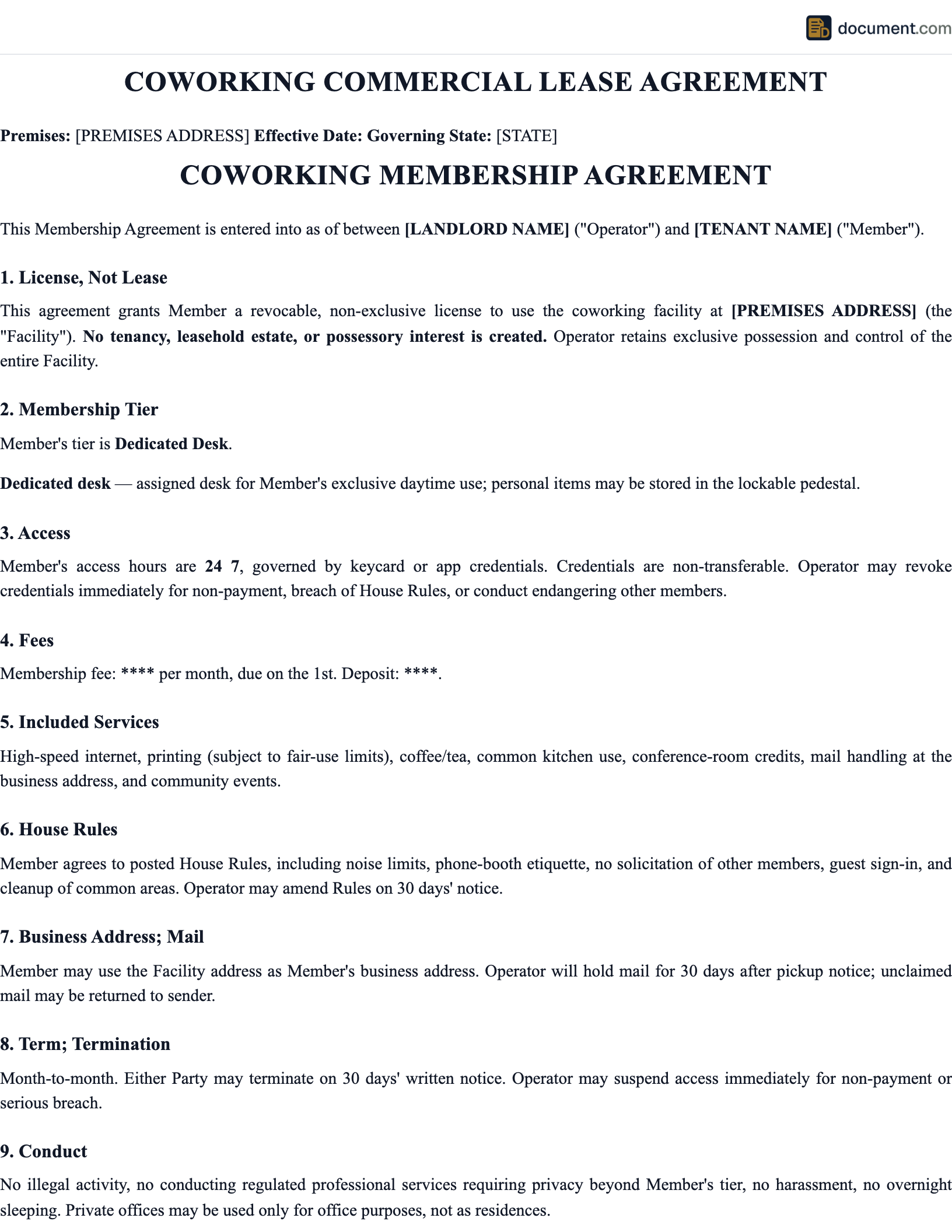
Below is a preview of our Kansas-specific coworking space lease agreement. Your customized document will include all fields and provisions required under KS law.
COWORKING SPACE LEASE AGREEMENT
STATE OF KANSAS
KS-Compliant Template
PARTY A (Operator):
Name: [Full Legal Name]
Address: [Kansas Address]
PARTY B (Member):
Name: [Full Legal Name]
Address: [Kansas Address]
PREMISES / MEMBERSHIP TIER:
Address: [Facility Address]
County: [Kansas County]
Tier: [Hot Desk / Dedicated / Private]
KANSAS COMPLIANCE
This document is governed by Kansas law and includes provisions for sales tax treatment, governing jurisdiction, and member protection under KS contract law.