



Georgia Coworking Space Lease Agreement Overview
Atlanta's coworking market has grown substantially alongside the city's broader tech and startup expansion. Midtown Atlanta, particularly the Ponce City Market corridor and areas adjacent to the BeltLine, hosts the densest concentration of coworking operators serving tech startups, freelancers, and remote workers from larger companies. Buckhead serves a more corporate coworking clientele with dedicated offices for professional services and financial teams. West Midtown and the Westside have attracted creative and production-oriented coworking tenants in adaptive reuse buildings. Georgia coworking membership agreements are structured as commercial licenses under Georgia contract law, with no dedicated statute governing member protections.
Georgia does not impose sales tax on commercial rent, which means coworking membership fees paid for occupying commercial space in Georgia are generally not subject to state sales tax. There is no statutory cap on commercial security deposits in Georgia, and all deposit and exit terms are negotiated. Atlanta coworking operators serving the startup and tech communities often offer community programming, investor access, and accelerator connections that go beyond desk space; for founders, evaluating these intangible benefits alongside price is often worth the effort.
Midtown/ATL
Primary market
No Cap
Security deposit
No Sales Tax
On commercial rent
Contract
Law governs
Georgia Legal Requirements
Georgia coworking memberships are governed by contract law. The following provisions protect members under standard commercial contract principles.
Georgia Coworking Note
Georgia has no commercial landlord-tenant statute protecting coworking members. O.C.G.A. 44-7 covers residential tenancies only. A Georgia coworking membership agreement is a private contract, and Georgia courts enforce its terms as written. Georgia does not tax commercial rent, which means coworking fees are generally not subject to sales tax. All deposit, exit, and notice terms must be negotiated in writing.
Key Provisions to Confirm
- Membership tier and access rights: Confirm which spaces, conference rooms, and amenities are included and whether access hours are fixed or variable
- Notice and exit terms: Confirm the required notice period (typically 30 days in Georgia), whether early exit triggers liquidated damages, and what happens to any prepaid months
- Technology commitments: Verify internet speed guarantees, redundancy options, and whether private network segments are available for teams handling sensitive data
- Business address and Georgia Secretary of State: Confirm whether the membership permits use of the address for Georgia business registration filings and how mail and service of process are handled
- Community programming and ecosystem access: If startup community connections are a priority, ask specifically about investor events, accelerator affiliations, and ATDC or other Georgia Tech ecosystem relationships
- Non-disturbance agreement: Ask whether the operator has a non-disturbance agreement with the building landlord that protects your membership if the operator loses its master lease
How to Choose and Sign a Georgia Coworking Agreement
Joining a Georgia coworking space involves evaluating location, community, technology, and written terms. These steps help you choose well and protect your business.
Tour During Peak Hours and Test Infrastructure
Visit Atlanta coworking spaces during weekday business hours to evaluate actual noise levels, internet performance, and conference room availability. Run a speed test, check parking access, and confirm the building's connectivity providers. Midtown and Buckhead locations vary significantly in build quality and internet reliability despite similar pricing.
Verify Inclusions and Community Programming in Writing
Request the written membership agreement before committing. Confirm which amenities, meeting hours, and community events are included. If startup programming or investor network access is a selling point, ask for specifics about frequency, past events, and any ATDC or Georgia Tech ecosystem connections the operator maintains.
Confirm Deposit Terms and Exit Flexibility
Negotiate deposit amount, return timeline, and written deduction criteria. Georgia has no statutory deposit cap for commercial arrangements. Confirm the notice period and whether early termination triggers a penalty or simply forfeits prepaid amounts.
Check Business Address Permissions
If you plan to register a Georgia LLC or corporation using the coworking address, or update an existing registration with the Georgia Secretary of State, confirm that the membership agreement explicitly permits this use. Some operators require a separate mail handling or registered address add-on.
Sign and Keep a Copy
Georgia coworking membership agreements do not require notarization. Sign through authorized representatives and retain a fully executed copy. Update your Georgia business registration to reflect the new address if applicable.
Important Considerations for Georgia Coworking Members
Georgia does not impose sales tax on commercial rent, making it one of the more cost-favorable states for coworking members relative to states like Florida that do tax commercial rent. Coworking membership fees paid for occupying commercial space in Georgia are generally not subject to state sales tax. Individual services bundled with a membership, such as printing, catering, or phone lines, may have different tax treatment depending on how they are itemized; confirm with the operator if this is a concern.
Atlanta's startup ecosystem has genuine depth. Georgia Tech's Advanced Technology Development Center (ATDC) operates incubator and accelerator programs that coworking operators near campus sometimes partner with. The city has hosted significant venture capital deal flow, and some Midtown and West Midtown coworking operators have built active programming calendars around founder events, demo days, and pitch competitions. For early-stage founders, evaluating these relationships before choosing a coworking space is worth the time.
Georgia Secretary of State business registration requires accurate principal office address information. Businesses that register or update their addresses to reflect a coworking location should confirm the operator explicitly permits this in the membership agreement. Mail handling, package receipt, and service of process policies vary across Georgia coworking operators, and relying on an address without confirming these policies in writing can create operational complications if the operator relocates or restricts mail services.
Georgia Coworking Costs and Tax Considerations
Georgia coworking rates are generally more affordable than Miami or New York but reflect Atlanta's significant growth in premium coworking demand. The following table covers key costs and the Georgia-specific tax factors.
| Cost / Tax Item | Georgia Details |
|---|---|
| Monthly hot desk membership | Midtown Atlanta: $200 to $400 per month; Buckhead premium operators: $300 to $500 per month; West Midtown/Westside: $150 to $300 per month; rates vary by operator and amenity level |
| Security deposit | No statutory cap for commercial memberships in Georgia. Typically one month of the membership fee. Negotiate return timeline and written deduction criteria before paying. |
| Georgia sales tax on membership fees | Georgia does not impose sales tax on commercial rent. Coworking membership fees for occupying commercial space are generally not taxable in Georgia. Bundled services may be taxed separately. |
| Meeting room overages | Conference room overages beyond monthly included hours typically run $30 to $100 per hour at Atlanta operators depending on room size and building tier. |
| Business deductibility | Coworking membership fees are generally deductible as business occupancy expenses under federal tax rules. Georgia also allows business expense deductions at the state level for Georgia income tax purposes. |
Sample Georgia Coworking Space Lease Agreement
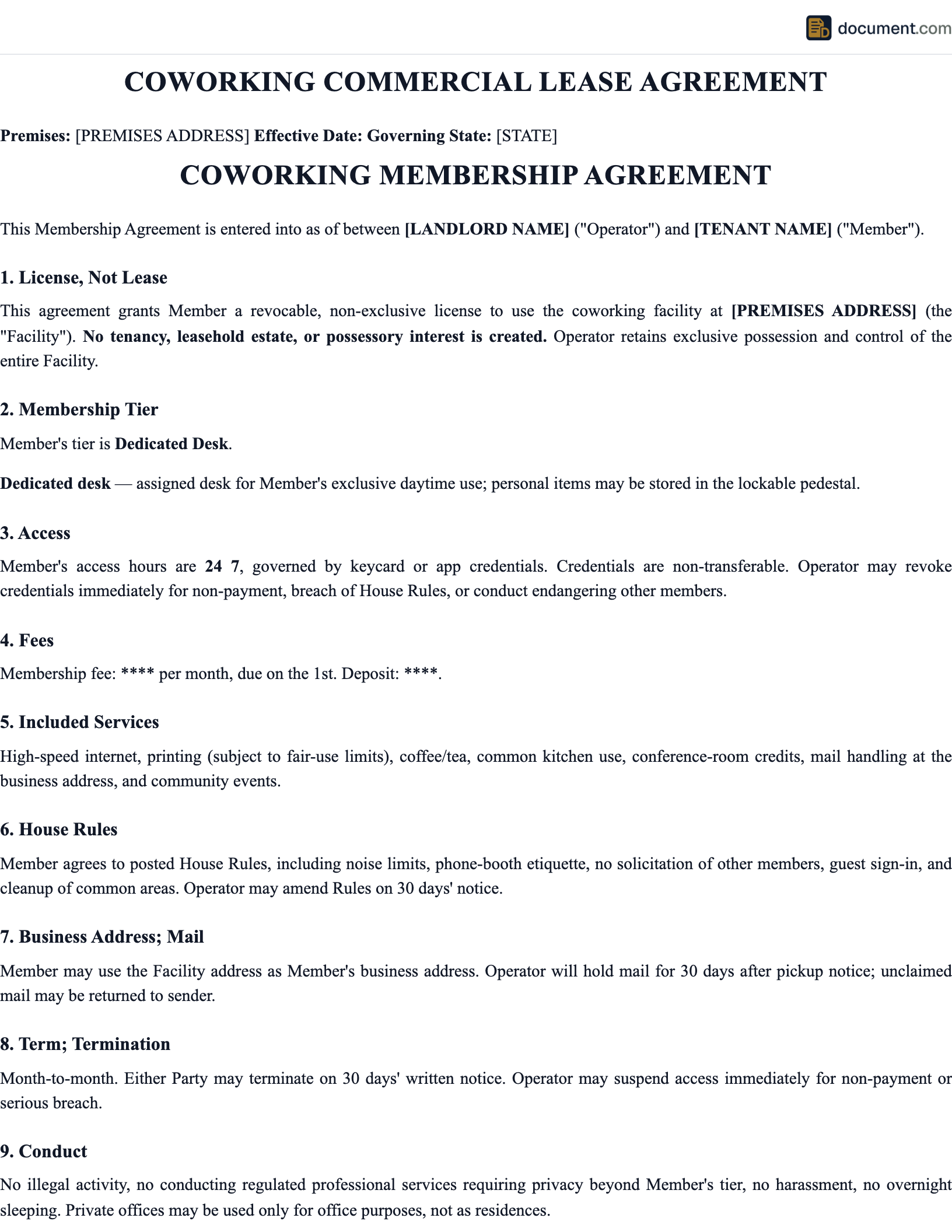
Below is a preview of our Georgia-specific coworking space lease agreement. Your customized document will include all fields and provisions required under GA law.
COWORKING SPACE LEASE AGREEMENT
STATE OF GEORGIA
GA-Compliant Template
PARTY A:
Name: [Full Legal Name]
Address: [Georgia Address]
PARTY B:
Name: [Full Legal Name]
Address: [Georgia Address]
PROPERTY / PREMISES:
Address: [Property Address]
County: [Georgia County]
GEORGIA COMPLIANCE
This document complies with Georgia (GA) state law requirements and includes all provisions mandated for this type of document in Georgia.