



Connecticut Coworking Space Lease Agreement Overview
Connecticut's coworking market is driven largely by the Stamford corridor, where proximity to New York City draws financial services and media professionals who want flexible office access without committing to traditional leases. The market has expanded as Connecticut employers embraced hybrid work arrangements, and demand for short-term private office space in Stamford, New Haven, and Hartford has grown steadily. Pricing in Connecticut coworking spaces reflects the state's high cost of doing business; Stamford in particular carries rates closer to Manhattan-adjacent markets than to other New England cities.
Connecticut coworking agreements are commercial contracts governed by Connecticut General Statutes and common law contract principles. The state does not have a dedicated coworking statute, but Connecticut courts have applied good faith obligations in commercial contract disputes under CGS framework, which gives members slightly more footing than in pure contract-only states if a dispute arises. That said, the written agreement is still the primary governing document. Connecticut's higher insurance environment means members should verify their business insurance policies meet any operator requirements before signing.
CT
State-specific
Varies
Filing fees
Written
Required format
Contract
Law governs
Connecticut Coworking Agreement Requirements
Connecticut coworking agreements are commercial contracts. The requirements below describe what a well-structured agreement should address for members in the Connecticut market.
Connecticut Coworking Note
Connecticut's high insurance cost environment means business owners should review their commercial general liability policy before committing to a coworking space. Many Connecticut operators require members to carry $1-2 million in CGL coverage and name the operator as an additional insured. Confirm your current policy meets this before signing.
Key Agreement Provisions
- Tier and Space Access: Specify your membership tier, whether you have a dedicated desk or hot desk, and your monthly conference room credit allocation with specific booking rules
- Insurance Requirements: Connecticut operators commonly require members to carry commercial general liability insurance with specific limits; confirm this obligation before signing
- Notice and Exit Terms: Confirm the cancellation notice period (typically 30 days in the Connecticut market), deposit return timeline, and what happens to prepaid monthly fees
- Technology Commitments: Internet speed, ISP identity, and network security features matter for financial services and law firm members in the Stamford market; get specifics in writing
- Business Address Use: Confirm whether you can use the coworking address for Connecticut Secretary of State registration, professional licenses, and client correspondence
- Parking: In Stamford especially, parking access and monthly costs should be specified; some operators bundle parking and others charge separately at rates that can add materially to monthly occupancy cost
How to Sign Up for Coworking Space in Connecticut
Joining a Connecticut coworking space is faster than signing a traditional office lease, but the higher-cost environment here makes careful review more important than in lower-cost states.
Calculate Total Monthly Cost
In Connecticut, particularly Stamford, add up the base membership fee, parking (often separate), meeting room overages based on your expected usage, and any required insurance premium increases. The all-in cost is often 20-30% above the quoted base rate.
Verify What Is Included in Writing
Connecticut coworking operators vary significantly on what is included at each tier. Conference room credits, printing, phone booths, and event access are often limited or subject to additional fees. Get the specific credit amounts and overage rates in writing before committing.
Check Insurance Obligations
Review the insurance exhibit before signing. If the operator requires you to carry coverage you do not currently have, contact your broker for a quote. Factor the premium increase into your total occupancy cost analysis.
Confirm Business Registration Use
If you need to use the coworking address for your Connecticut Secretary of State business registration or professional licensing, get the operator's permission in writing and understand the mail handling policy before signing.
Sign and Keep a Copy
Connecticut coworking agreements do not require notarization. Sign and request a fully executed copy. Keep the agreement for your records as it supports any business expense deductions and is your primary recourse if a dispute arises.
Important Considerations for Connecticut Coworking Members
Connecticut's coworking market has some characteristics that members from lower-cost states may not anticipate. The state's generally higher operating costs, insurance environment, and property taxes all flow through to coworking pricing. Understanding these dynamics helps you evaluate what you are getting for your monthly fee.
Financial services and legal professionals in the Stamford market should pay particular attention to data security provisions. If you work with confidential client data or financial information, ask the operator specifically about network segmentation, VLAN availability, and whether the shared network is segmented from other members. Many Stamford operators serving finance-adjacent clients have addressed this; others have not.
The Connecticut market also tends toward somewhat longer commitment periods for private office tiers than you might find in faster-growing tech markets like Denver or Austin. Operators in Hartford and Stamford frequently use three-month or six-month minimum terms for private offices, with month-to-month conversion available after the initial period at a premium. Factor this into your flexibility assessment.
Connecticut Coworking Costs and Tax Considerations
Connecticut's coworking cost structure reflects the state's higher commercial real estate environment. Here is what to understand before committing.
| Cost Item | Connecticut Context |
|---|---|
| Monthly Membership Fee | Hot desks in Stamford typically $250-$450/month; dedicated desks $500-$800/month; private offices $1,000-$3,000+/month. Hartford rates are generally 20-30% lower. |
| Parking | Stamford parking adds $150-$300/month in many cases. Confirm whether parking is included or billed separately before evaluating total cost. |
| Connecticut Sales Tax | Connecticut does not impose a general sales tax on commercial rent, but some bundled services, such as IT support or cleaning charged as separate line items, may be subject to Connecticut's services sales tax. Confirm with the operator how monthly fees are classified. |
| Insurance Premium Increase | If the operator requires commercial general liability coverage you do not currently carry, factor the premium increase into your total monthly cost. Connecticut insurance rates are generally higher than the national average. |
| Business Deductibility | Coworking membership fees generally qualify as ordinary business expenses deductible for Connecticut and federal income tax purposes. Retain your membership agreement and monthly receipts to support the deduction. |
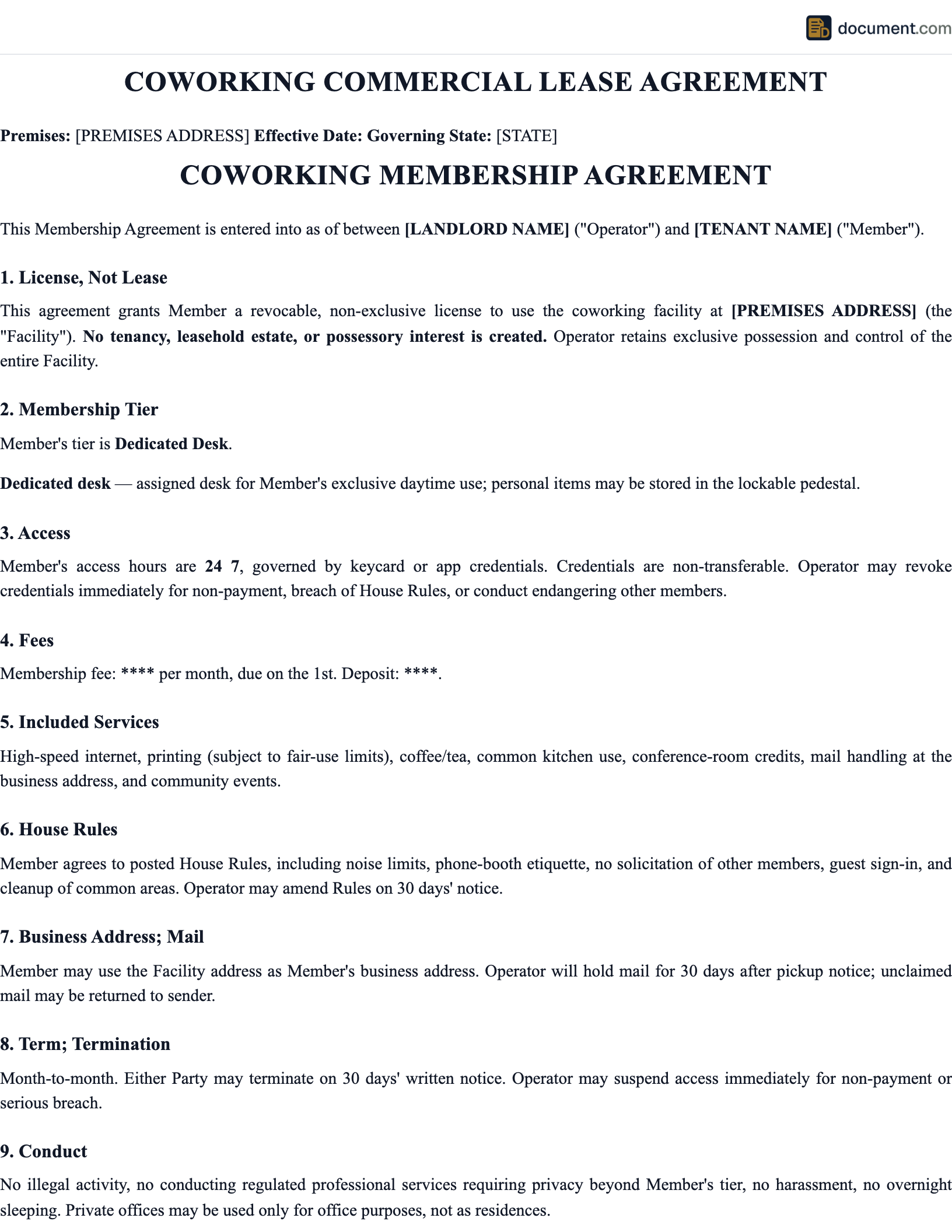
Sample Connecticut Coworking Space Lease Agreement
Below is a preview of our Connecticut-specific coworking space lease agreement. Your customized document will include all fields and provisions required under CT law.
COWORKING SPACE LEASE AGREEMENT
STATE OF CONNECTICUT
CT-Compliant Template
PARTY A:
Name: [Full Legal Name]
Address: [Connecticut Address]
PARTY B:
Name: [Full Legal Name]
Address: [Connecticut Address]
PROPERTY / PREMISES:
Address: [Property Address]
County: [Connecticut County]
CONNECTICUT COMPLIANCE
This document complies with Connecticut (CT) state law requirements and includes all provisions mandated for this type of document in Connecticut.