



Colorado Coworking Space Lease Agreement Overview
Colorado is one of the strongest coworking markets in the country. Denver's LoDo, RiNo, and Platte Street neighborhoods host a dense collection of coworking operators catering to tech startups, remote workers, and growing companies that want flexibility without committing to a multi-year office lease. Boulder's innovation ecosystem supports a similar coworking culture, with spaces that tend to attract STEM-focused companies and university-adjacent ventures. The agreements governing these spaces are primarily license agreements under Colorado contract law, not residential-style leases, which means members have fewer baseline protections and more negotiating responsibility.
Colorado has no dedicated statute governing coworking agreements. The arrangement is essentially a commercial license or sublicense, and Colorado courts will enforce the terms as written. This makes the language in the agreement itself critically important. Month-to-month flexibility is the norm in the Colorado market, but operators vary significantly on deposit requirements, amenity guarantees, technology commitments, and exit terms. Denver's startup culture has also pushed operators toward community programming and event spaces, so many agreements now include access rules for these as well.
CO
State-specific
Varies
Filing fees
Written
Required format
Contract
Law governs
Colorado Coworking Agreement Requirements
Coworking agreements in Colorado are commercial contracts governed by general contract principles. What you see in the agreement is what you get. The requirements below represent what a well-structured Colorado coworking agreement should address.
Colorado Coworking Note
Most coworking operators structure their agreements as license agreements, not leases. This distinction matters in Colorado because it affects your rights if the operator closes or loses its master lease. If the operator is not the building owner, ask whether a non-disturbance agreement with the building owner is available.
Key Agreement Provisions
- Membership Tier and Access Rights: Specify exactly which spaces you have access to, whether your desk or office is dedicated or hot-desked, and your monthly meeting room credit allocation
- Technology Commitments: List the minimum internet speed, ISP name, and any specific infrastructure the operator promises, particularly important for Colorado tech companies with high bandwidth needs
- Notice and Exit Terms: Define the notice period required to cancel (typically 30 days in the Colorado market), what happens to prepaid fees, and the deposit return timeline
- Amenity Modification Rights: Understand whether the operator can change or remove amenities during your term and what remedy, if any, you have if they do
- Denver and Boulder Zoning Compliance: Confirm your specific business activity is permitted at the coworking location under local land use rules
- Security and Access Control: Clarify 24/7 access availability, key fob or app-based entry, guest policies, and any security deposit or access device deposit
How to Sign Up for Coworking Space in Colorado
Joining a Colorado coworking space is faster than signing a traditional office lease, but reviewing the agreement carefully before committing still matters.
Tour the Space and Test the Infrastructure
Visit during business hours and run a speed test on the internet connection. Denver and Boulder coworking operators vary widely on bandwidth. Ask what ISP serves the building and whether the connection is shared or dedicated.
Confirm Your Membership Tier in Writing
Make sure the agreement specifies your tier, what's included, monthly meeting room credits, and any amenities that were part of the pitch. Verbal commitments by sales staff are not binding in Colorado without being written into the agreement.
Review Notice and Exit Terms
Read the cancellation, notice, and early exit provisions carefully. Colorado operators who follow the Denver market standard use 30 days written notice, but some private office agreements include longer lock-in periods with termination fees.
Verify Zoning for Your Business Activity
Some business activities require their own permits even when operating from a licensed coworking space. Check with the City of Denver, Boulder, or the relevant Colorado municipality that your specific use is allowed at the address.
Sign the Agreement and Keep a Copy
Colorado coworking agreements do not require notarization. Sign and request a fully executed copy for your records. Update your Colorado business registration address with the Secretary of State if you are using the coworking address as your registered business address.
Important Considerations for Colorado Coworking Members
Colorado's coworking market is mature and competitive, which generally works in the member's favor. Operators compete on amenities, community programming, and flexibility. But the agreements are still commercial contracts that Colorado courts will enforce, and the details matter.
One area that often catches Colorado coworking members off guard is the tax treatment of coworking memberships. The monthly fee typically covers shared services alongside space access, and how this is classified for accounting purposes can affect your business deductions. Confirm with your accountant whether the arrangement qualifies as a lease expense or a service subscription for federal and Colorado income tax purposes. Most arrangements qualify as ordinary business expenses either way, but the documentation requirements differ.
Business identity is also worth thinking through. If you are listing the coworking address on your Colorado business registration, client contracts, or professional licenses, make sure the operator explicitly permits this and that their signage and mail handling policies support it. Some Denver and Boulder coworking operators provide mail forwarding and a suite number in their agreements; others do not, which can create problems when regulatory mail arrives.
Colorado Coworking Costs and Tax Considerations
Understanding the full cost structure of a Colorado coworking membership goes beyond the monthly rate. Here is what to look for.
| Cost Item | Colorado Context |
|---|---|
| Monthly Membership Fee | Hot desks in Denver run roughly $200-$400/month; dedicated desks $400-$700/month; private offices $800-$2,500/month depending on size and operator |
| Security Deposit | Typically 1-2 months for private offices; many hot-desk memberships require no deposit. No statutory cap applies to commercial deposits in Colorado. |
| Colorado Sales Tax | Colorado does not impose a statewide sales tax on commercial rent. Denver and other municipalities do not currently tax coworking memberships, but verify with the specific operator whether any local taxes are included in or added to your monthly rate. |
| Meeting Room Overages | Credits included in base membership vary widely. Overage rates in Denver typically run $25-$75/hour. Negotiate a larger credit pool or a discounted overage rate upfront. |
| Business Deductibility | Coworking fees generally qualify as ordinary business expenses deductible for federal and Colorado income tax purposes. Keep receipts and your membership agreement to support the deduction. |
Sample Colorado Coworking Space Lease Agreement
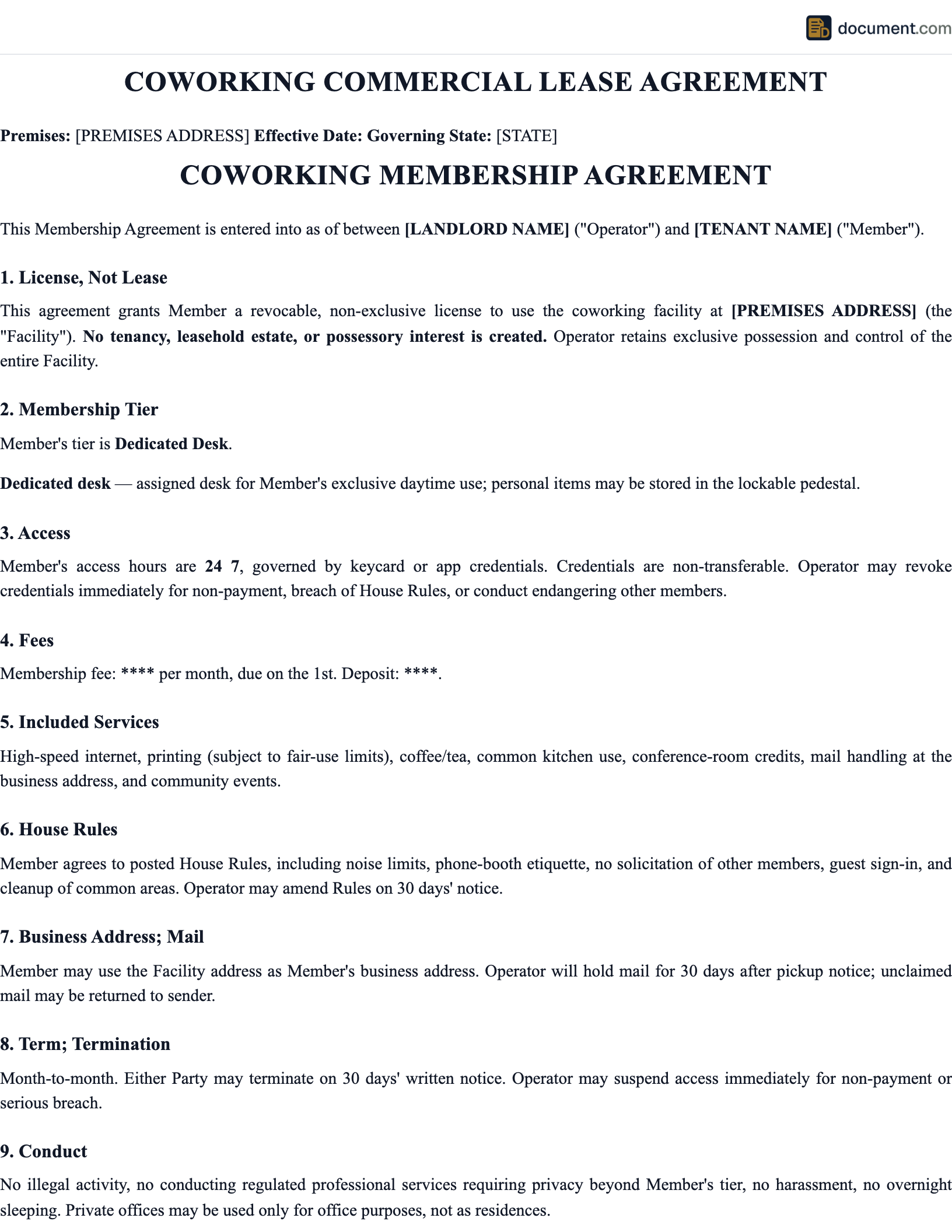
Below is a preview of our Colorado-specific coworking space lease agreement. Your customized document will include all fields and provisions required under CO law.
COWORKING SPACE LEASE AGREEMENT
STATE OF COLORADO
CO-Compliant Template
PARTY A:
Name: [Full Legal Name]
Address: [Colorado Address]
PARTY B:
Name: [Full Legal Name]
Address: [Colorado Address]
PROPERTY / PREMISES:
Address: [Property Address]
County: [Colorado County]
COLORADO COMPLIANCE
This document complies with Colorado (CO) state law requirements and includes all provisions mandated for this type of document in Colorado.