



California Coworking Space Lease Agreement Overview
California has the most developed coworking market in the United States, driven by the high concentration of technology, media, entertainment, and life sciences businesses across the state's major metropolitan areas. San Francisco's SoMa, Mission, and Financial District neighborhoods have been coworking hubs since the early days of the modern coworking industry. Los Angeles has a fragmented but deep market spread across the Westside, Downtown, and inland submarkets. San Diego's growing biotech and defense sector has supported a maturing coworking market in Little Italy, the Gaslamp, and UTC. Post-pandemic market dynamics have generally improved availability and pricing across all three markets.
California law provides no specific regulatory framework for coworking memberships. Agreements are classified as license agreements or service contracts, not leases, and California's extensive residential tenant protections do not apply to commercial coworking members. The California Unruh Civil Rights Act prohibits coworking operators from discriminating against members on the basis of protected characteristics. California's disability access law (Civil Code Section 55 et seq.) applies broadly to operators whose spaces are open to the public, requiring physical accessibility standards that often exceed federal ADA requirements. Beyond these baseline obligations, the membership agreement controls the relationship entirely.
$200-600
Hot desk SF/month
No
CA rent tax
Unruh
Civil Rights Act
License
Not a lease
California Legal Requirements
California imposes no specific regulatory requirements on coworking membership agreements beyond the general civil rights, disability access, and consumer protection obligations that apply to businesses operating in the state. The membership agreement is the primary legal document governing your rights as a member.
California Coworking Agreement Note
California coworking memberships are license agreements, not leases. California's tenant protection laws do not apply. The Unruh Civil Rights Act prohibits discrimination against members on protected grounds. California Civil Code Section 55 requires accessible premises for spaces open to the public. The SF Gross Receipts Tax may apply if your business operates at a San Francisco address above certain revenue thresholds.
Key Agreement Provisions to Review
- License vs. Lease Classification: Confirm the agreement is structured as a license agreement; California coworking members do not hold leasehold interests and have more limited legal protections
- Termination Notice: Most California operators require 30 days written notice; confirm exactly how notice must be delivered (email, certified mail, or in-person) to start the clock
- Address Use Rights: Confirm whether the agreement permits use of the address for California Secretary of State filings, business licenses, professional licenses, or client-facing materials
- Fee Escalation: California operators may escalate monthly fees without significant notice if not contractually restricted; confirm any rate increase limitations in writing
- Location Transfer Rights: Confirm whether a multi-location operator permits use of other California locations under your membership and at what credit or cost structure
How to Draft a Coworking Space Lease Agreement in California
Finding and joining a California coworking space follows a more involved process than most other states, given the depth and variety of the California market and the higher costs at stake in major cities.
Identify the Right California Submarket
Choose the California submarket that fits your business needs: SF Financial District or SoMa for tech and financial services; LA's Venice, Santa Monica, or Culver City for creative and entertainment; Downtown SD or Little Italy for biotech and professional services. Proximity to clients, transit access, and commute patterns for your team all matter significantly in California's traffic-intensive cities.
Tour Multiple Options and Compare Full Costs
Tour at least three to five California coworking options and compare the all-in cost including base membership, conference room credits or hourly rates, parking (often a significant add-on in California's dense markets), and any service fees. In SF and LA, parking can add $200 to $500 per month per vehicle, a meaningful total cost consideration.
Review the Membership Agreement
Request the full membership agreement before committing. Review termination notice requirements, deposit refund terms, fee escalation provisions, house rules that could affect your specific business operations, and address use rights. California law does not provide any minimum protections for coworking members, so all rights must come from the agreement itself.
Confirm Address Use and Tax Implications
If you need the coworking address for California Secretary of State filings, a business license, or a professional license application, confirm in writing that the operator permits this use. If you are in San Francisco, discuss with a tax professional whether using a San Francisco address triggers the city's Gross Receipts Tax at your revenue level before signing.
Sign and Retain Documentation
Sign the membership agreement, pay the security deposit, and retain a copy of the executed agreement and deposit receipt. Note the exact termination notice procedure in writing and set a calendar reminder well in advance of when you might want to exit, to avoid missing the notice window and being obligated for additional months.
California-Specific Key Provisions
California coworking agreements should be evaluated with several state-specific considerations in mind. Disability access obligations under California Civil Code Section 55 et seq. go beyond federal ADA and apply to California coworking operators whose spaces are open to the public. These requirements have driven significant accessibility investment in California coworking locations, but you should verify the physical accessibility of any space you consider, particularly if members of your team or clients have mobility or sensory disabilities.
California does not impose a state-level commercial rent tax, but San Francisco imposes city-level taxes (Gross Receipts Tax and Commercial Rents Tax) that affect businesses operating in the city. Using a San Francisco coworking address as your principal place of business may establish nexus for these taxes if your gross receipts exceed certain thresholds. This is a meaningful consideration for businesses that generate significant revenue, as San Francisco's tax rates on gross receipts are among the highest of any major US city.
The California coworking market is among the most competitive and sophisticated in the world. Major national operators (WeWork, Industrious, Regus, Spaces) compete with well-established regional operators (Galvanize, NextSpace, and others) and niche independents focused on specific industries or communities. This competition generally benefits members in California more than in smaller markets: operators are more willing to negotiate on price, offer flexible terms, and provide additional services to attract and retain members. Multi-location access, day pass arrangements, and team package pricing are widely available throughout the state.
California Fees & Costs
California coworking prices vary significantly across San Francisco, Los Angeles, and San Diego, and within each city based on neighborhood, operator, and membership type. These ranges reflect typical current market conditions.
| Fee / Cost | Typical Amount |
|---|---|
| Hot Desk (San Francisco) | $300 - $600/month |
| Hot Desk (Los Angeles) | $200 - $500/month |
| Hot Desk (San Diego) | $175 - $400/month |
| Private Office (San Francisco) | $900 - $2,500+/month |
| Private Office (Los Angeles) | $700 - $1,800/month |
| Parking (SF/LA premium) | $200 - $500/month/vehicle |
Sample California Coworking Space Lease Agreement
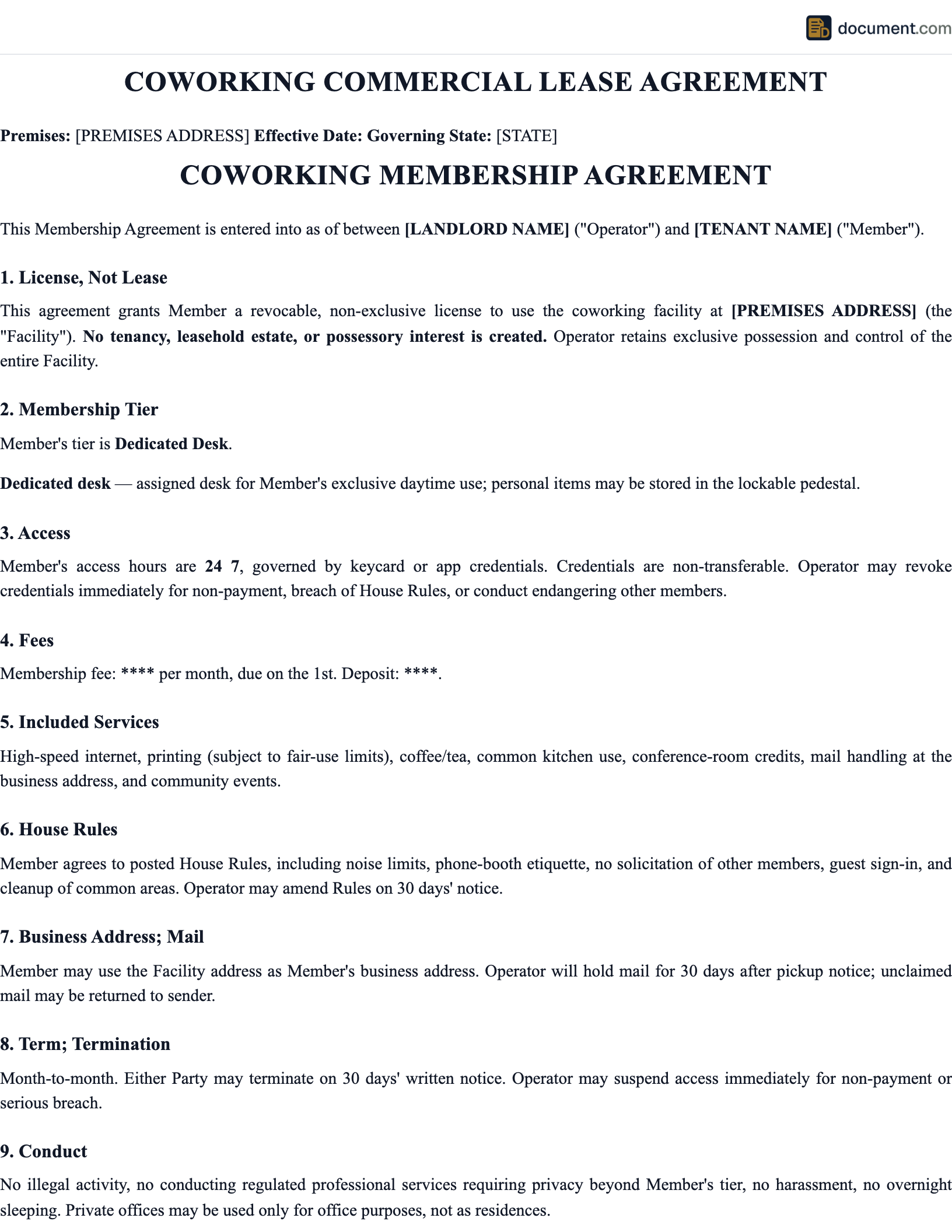
Below is a preview of our California-specific coworking space lease agreement. Your customized document will include all fields and provisions required under CA law.
COWORKING SPACE LEASE AGREEMENT
STATE OF CALIFORNIA
CA-Compliant Template
PARTY A:
Name: [Full Legal Name]
Address: [California Address]
PARTY B:
Name: [Full Legal Name]
Address: [California Address]
PROPERTY / PREMISES:
Address: [Property Address]
County: [California County]
CALIFORNIA COMPLIANCE
This document complies with California (CA) state law requirements and includes all provisions mandated for this type of document in California.