



Alabama Non-Compliance Eviction Overview
Alabama's eviction process for lease violations is governed primarily by the Alabama Uniform Residential Landlord and Tenant Act (AURLTA), found in Ala. Code Title 35, Chapter 9A. This statute applies to residential rental properties in counties with a population of 25,000 or more. For non-compliance issues that are not related to nonpayment of rent, AURLTA provides a structured cure-or-quit framework that balances the rights of landlords and tenants.
The core provision for non-compliance evictions is Ala. Code 35-9A-421, which requires landlords to deliver a written notice specifying the nature of the breach and allowing the tenant 14 days to remedy the violation. If the tenant does not cure within that window, the rental agreement terminates and the landlord may file an unlawful detainer action in the county's District Court. Importantly, AURLTA includes a repeat-offender provision: if the same type of violation recurs within six months, the landlord may serve an unconditional 14-day termination notice with no right to cure.
In counties not covered by AURLTA, landlords rely on the lease agreement itself and Alabama common law. These situations often require the landlord to follow whatever notice procedures are specified in the lease contract. If the lease is silent on the process, reasonable written notice is still strongly recommended before filing court proceedings. Regardless of which framework applies, self-help evictions such as changing locks, shutting off utilities, or removing the tenant's belongings are illegal in Alabama.
14 Days
Cure period
AURLTA
Governing law
$228-$321
Filing fees
6 Months
Repeat violation window
Alabama's 14-Day Cure Period Under AURLTA
The 14-day cure period is the cornerstone of Alabama's non-compliance eviction process under AURLTA. When a tenant violates a material term of the lease agreement, the landlord must deliver written notice that identifies the specific breach and informs the tenant that the rental agreement will terminate in 14 days unless the violation is remedied. This requirement is codified in Ala. Code 35-9A-421(a).
AURLTA Coverage Limitation
AURLTA only applies in Alabama counties with populations of 25,000 or more. If your rental property is located in a smaller county, the statutory 14-day cure period may not apply. Instead, the terms of your lease agreement and Alabama common law will govern the eviction process. Always verify whether AURLTA applies to your specific county before relying on the 14-day framework.
Key Rules for the Cure Period
- First offense: Tenant receives 14 days to cure the violation. If cured, the lease continues unchanged
- Repeat offense within 6 months: Landlord may issue an unconditional 14-day termination notice with no cure opportunity under Ala. Code 35-9A-421(b)
- Notice specificity: The notice must describe the breach with enough detail for the tenant to understand what must be corrected
- Written form required: Oral notices do not satisfy AURLTA requirements and will not support a court action
- Calendar days: The 14-day period is counted in calendar days, not business days, beginning the day after service
Common Lease Violations in Alabama
Non-compliance evictions in Alabama cover a wide range of lease violations beyond nonpayment of rent. Below are the most frequently encountered violations that lead landlords to serve a cure-or-quit notice under AURLTA.
Unauthorized Pets
Keeping animals on the property when the lease prohibits pets or exceeding breed, size, or number restrictions. The tenant must remove the animal within 14 days. Note that service animals and emotional support animals with proper documentation are protected under federal fair housing law.
Noise and Nuisance
Persistent loud music, parties, or disruptive behavior that violates quiet enjoyment clauses or local noise ordinances in cities like Birmingham, Huntsville, or Mobile. Document complaints from neighbors and any police reports to support the notice.
Unauthorized Subletting
Renting or allowing someone not on the lease to reside in the unit without the landlord's written consent. This includes short-term rental platforms like Airbnb if the lease does not specifically permit such use.
Property Damage
Intentional or negligent damage to the premises beyond normal wear and tear, including holes in walls, broken fixtures, damaged flooring, or exterior damage. Under Ala. Code 35-9A-301, tenants must maintain the unit in a clean and safe condition.
Unauthorized Occupants
Allowing individuals not named on the lease to move in as permanent residents. Alabama leases typically specify all authorized occupants, and additional people change the insurance and liability profile of the property.
Improper Use of Premises
Operating a commercial business from a residential property, conducting illegal activities, or using the unit in any manner that violates local zoning ordinances or the terms of the lease agreement. For illegal activity, immediate termination may be available under AURLTA.
How to Serve a Non-Compliance Notice in Alabama
Proper service is essential for the notice to be legally effective. Under AURLTA, Alabama provides several acceptable methods of delivery. Choosing the right method and documenting service carefully will protect your case if the matter proceeds to court.
Identify the Specific Violation
Document the lease provision being violated and gather evidence such as photographs, neighbor complaints, police reports, or inspection notes. Be precise about what clause is breached.
Draft the Written Notice
Include the tenant's full name, property address, specific violation description, the 14-day cure deadline, and a statement that the lease terminates if the breach is not remedied. Reference Ala. Code 35-9A-421.
Serve the Notice
Deliver by personal hand-delivery to the tenant, by leaving with a suitable person at the dwelling, or by mailing via certified mail with return receipt requested to the tenant's last known address. Certified mail provides the strongest proof of service.
Document Service
Record the exact date and time of delivery, the method used, the name of any witness, and retain a copy of the notice along with any certified mail receipt. Take a timestamped photo if posting on the door.
Wait the Full 14 Days
Allow the complete cure period to expire. Count calendar days starting the day after service. If the tenant does not cure or vacate, proceed to file an unlawful detainer action in Alabama District Court.
Alabama Legal Requirements for Non-Compliance Notices
Alabama courts will scrutinize the notice for compliance with AURLTA before allowing an eviction to proceed. A deficient notice is one of the most common reasons eviction cases are dismissed. The following elements must be present in every non-compliance notice.
Required Notice Elements
- Tenant identification: Full legal names of all tenants on the lease agreement
- Property address: Complete street address including unit or apartment number
- Violation description: Specific identification of the lease term or rule being violated and the factual basis
- Cure deadline: Statement that the tenant has 14 days to remedy the breach
- Termination consequence: Clear statement that the lease will terminate if the breach is not cured within 14 days
- Landlord signature and date: The notice must be signed and dated by the landlord or authorized property manager
- Statutory reference: While not strictly required, referencing Ala. Code 35-9A-421 strengthens the notice
Self-Help Evictions Are Prohibited
Under Ala. Code 35-9A-427, a landlord may not unilaterally change locks, remove doors or windows, shut off utilities, or remove the tenant's personal property to force a tenant out. These actions constitute an illegal self-help eviction and can expose the landlord to liability for actual damages, up to three months' rent, and attorney's fees. The only lawful path to regain possession is through the court system.
Alabama Eviction Court Process
If the tenant does not cure the violation or vacate within the 14-day notice period, the landlord files an unlawful detainer action in the Alabama District Court for the county where the property is located. The process typically unfolds as follows.
| Stage | Timeframe | Details |
|---|---|---|
| Serve Notice | Day 0 | Deliver 14-day cure-or-quit notice to tenant |
| Cure Period Expires | Day 14 | If tenant has not cured, lease terminates |
| File Unlawful Detainer | Day 15+ | File complaint in District Court, pay filing fee ($228-$321) |
| Court Hearing | 7-14 days after filing | Both parties present evidence; judge issues ruling |
| Writ of Possession | 7 days after judgment | Sheriff enforces removal if tenant does not voluntarily vacate |
The total process from initial notice through sheriff enforcement typically takes 5 to 8 weeks for uncontested cases. If the tenant contests the eviction, files an appeal to Circuit Court, or requests continuances, the timeline can extend to 2 to 4 months. Tenants in Alabama have 7 days to appeal a District Court eviction judgment to Circuit Court, which triggers a trial de novo (new trial).
Sample Alabama Non-Compliance Notice
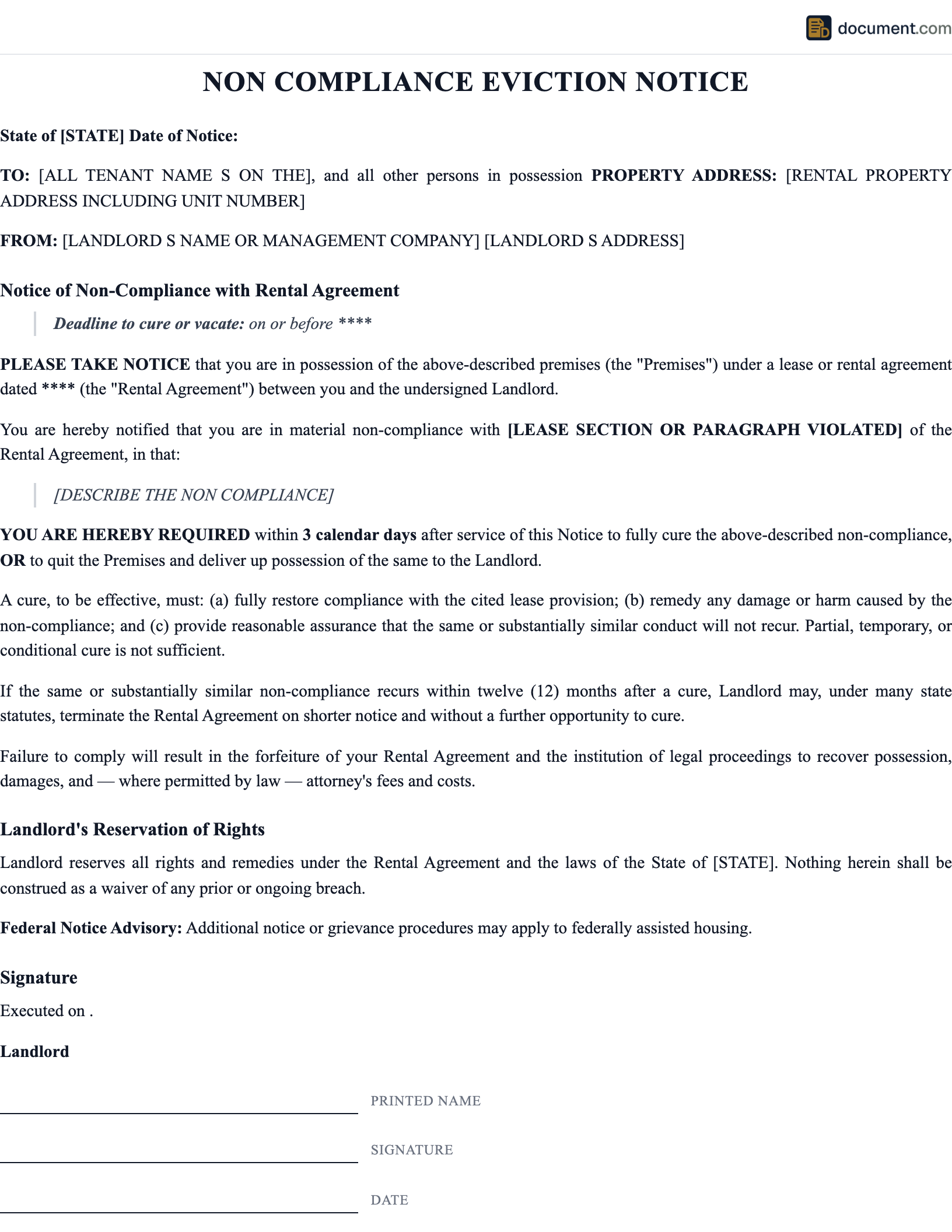
Below is a preview of an Alabama-specific notice for lease non-compliance under AURLTA. Your customized document will include all fields and statutory language required under Ala. Code 35-9A-421.
NOTICE OF NON-COMPLIANCE
14-DAY CURE-OR-QUIT NOTICE
Pursuant to Ala. Code 35-9A-421
TO TENANT(S):
Name: [Full Legal Name]
Address: [Alabama Property Address]
NATURE OF VIOLATION:
You are in violation of the following provision of your lease agreement:
[Specific lease clause and factual description]
CURE DEMAND
You have fourteen (14) days from the date of service of this notice to remedy the above violation. If you fail to cure the breach within 14 days, your rental agreement will terminate and the landlord will pursue legal action to recover possession of the premises through the Alabama District Court.